

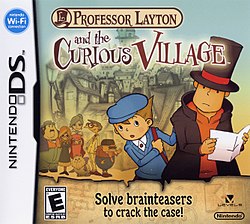

Professor Layton and the Curious Village dresses like a cozy mystery novel and plays like someone handed your brain a lovely cup of tea and a crossword. It is the gentle, surprisingly cinematic entrée that introduced the improbable pairing of a top-hatted, pipe-less archaeologist and his small, endlessly enthusiastic apprentice to the world. On paper it's a puzzle-adventure: tap the screen, solve riddles, unlock secrets. In practice it's a character-driven little theatre of moral choices, identity reveals and tiny, touching human moments. The story sets up a simple premise - find the Golden Apple hidden in St. Mystere and win a fortune - and then proceeds to complicate that premise by throwing in a missing-but-not-really-missing heir, a villain with a flair for dramatic entrances, and townsfolk who might be better described as "mechanically inclined." Throughout, the game uses its puzzle structure not as padding, but as an instrument to reveal who these people are and why their arcs matter.
Gameplay mechanics are where the game's personality subtly doubles as characterization. The town of St. Mystere is obsessed with brain teasers - literally. Residents ask you for puzzles, hide them in their wares, or insist you solve them before they'll say a word. Those puzzles aren't just obstacles; they act like conversations you never expected to have with strangers. You don't just get to know someone by asking what they ate for breakfast; you learn them by unlocking their favourite riddle, their stubbornness, or their secret pride in a particular logic problem. The "picarat" system (the value assigned to each puzzle) feels like the town doling out little compliments when you get something right: they grant you rewards that are both mechanical (gizmos, portrait pieces, furniture) and narrative (new areas, new confidences). The touch-based answers and hint-coin economy reinforce this: you can brute-force your way through by burning hints, but choosing to earn coins by snooping around the environment mirrors the detective's patience and Luke's inquisitiveness. Hershel Layton, the eponymous professor, is introduced as the archetypal English gentleman detective - calm, politely bewildered by explosions, and smugly brilliant with a taste for cravats. But the game is careful not to let him be only a clever silhouette; his arc is mostly revealed through his interactions with Luke and the town. Layton's detective charm is the hook, while his empathy (and occasional improvisational heroics) reveal the empathy beneath the fedora. Building a glider out of spare bits to save Flora isn't a puzzle per se, but it's the kind of narrative payoff the game leans on after you've spent hours exercising the left hemisphere of your brain. The calm exterior hides a man who treats puzzles as a social currency - whether to earn trust, prod confessions, or honor the Baron's love of testing minds. Luke Triton is the real emotional anchor. He's not just a child sidekick who says cute things; he's the lens through which wonder, fear, and moral curiosity filter. His arc runs from adoring apprentice to a kid who begins to weigh the consequences of curiosity. Luke's enthusiasm for puzzles is infectious, but the reveal that many of the town's residents are robots gives him a more complex question to answer: does loving someone depend on whether they are made of flesh or cogs? Luke's decision-making - trusting Layton, befriending Flora, and finally accepting the Baron's odd test - tracks a believable, warm maturation. The game stages small moments for him to grow: comforting a malfunctioning "person," gasping with childlike astonishment at the Ferris wheel chase, and ultimately participating in the choice to leave the treasure for the robots. Flora Reinhold's arc is the quiet emotional twist of the story. Given the game's passed-on treasure plot, Flora could easily have been a cliché "damsel-in-an-inheritance" - instead she's revealed to be the Golden Apple herself, a person raised behind a tower and surrounded by robots who love and protect her. Her arc reads as the discovery of personhood: initially mysterious and almost storybook, then gradually revealed as a girl who must choose between material wealth and the lives of those who kept her safe. That choice - to forgo the family fortune to keep the robots functioning - is where the game earns its heart. Rather than the expected picture of greed or triumph, Flora's decision is quietly heroic and morally complex; in one stroke she transforms from prize to moral agent. Don Paolo is the series' melodramatic foil: equal parts pomp and bad science. He provides the comic relief of the antagonist, popping up as Inspector Chelmey (a fake identity), stealing people in sacks (a very 19th-century villain move), and trying to blow up ferris wheels. His arc is less redemptive and more cartoonish - he exists to create stakes and escalate danger. That said, Paolo's repeated failures to best Layton paint him as a persistent, human-sized antagonist who gives the plot teeth without derailing the game's tone. The imbalance between his grandiose plans and their often slapstick results makes him memorable without turning the tale into a morality play. Bruno, the mechanic, functions as both plot pivot and moral grey area. He's complicit in the creation of St. Mystere's robotic population yet acts with remorse and practical care, repairing malfunctions and tending to the village like a guilty gardener. Bruno's arc moves from conspiratorial helper to tragic conscience: his role in making the robots is monstrous in concept, but the tenderness with which he repairs them raises questions about creator responsibility. The revelation that Simon "died" only due to malfunction and was, in fact, a robot, reframes much of the mystery as ethical commentary on invention and protection. The Reinhold family members and the manifold townsfolk - including Matthew the butler, the apparently deceased Simon, and the ever-present Granny Riddleton - provide episodic arcs that read like short stories. Each puzzle tied to a character gives a brief emotional vignette. Some puzzles are playful; others let you pry into loneliness, fear, or pride. Several characters regress or vanish as the story marches forward, but the game handles those transitions with a mechanic that respects player time: if you miss a puzzle tied to a character who later leaves, the puzzle turns up at the Puzzle Shack. That design choice is narratively polite: the town continues, but the player's relationship with its people remains intact. In short, the game makes you responsible for remembering characters by letting you chase their puzzles. Mechanically and narratively, the reveal that "everyone is a robot" reframes every prior interaction: the puzzles become final exams; the townsfolk's oddities are not mere quirks but programmed behaviors. This could have been a cold twist; instead, the game hinges its emotional payoff on the humans involved - particularly Flora and Layton - choosing empathy over avarice. The endgame is less about finding treasure and more about making a moral call: the Golden Apple as a person chooses to protect the residents she has come to love. The game concludes "to be continued," and those words land like a wink: the mystery gave you answers, but more importantly, it gave you people you care about.
Professor Layton's visual style is an exercise in charming restraint. The DS's modest horsepower is used sparingly: static, beautifully drawn backgrounds and character portraits get the bulk of the screen time, while full animated cutscenes (produced by P.A. Works) are saved for the moments that matter. This creates a contrast that feels deliberate - the everyday is illustrated like a storybook, while the pivotal scenes bloom into animation. The art direction leans heavily into a European, turn-of-the-century aesthetic: cobbled streets, tea shops, and top hats abound. Takuzo Nagano's character designs are deliberately stylized: long noses, expressive brows, and theatrical silhouettes that read instantly on the small screen. On the technical side, the bottom touchscreen is where puzzles come alive. Interaction feels tactile: drawing, tapping, and selecting are intuitive, and the simple animation flourishes - a puff of dust, a sliding cog, a bemused eyebrow raise - sell personality more than polycount ever could. The tower, the amusement park, and the Reinhold manor are well-composed set pieces that rely on mood and detail rather than photorealism. The portrait-piece minigame and furniture arrangement screens are cute, optional pockets of visual reward that fit the game's overall tone. The soundtrack by Tomohito Nishiura complements the palette with French-tinged compositions that reinforce the continental vibe; critics called the score repetitive at times, but it does a consistently good job of underlining mood shifts from quiet reflection to playful mystery.
Professor Layton and the Curious Village is more than a string of brain teasers wrapped around a mystery. It's a study in how puzzles can be characters' dialect: the way people ask for help, hide things, or test strangers tells you who they are. The game's narrative is unafraid to be gentle and philosophical, choosing emotional nuance over shock. Layton's gentlemanliness, Luke's earnest growth, Flora's ethical maturity, Bruno's remorse and Don Paolo's caricatured menace form a cast whose arcs reward patient players. Presentation-wise, the DS version squeezes earnest animation and illustrative restraint into a package that still looks lovely today. If you want to nitpick, replay value can be low once every puzzle is finished and some musically inclined players might tire of the looped soundtrack. If you prefer a mystery that asks you to do more than point and shoot - one that nudges you to decide what matters - this game will sit in your heart's Cabinet of Curiosities for a long time. It's still an excellent place to start if you want to fall in love with a series, a professor, and a boy who thinks every locked box has a polite, solvable soul inside.
 Crash Bandicoot: The Wrath of Cortex on PS2
 MLB The Show 22 on Switch
 Ōkami on PS2
 Tintin: Destination Adventure on PlayStation
 One Piece Grand Adventure on PS2
 Professor Layton and the Last Specter on DS
 Puzzle by Nikoli 4: on PS4
 Dragon Quest IX: Sentinels of the Starry Skies on DS
 Professor Layton and the Diabolical Box on DS
 Fantasy Life i: The Girl Who Steals Time on PS4
 Professor Layton and The New World of Steam on Switch 2
 Fantasy Life i: The Girl Who Steals Time – Nintendo Switch 2 Edition on Switch 2












 Another SquareThought Site