

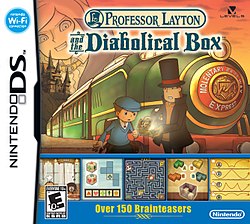

Professor Layton and the Diabolical Box is the second installment in Level-5's peculiarly British puzzle safari, which somehow traffics in top hats, tea, and murder-adjacent mystery. It moves the series out of the quaint single-town setting of Curious Village and onto a cross-country train trip-the Molentary Express-because when someone mentions a cursed box that kills anyone who opens it, the polite thing is to follow the train ticket and hope for the best. The game's DNA is unmistakably Layton: genteel sarcasm delivered with a monocle that is only implied, an apprentice named Luke who alternates between being useful and adorably over-eager, and puzzles that pop up like polite little riddles that will take your brain to the cleaners. The story kicks off with Professor Layton and Luke discovering that their mentor, Dr. Schrader, has lain down in the way of villainy after encountering the Elysian Box. The only clue is a train ticket. The player then embarks upon a succession of locations, characters, and head-scratchers en route to Folsense and Dropstone, encountering Flora, Inspector Chelmey, Don Paolo, Katia, Duke Herzen, and a legacy of gold mines that apparently come with a side of hallucinatory gas. The game manages to keep a mellow, politely ominous tone even when the plot dips into a gothic transatlantic of castles, fencing, and emotional reconciliation. If you liked the first game, you will recognize everything immediately: puzzle menus, the 'picarat' scoring, three-hint system purchased with finite 'hint coins', and a Professor who would judge you if you answered incorrectly but remains fond of you in a way that implies unsolicited tea. If you didn't like the first game, Diabolical Box does not reprogram you at gunpoint; it refines and widens the formula rather than reinventing it, and does so with the kind of meticulous gentility that makes murder mysteries seem like a polite dinner party where someone will eventually be asked to leave.
The mechanical backbone of Diabolical Box is pleasantly simple: you walk Layton and Luke through a series of locations, poke at the scenery, interrogate the odd townsfolk, and get puzzles shoved politely in your face. Puzzles themselves arrive in a catalog of styles-brain teasers, sliding puzzles, logic conundrums, and the occasional touchscreen scribble that trusts your finger and your patience. Each puzzle has a picarat value that acts like an ego meter for the Professor: get it on the first try and you're handsome; fail twice and the puzzle starts to shed value like a disgruntled hedgehog. Time is not your enemy, which is a relief if you are the sort of person who enjoys catastrophically overthinking whether a series of oddly shaped blocks can be arranged into a human silhouette. You can try forever without being punished-except by your own dignity-though incorrect answers reduce the picarats the first two times. Hints are available in a three-tiered system, but each hint costs a 'hint coin'. The game starts you off with ten coins and then hides more around the locales. This encourages exploration, and also rewards that nagging compulsion to prod every cupboard in a pixelated hotel room. Rewards for puzzle completion are not merely vain numbers. You collect hamster toys, which are used for mini-games that involve getting an obese hamster back into shape (objectively the most wholesome side quest in modern gaming). You also gather pieces of a broken camera that belonged to a character named Sammy-collect the correct shards and you repair the camera, which feels suspiciously like being paid in sentimental value. Finally, tea ingredients are another currency; brew the right blends to serve tea to Layton, Luke, and NPCs. This is both oddly soothing and functionally useful if you enjoy the idea of inventory dedicated entirely to beverages. The game houses 138 puzzles in the main narrative, with additional unlockables bringing the total to 153 (not counting the downloadable weekly puzzles that were available for 33 weeks via Nintendo Wi‑Fi Connection-an old-school bonus now inaccessible since the service shut down in 2014). A Hidden Door section contains bonuses, and some of these extras are only reachable if you've linked codes between Curious Village and the sequel to gain cross-title rewards, an indulgent little nod to continuity. Developer changes since the previous game are mostly iterative and sensible. Level-5 made a conscious effort to make puzzles feel more relevant to the story after criticism that the first game's brainteasers were too disconnected. Many puzzles now bleed more naturally into your investigation, which removes the odd sensation of solving a riddle that could just as well exist in a pamphlet. Also, strangely, puzzles use more English than Japanese, which made localization easier and reduced the number of puzzles that had to be recreated for Western audiences. Technical improvements mean the second game uses nearly twice as much data as Curious Village, a fact that will make anyone nostalgic for compressed sprites and smaller cartridges weep into their pixelated tea.
Visually, Diabolical Box continues the series' signature aesthetic: hand-drawn cutscenes, elegant character silhouettes, and environments that resemble watercolors from a particularly stylish stationery set. The DS's dual screens are put to polite use-the top often displays narrative or character portraits while the bottom handles the action and puzzles. Animations are deliberately understated; characters don't explode into exaggerated poses, they give the sort of sigh that suggests an English butler is about to make a pointed remark about your life choices. The town of Folsense is the game's showpiece for atmosphere. At first it seems like a quaint mining settlement with a suspiciously gothic castle, then slowly peels back to reveal that the place is rather more of a ghost town once the hallucinatory mine gas clears. The design team uses color and sound economically: as causal hallucinations disperse, both palette and architecture change just enough to make you reassess earlier assumptions. The Molentary Express train, Dropstone's festival, and the dark forest are all distinct visual statements that keep exploration from feeling like a single long corridor. If you are hoping for high-definition spectacle, this is not the game for you-nor is it pretending to be. The iOS/Android HD remasters decades later tried to polish things up, but on the DS the art is about restraint and charm. UI-wise, the puzzle menus are clean, readable, and appropriate for a stylus. Character portraits are expressive in a way that says 'these people have feelings' without ever descending into melodrama. It is a visual style that complements the game's tone: polite, slightly melancholy, and committed to not looking like a shooter.
Professor Layton and the Diabolical Box is a refined sequel that does what good sequels do: it makes small, meaningful improvements without throwing out the thing fans already loved. The narrative takes a more cross-country approach than its predecessor, giving Layton and Luke room to breathe and place puzzles in varied contexts. The mystery of the Elysian Box is a tidy MacGuffin that leads to genuine character moments-fencing duels, identity reveals, and a surprisingly tender resolution involving a message and the awkward logistics of family reunions. Critically, the game was well received-Metacritic aggregates it to about 84/100-and it earned praise for tightening the relation between puzzles and plot, expanding minigames, and maintaining a soundtrack by Tomohito Nishiura that is both pleasant and thematically appropriate. The title sold well, nominated for portable game awards, and was praised by many outlets that noted its charm and puzzle design. Complaints are mostly about replay value (it's not built to be played forever) and the occasional disconnection between some puzzles and the story (a problem reduced but not entirely erased). Additionally, the downloadable weekly puzzles, once a delightful carrot, are now a vintage casualty of server shutdown, giving the game a slightly more finite museum-piece feel. If you like gentle mysteries, clever puzzles, and a protagonist who would scold you with a cup of chamomile, Diabolical Box is an excellent companion on the commute. It is not explosively innovative, but it is thoughtful, well-constructed, and oddly soothing-like a crossword in a drawing room, if that drawing room also contained a slightly cursed artifact and a dramatic fencing scene. For DS owners with an appetite for puzzles wrapped in story, give it your time. For everyone else, consider it the friendly, top-hatted introduction to a series that knows how to make thinking feel like an affectionate sport.
 Crash Bandicoot: The Wrath of Cortex on PS2
 MLB The Show 22 on Switch
 Ōkami on PS2
 Tintin: Destination Adventure on PlayStation
 One Piece Grand Adventure on PS2
 Professor Layton and the Last Specter on DS
 Puzzle by Nikoli 4: on PS4












 Another SquareThought Site