

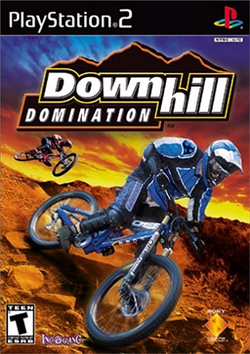

Downhill Domination arrives like a very determined mountain biker at the top of a steep slope: loud, slightly out of breath, and threatening to fling dirt at your face for entertainment. Released for the PlayStation 2, this game straps you to a downhill bicycle and hands you two very specific responsibilities: go fast, and punch people with your handlebars. The developer, Incog Inc. Entertainment, and the publishers (Sony in North America, Codemasters in Europe and Australasia) present a racing title that thinks gravity should be a gameplay mechanic and that loops of combat and tricks count as acceptable methods of maintaining civility on a slope. The result is an oddly charming hybrid of arcade racing and low-budget gladiatorial mountain biking. The reception was mostly favorable, which is developer-speak for "we did enough stuff well that critics stopped being angry mid-ride." Metacritic sits around 79/100; that's the score equivalent of a polite clap from an audience that doesn't want to make you feel bad. If you remember the PS2 era fondly - and by "fondly" we mean that polygon count was still a thing to brag about at parties - Downhill Domination feels like an artifact from that time that still manages to have fun with its constraints.
The main menu is mercifully straightforward: single-player, multiplayer, and options. Nothing flashy. Nothing that asks for your social security number. Single-player flings you at the top of a mountain where six fictional racers lounge like statues, and locked competitors really are statues, which is either symbolic or lazy asset reuse. Pressing select over an unlocked rider reveals their bio - which may include things like bravado, questionable fashion choices, and preferred lines down the mountain. Pressing select over a locked statue gives you a tutorial in how to unlock them. Unlocking riders is the game's way of keeping you honest: complete a particular career or tournament and the game rewards you with yet another person to ride fast and possibly elbow. The roster mixes fictional characters with actual pros. If you like authenticity and an inflated sense of credentialism, the game lets you unlock real-life racers such as Eric Carter, Tara Llanes, Brian Lopes, Richie Schley, and Missy Giove by finishing specific tournaments. It's reassuring to know that the very real people who made careers out of going downhill at terrifying speeds also moonlighted as unlockable prizes in a PS2 racing game. Combat is integrated tightly into the core loop. You have two attack buttons: one for left and one for right. This is the sort of elegant simplicity that makes you feel like a tactical genius until you miss a turn and smack into a tree. Attacks level up: do tricks, collect pickups scattered around the track, or take out opponents and your attacks become meaner, like a manager after coffee. Tricks themselves are a currency - perform them to charge attacks and feel slightly better about being airborne instead of on the trail where proper people live. Pickups work the way pickups always do: you grab one and the game gives you something that will probably end your opponent's day. There's also a bike shop accessible in single-player mode where in-game currency and unlockables can be spent. It's reassuring to have a place to spend money in a PS2 game, because otherwise that loose change under the couch would have no purpose. The shop offers items to tweak your ride and aesthetics, though the fair restriction to single-player mode ensures you can't shop your way to victory in multiplayer and die of shame in public. Multiplayer supports up to four players, which in theory sounds like a party. In practice, the game limits certain tracks and modes when more than two players are involved. This is the modern equivalent of saying "we'd like to host a banquet but also we only own two chairs." It's a compromise that makes multiplayer brawls possible but occasionally feels like a scaled-back suggestion rather than a full feature. Career mode is where the meat of the game sits. Tournaments are the progression system and also the narrative device for unlocking characters and content. Complete tournaments to earn access to the bigger names and the more satisfying rewards. The game keeps the structure accessible: you know what you need to do, you are given explicit instructions, and the rewards are straightforward. The difficulty is adjustable from the options, making it either a gentle introduction to downhill violence or a punishing gauntlet where every jump is an existential threat. If you enjoy the PS2 era's insistence on unlockables, a roster of quirky characters, and the idea of bicycle combat treated with the same respect as a demolition derby, you will find a lot to like. If you are seeking sophisticated physics modeling, Downhill Domination will likely be polite but firm about your expectations.
Graphically, Downhill Domination is a product of its time, and it wears that era like a well-used helmet. The environments are varied enough to keep the ride interesting: forests, rocky slopes, and the occasional stretch that seems to exist solely to let you perform an extravagant trick. The PS2 hardware handles the velocity of descent with reasonable grace; you'll get the sensation of speed without the game collapsing into a slideshow. Character models and textures are serviceable. Faces do not convey deep emotional nuance, but when your avatar is hurtling toward a tree at terminal velocity, you don't particularly care whether their cheekbones are realistic. Pop-in and occasional clipping are present, but they rarely impair the fun. The camera does its best, which is to say it usually follows you down the hill without becoming a passive-aggressive obstacle. There is a sense of polish in how the tracks are laid out and the way pickups and trick opportunities are placed - intentionally or not, the game funnels you into chaotic collisions that feel remarkably intentional. All of this lands within the PS2's visual vocabulary: deliberate design choices compensate for hardware limits, and an overall aesthetic of exaggerated arcade charm helps mask imperfections. If you expected photo-realism from a 2003 downhill biking game, you had other problems besides low draw distances.
Downhill Domination is not trying to be a cycling simulator. It does not apologize for its arcade leanings, its combat mechanics, or its roster of characters who look like they would rather be doing anything else. What it does do is provide a compact, energetic downhill experience that blends racing, tricks, and light vehicular combat into a package that was well-received at release and still scratches a particular itch: the itch for fast, dumb fun with an accent of unlockable achievement. The game's strengths are clear: addictive multiplayer (with caveats), a progression system that rewards persistence, and a straightforward combat/trick loop that keeps each run feeling meaningful. Its flaws are those of many PS2-era titles - some visual rough edges, limited multiplayer track availability when more than two players join, and a general refusal to pretend it's anything other than cheerful mayhem on two wheels. If you own a PS2, nostalgia is on the menu, and you have a friend or three who enjoy the idea of elbowing each other down a mountain, this game is worth a ride. If you demand modern physics and a serenity found only in spreadsheet-accurate simulations of gravity, you may wish to take the paved road instead. Otherwise, strap in, pull left or right when you feel like it, and enjoy a game that understands the basic truth: sometimes the best way to solve a race is to whack someone in the ribs with your handlebars.
 Evil Genius 2: World Domination on PS5
 Evil Genius 2: World Domination on PS4
 Project Awakening on PS4
 Combat Elite: WWII Paratroopers on PS2
 Orphen: Scion of Sorcery on PS2
 Monster Hunter Stories 2: Wings of Ruin on Switch













 Another SquareThought Site