

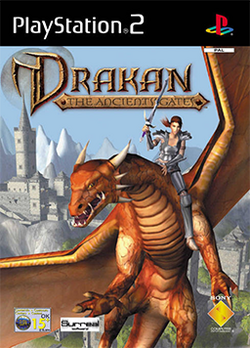

Drakan: The Ancients' Gates is the kind of game that hands you a sword, a dragon and a vague sense of destiny, then watches to see which one you'll mess up first. The sequel to the PC cult classic Order of the Flame, this PS2 outing keeps the series' two-headed appeal: ground-based third-person action with Rynn, and full 3D aerial combat riding her dragon buddy Arokh. If you enjoy being tested on multiple skill axes at once - precise melee timing, aim while airborne, quick thoughtfulness in spellcasting, and a dash of resource management - then Drakan is basically a gauntlet wearing a very convincing set of wings. It doesn't mollycoddle the player with difficulty sliders. Instead, it asks you to learn, adapt, and sometimes die embarrassingly before getting better.
The backbone of Drakan's challenge is its split personality: on-foot hack-and-slash meets three-dimensional dragon dogfighting. Ground combat is deceptively simple to start: swing, dodge, block. The nuance comes from learning to combine Rynn's melee and ranged options with a surprisingly deep spell system and equipment variety. There are 74 weapons to find or buy - swords, clubs, bows, scimitars - and each one changes how you approach encounters. Shields block damage but sap your attack speed, forcing you to pick between turtle mode and reckless DPS. That trade-off is the kind of mechanical choice that rewards thinking more than button-mashing. Spellcasting in Drakan is its own mini-skill test. Thirty spells exist and each one requires a directional gesture on the PS2 stick to cast. You quickly learn that spells aren't just flashy add-ons; they're tools for controlling the battlefield. Clone and Fear can turn an outnumbered fight into a circus of confusion; Combust and elemental spells let you punish grouped foes. Pulling off the gestures under pressure is an exercise in muscle memory and calm thumbs - impatient flicks lead to misfires and awkward close-quarters consequences. Think of it as a rhythm-game-lite for wizards: timing, correct direction, and speed matter. One of the game's biggest challenges is how often it forces you to switch mental models mid-combat. You might be sprinting through a dungeon, relying on melee combos and archery for precision kills, then be called upon to call Arokh mid-battle. The mechanics when mounted shift the difficulty curve dramatically. Arokh gives you free movement in six directions - up, down, forward, back, left, right - and the controls demand spatial awareness. Flying enemies fill the sky, and taking them down requires both aiming skill and finesse in flight. You must manage altitude, momentum, and lock-on while juggling elemental breath attacks and sonic waves. PvE dogfights become a test of geometry: positioning often wins before raw damage does. Target-locking on both Rynn and Arokh is a welcome aid, but it's a double-edged sword. Lock helps focus your attacks, but overreliance can trap you into tunnel vision. Some of the tougher encounters - namely larger groups or faster flyers - reward loosening the lock to strafe and circle. Bosses often combine high HP, varied attack patterns, and occasional geometry tricks that punish predictable play. Their telegraphed moves still require sharp reflexes to read, and dodging often matters as much as hitting. Progression is where Drakan gets clever with challenge scaling without a formal difficulty setting. Experience points are the single currency for three distinct skill trees: Melee, Archery, and Magic. You can be a jack-of-all-trades or a glorified archer who occasionally breathes fire. The skill system forces choices. Spend too much in melee and you'll struggle against airborne foes; ignore magic and you'll miss crucial utility spells that change fights' pacing. This design encourages replayability: a magic-focused Rynn plays differently than a two-handed-sword specialist. Inventory and loot management are additional skill checks. With many weapons available, learning which tool works against which enemy type is part of the loop. Shops make certain gear accessible, but exploration and side quests are where the best toys hide. The game's mission structure nudges players toward exploration, and that helps build the necessary XP and gear to tackle later regions. You'll often find yourself returning to earlier areas to grind or pick up items you missed, which is satisfying if you enjoy mastering systems but tedious if you hate repetition. A recurring difficulty spike is the marriage between bugs and design rough edges. Critics noted (and players will feel) occasional glitches and a lack of variety in some missions. While these don't break core systems, they can amplify challenge in frustrating ways - like mistimed spell inputs or enemy pathing that makes a fight take longer than it should. Still, the core learning loop - practice, adapt, re-spec, repeat - makes progression feel earned rather than handed out.
Graphically, Drakan shows off what the PS2 could do in the early 2000s: far more polygons and richer environments than its PC predecessor. Rynn and Arokh benefit from substantial polygon bumps, giving character models a level of detail that holds up for nostalgic play. Environments - dungeons, castles, deserts - have improved depth and contrast, and the game extends draw distance when flying to allow sweeping vistas. The visual clarity when airborne is not just eye candy; it's part of the challenge. Seeing enemy flight paths and environmental hazards from a distance helps you plan an interception or avoid a nasty plunge. The art direction keeps the mood serious with occasional whimsical touches. Effects like Arokh's elemental breaths and spell flares are readable and satisfying, which matters when you're making split-second decisions mid-air. The downside: some textures and animations can feel dated, and certain graphical bugs reported in reviews discolor the polish. Overall, the graphics serve gameplay rather than overshadow it, which is exactly the right call for a game so focused on player skill.
Drakan: The Ancients' Gates isn't interested in holding your hand. It's a game that asks you to become competent across multiple, very different playstyles: a nimble melee grinder, a patient spellcaster, an accurate archer, and a competent dragon pilot. The lack of a traditional difficulty slider is replaced by a deeper requirement for player skill and strategy: mastering spell gestures, learning to trade off shield and speed, aiming and maneuvering while suspended in three-dimensional combat, and wisely investing XP into the right skill tree for your playstyle. It stumbles at times with bugs and repetitive mission beats, but when it clicks - when a difficult boss finally yields because you learned to kite, feint, or cast better - the satisfaction is real. For players who like a challenge that rewards learning and adaptation (and who enjoy barking at their controller in the privacy of their room), Drakan offers a rewarding, if slightly rough-edged, ride on the back of a dragon.
 Radial-G: Racing Revolved on PS4
 Arcade Archives: Alpine Ski on Switch
 Tintin: Destination Adventure on PlayStation
 Disney's Chicken Little: Ace in Action on PS2
 One Piece Grand Adventure on PS2
 Taiko no Tatsujin: Dokodon! Mystery Adventure on Switch












 Another SquareThought Site