

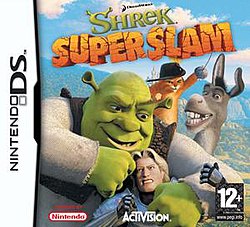

Shrek SuperSlam arrives like a marshmallow in a demolition derby: soft, oddly cheerful, and somehow intent on cracking things open. The game straps 20 characters from the first two Shrek movies - and a few original faces who seem to have wandered in from a medieval costume party - into 3D arenas where the stated goal is to 'Slam' one another into disrepair and collect points for your trouble. Up to four players can bicker in real time, which is handy because nothing says friendship like hurling Fiona off a cliff while someone else grills Donkey with a barrage of arrows. The game was developed by Shaba Games and published by Activision in late 2005, and for the PlayStation 2 specifically it sits comfortably in the 'fun with caveats' zone. The concept is simple: build a Slam meter, unleash a signature Slam attack, and watch the stage fall apart like a gingerbread house in an earthquake. You either score more Slam points than everyone else, or you eat crow - usually both. The game wears its family-friendly belt proudly, but beneath that mild exterior is a bruising little party fighter that knows how to be loud when it needs to be.
On paper Shrek SuperSlam is the kind of multiplayer fighter that invites people who normally promise they 'don't do video games' to show up, press buttons wildly, and then explain rules inaccurately. Two to four fighters slug it out in destructible 3D arenas. The objective depends on the mode, but it always involves generating Slam points by hitting multiple opponents with your special move - and ideally doing so while someone else is distracted by an exploding pumpkin or a falling giant gingerbread man named Mongo. There are three core multiplayer modes. 'Melee' is the time-limited, point-gathering chaos: fill your Slam bank, detonate it, and hope you're standing in the right place when a dozen physics-defying objects scatter opponents into the sunset. 'King of the Hill' transfers the value of hubris into points: control the hill, pad your lead, and pretend you were executing a strategy rather than wildly spamming attacks. 'Slammageddon' is the game's attempt at a 'noisy everything counts' rulebook, where each hit is a Slam and subtlety is politely asked to leave. Every character comes with a unique set of moves and a personal Slam attack that can actually define playstyle. Shrek's 'Green Storm' is a close-range, unglamorous wind that sends enemies flying; in a moment of culinary-physics brilliance the game rewards you for farting on people - that old adage about different strokes applies. Robin Hood summons arrows in a sweeping sky-shower, which is significantly more reliable when you prefer ranged humiliation. Pinocchio's nose-powered 'Buzz Bomber' transforms his facial growth into an aerial battering ram, a solution to the question 'what if my nose could fly?' that the franchise apparently never asked before. Fiona Ogre belts out 'Ogre Aria' in a display of projectile vocals that does surprisingly well in combat and terribly in any local tone-deaf choir auditions. Characters number twenty in total, ten locked behind play progression so your patience will be rewarded with unlocks rather than a participation trophy. Some fighters have alternate costumes, which is the game's polite way of acknowledging that sometimes you want Puss in Boots to wear a slightly different hat while you launch him at someone. The roster mixes mainstays like Shrek, Donkey, Fiona, and Puss, with weirder picks like Humpty Dumpty, Quasimodo, and Luna the witch. John Kassir provides the announcer's voice, which reads like the game hired a carnival barker who'd been to three corporate voiceover seminars. Controls on PS2 are solid if unspectacular. Attacks are readable and intuitive enough for newcomers, although the precision expected in higher-skill play can be a few frames behind what competitive players would prefer. Movement in the 3D arenas feels serviceable; the arenas themselves are a highlight because they invite creative use of the environment. Stages crumble and animate - Mongo the Giant Gingerbread Man stomps through one level like a confectionary deity - which is entertaining even when the camera gets confused and you feel like you're watching a puppet show through a keyhole. Single-player exists, but its primary function is to warm your thumbs for the multiplayer shenanigans. The game is best experienced with friends and a small pile of snacks. Local multiplayer is where it shows its teeth, which are mostly comic-shaped and occasionally game-winning. The design rewards spectacle and momentum over razor-sharp competitive balance, meaning it's a fantastic party option and a slightly rougher competitive fighter than the lineup of specialist brawlers worth studying.
Visually the PlayStation 2 version sits at the 'fine for its time' table. Character models are expressive in that chipmunk-lipstick cartoon way and animations for Slams feel dramatic enough to sell the spectacle. Environments are colorful and destructible, and Mongo's cameo as a moving stage is a nice bit of set-piece drama. Frame rate hiccups are rare but present, and the camera will occasionally treat you to an abstract art piece of your own feet while your opponent walks into a trap. The art direction leans into DreamWorks' aesthetic: big personalities, bright colors, and a slightly greasy sheen on certain characters that suggests the game has eaten one too many adventurers. Texture detail and lighting are era-appropriate; they won't start arguments with modern hardware but they still manage to charm on nostalgia. Costumes and alternate skins add variety, though mostly cosmetic. If you've been hoping for a photorealistic retelling of Shrek's eyelash regimen, this is not that. If you've been hoping for wholesome cartoon chaos with occasional physics-induced pratfalls, it delivers.
Shrek SuperSlam on PS2 is honest about what it tries to be: a family-friendly, loud, arena-based brawler that prioritizes moments of ridiculousness over tight, high-level balance. Reviews at the time called it 'mixed or average' and those sums are fair. It doesn't rewrite fighting game rules, but it does what it sets out to do with a grin and a well-timed flatulence gag. If you want competitive depth measured in frame-perfect inputs, look elsewhere. If you want a four-player session where someone will inevitably complain that Puss keeps stealing the lead and someone else will swear that Shrek's breath is illegal in two states, this is perfect. The PlayStation 2 version gives you most of the roster, the arena destruction, and the slapstick S drink of mayhem you expect. It is not perfect. It is, however, very good at being exactly what it is: a chaotic, cartoonish super-slam party where the rules are simple, the characters are loud, and dignity is optional. Recommended for parties, nostalgia trips, and anyone who thinks a well-executed Ogre Aria is a valid life choice.
 DreamWorks Shrek Forever After on DS
 DreamWorks Shrek the Third on PS2
 Lego Party on PS4
 Quiplash 2 on PS4
 Ultraman Fighting Evolution on PlayStation
 Super Mario Party Jamboree – Nintendo Switch 2 Edition + Jamboree TV on Switch 2
 Grind Session on PlayStation
 Razor Freestyle Scooter on PlayStation












 Another SquareThought Site