

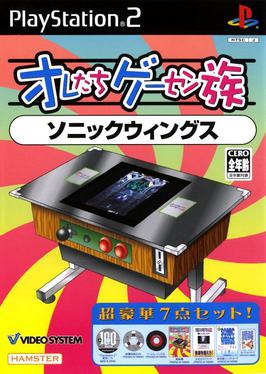

Oretachi Gēsen Zoku is Hamster Corporation's polite way of telling you they have dug up a box of arcade relics, dusted them off, wrapped each in collectible packaging, and put them on a PS2 shelf in Japan for 2,000 yen a pop. Volume 5 of this archaeological hobbyist series contains Moon Cresta, the 1980 fixed shooter from Nihon Bussan. If you expect modern conveniences like checkpoints, autosaves, or a story about your ship's therapy sessions, this is not the title for you. What you do get is a faithful emulation of a game designed to take quarters and dignity in equal measure, presented with the kind of retro love that includes a CD of remixes, a miniDVD with trailers and a masterplay video, a tiny strategy booklet, and a replica display card. The bundle treats Moon Cresta less like a game and more like a curated museum piece with music and pamphlets. The PS2 release is part of a 19-title series that reissues arcade classics, often barebones in gameplay but high in historical value. Hamster's packaging fetish means each disc comes with the original arcade ROM on a PS2 CD, a soundtrack mini CD featuring both original tunes and remixes by Super Sweep, a miniDVD with promotional content and a pro playthrough to stare at when your skills fail, and a small strategy guide that will make you feel clever for five minutes. If you are a collector, this is the sort of thing you buy to complete a set and then occasionally remove from a shelf to remember how cruel pixel patterns used to be.
Moon Cresta is the kind of game that assumes your fingers are made of determination and your patience is unlimited. At its core it is a single-screen fixed shooter: enemies come in waves, you shoot them, and you try not to be turned into a constellation of tiny explosions. The twist-Moon Cresta's claim to historical fame-is the docking mechanic. Your craft starts small and relatively nimble. After completing certain stages you have the opportunity to dock with extra ship modules, effectively increasing your firepower but also making your hitbox less sympathetic to incoming bullets. This trade-off between raw power and increased vulnerability creates the most meaningful decisions in the game: risk becoming a shooting platform or stay small and more survivable. It is rare for a 1980 arcade title to ask you to make engineering choices that feel borderline philosophical, but Moon Cresta manages it between one-sitting-at-the-arcade and 'I should probably get a real job' levels of tension. The PS2 emulation reproduces the arcade pacing faithfully. Levels are short, waves are tightly choreographed, and the scoring system rewards precision more than brute force. Enemies follow predictable patterns, so success is less about reflex heroics and more about pattern recognition and memory. This is excellent if you enjoy learning the choreography of attack patterns and then dancing around them like a slightly panicked ballet dancer. Lives are precious because each loss is a sentence to start a stage again, and continues are not indulgent. The mini strategy guide included in the Oretachi package genuinely helps; it points out docking windows, scoring quirks, and enemy behaviors that feel like arcane knowledge until you apply them and suddenly the leaderboard seems less intimidating. Moon Cresta is designed for repeat plays. The learning curve is gentle in the short term but brutal in the long term, the way a language is easy to start learning and impossible to master without decades of devoted attention. The masterplay video on the miniDVD is both comforting and demoralizing. It demonstrates flawless runs that are aspirational in the way professional mountain climbing is aspirational: you can watch and admire, but attempting the same will likely end in scrapes, bruises, and a stoic acceptance of mediocrity. For single-player fans who enjoy incremental improvement and scoreboard-driven goals, Moon Cresta is pure. For players used to modern conveniences like dynamic difficulty, autosaves, or any form of forgiveness, the game will feel like an unforgiving mentor who offers little consolation besides the occasional high score. Controls are as simple as the era allows: move left and right, fire, and time your docking sequences. There is no combo system, no upgrades you buy mid-game, and certainly no ridiculous side quests involving NPCs who need your help finding a lost sock. What the game does have is immediacy. The clean input makes your mistakes obvious and your tiny victories disproportionately satisfying. A run where you dock twice and keep all your modules is the kind of achievement you will quietly celebrate, perhaps with a small, private fist pump, because in Moon Cresta the payoff is literal: more guns on your ship and another chance to carve a respectable number into the machine's forgotten leaderboard.
Graphically Moon Cresta is unapologetically 1980. The visuals are charming in the way a sepia photograph is charming: you appreciate the texture and age rather than demanding realism. Sprites are chunky, colors are bright to the point of being defiant, and backgrounds are functional rather than decorative. The PS2 emulation does not attempt to modernize or upscale; it presents the arcade board's output with a kind of faithful stubbornness. If you are buying this for eye candy, you should know you are buying nostalgia more than fidelity. The pixel art has personality, though. Enemy formations are distinctive, explosions are satisfyingly crunchy, and the docking animations are crisply mechanical, as if a tiny spacecraft bureaucracy is processing your decision to merge. The included soundtrack mini CD is where the package quietly excels visually in the mind. Remixes by Super Sweep add an unexpected sheen to the original tunes, making the music feel like a retro club remix rather than a museum audio loop. The miniDVD's masterplay also gives the game an audiovisual context: watching an expert navigate enemy patterns while the retro soundtrack plays is oddly soothing. There is, throughout the package, a clear respect for the source material. Hamster does not hide the game's age. Instead they frame it, put it on a plinth, and hand you a booklet that says 'this is what retro looked like.' The result is honest presentation rather than fussy enhancement, which is exactly what a preservation-minded collection should aim for.
Oretachi Gēsen Zoku: Moon Cresta on PS2 is not a purchase based on convenience or modern design sensibilities. It is a purchase for people who enjoy carefully preserved slices of arcade history, complete with soundtrack CDs, strategy pamphlets, and a miniDVD that will either inspire or gently humiliate you depending on how competitive you are. The game itself is compact, difficult in the way old arcade games are difficult, and strangely clever with its docking mechanic. As part of Hamster's series it benefits from excellent packaging and a clear archival intent. As a standalone experience it can be frustrating to anyone who expects modern pacing, but it is rewarding in short bursts and deeply satisfying to players who enjoy mastering patterns and optimizing runs. If you like games that teach you slowly and then refuse to cut you any slack, you will find something to admire here. If you dislike being taught, Moon Cresta will still be historically interesting, and the extras make the PS2 release feel like a collectible rather than a simple re-release. Score-wise, it earns a solid 7 out of 10 for faithful emulation, clever mechanics for its time, and the charm of its packaging. It loses points for punishing difficulty by modern standards and for offering little in the way of modern comforts. Buy it if you like your shooters terse, your packaging meticulous, and your victories earned one pixel at a time.
 Press Your Luck on PS3
 Oretachi Game Center Zoku: Trio the Punch on PS2
 Game Dev Story on PS4
 Oretachi Game Center Zoku: Rabio Lepus on PS2
 Oretachi Game Center Zoku: Quarth on PS2
 Ninja Assault on PS2
 Oretachi Game Center Zoku: Sonic Wings on PS2












 Another SquareThought Site