

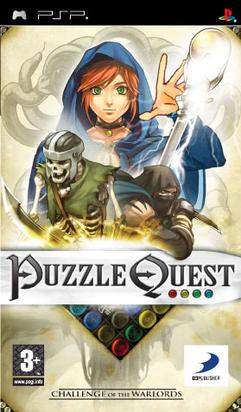

There are moments in a reviewer s life when two very different ideas collide and, to one's embarrassment, produce something entirely sensible. Puzzle Quest: Challenge of the Warlords is one such collision - an oddball but elegant marriage between the compulsive jangle of match-three puzzle play and the stat-heavy trappings of a traditional role-playing game. Released across a dozen platforms in 2007, the PlayStation 2 version arrives as the console port of a phenomenon that quietly upended expectations: what might have been a novelty turned into a relentlessly entertaining loop with surprising strategic depth. This review approaches Puzzle Quest with the crusty seriousness of a 1990s print critic who still believes tariffs on floppy disks were a good idea, and who will not be flattered by shiny buttons unless the game beneath them earns it.
At heart Puzzle Quest is a duel: you stand opposite an opponent and win or lose through a turn-based match-three board that looks suspiciously like Bejeweled after a visit to a magic shop. The mechanics are straightforward to explain and fiendish to master. Each turn you swap two adjacent tiles in order to form a horizontal or vertical line of three or more identical tiles. Matches vanish, tiles fall, chains form, and sometimes the gods of randomness bless you with cascades that feel like discovering spare change in a trouser pocket from last winter. Tiles are not merely pretty pebbles. Coloured gems supply mana of corresponding types, skulls inflict direct damage, and there are experience and gold tokens for the enterprising match-maker. Match four or more and you earn extra turns or bonuses; string together chains and the board rewards you with bountiful spoils. A clever bit of design is how the character sheet affects the board: your class, level and equipment alter how much mana or damage you draw from matches, so a single three-gem move can be a tiny economic decision or a tactical coup depending on your build. Layered on the puzzle is a full-blown RPG structure. You choose one of several professions at the outset and develop attributes such as combat ability, morale and magical affinity. Experience points and gold are the twin currencies of progression: experience hands out skill points and stat increases, while gold buys equipment and pays for citadel upgrades. The citadel is a sensible, old-school hub - a place to forge items, study captured monsters for spells in the bestiary and tinker with mounts and companions. Many of these interludes demand mini-game variants of the tile board, which keeps the central plumbing of the game present even while you tinker. Combat itself rewards both puzzle skill and tactical forethought. Before any move you may cast spells if you have the requisite mana. Spell effects range from direct damage to board manipulations that can be used to clear troublesome tile types or to force combinations. Spells have cooldowns, armour mitigates incoming hits, and when either combatant runs out of life the duel ends. Lose a fight and you can usually try again; lose one that is key to the main quest and you will be invited to grit your teeth and improve your build. The world is presented on a simple map that would be at home in a 1996 strategy magazine: towns, roads, quest markers and wandering foes that block travel until you smash them back into the dirt. The campaign is structured by quests, both main and side, which are the primary means of earning experience, new gear and the occasional narrative moment. Story-wise the game leans on a familiar high-fantasy template; it is competent but hardly Shakespeare. This is by design: Puzzle Quest wants to give you reasons to journey across the map and fight rather than to pause for lengthy lore dumps. If there is a complaint here it is that the loop can be rote after many hours. The rhythm of travel, duel, reward, and upgrade is addictive and efficient, but the core ingredients are repeated relentlessly. That's not a strike so much as a warning: if the match-three hook stops appealing to you, the rest of the RPG trappings will struggle to keep pace. Fortunately, the game offsets this with meaningful class variety, companions that change combat math, and the satisfaction of incremental improvements that actually alter how the tile board pays out.
By 2007 standards the PlayStation 2 release is serviceable rather than showy. The visual presentation favors clarity over spectacle; the combat board is clean, the icons legible, and the little portraits and spell effects convey the necessary information without fuss. You will not be dazzled by cinematic set-pieces or lavish cut-scenes. The PS2 version inherits the same modest aesthetic that marked the original handheld releases - art that aims to communicate rules and consequences rather than to hog your attention. In short: it looks like a game that expects you to be paying attention to the tiles, not the bloom effects. This economy of presentation works in its favour and against it. On the positive side, the simplicity keeps the puzzle readable even in heated matches and preserves performance on older hardware. On the negative, the game by its nature shows its age: the world maps are functional but bland, the story art is generic, and the UI lacks the polish modern audiences have come to expect. If you are playing on a CRT in a dim room with some crunchy soundtrack on a battered stereo, the PS2 visuals are perfectly agreeable. If you wanted jaw-dropping visuals, you bought a different disc.
Puzzle Quest on PlayStation 2 is an exercise in elegant restraint. It takes a nearly perfect puzzle loop, straps an RPG around it and then resists the urge to bloat either half with needless complication. The result is addictive, clever and occasionally ruthless; the balance between tile-based chaos and long-term character planning is handled with the kind of measured judgement that made late-90s strategy pages such a pleasure to read. Its flaws are not catastrophic but they are telling: a generic fantasy plot, plain visuals, and a repetitive structure that will either become your new daily compulsion or a charming curiosity depending on temperament. For those who remember the era of thick manuals and considered difficulty curves, Puzzle Quest feels like the kind of pleasant surprise that once made gaming columns interesting. For modern players it remains a prototype of genre-blending done right - influential, compact and still fun. On the PlayStation 2 it is not the flashiest version, but it is a faithful port of an ingenious design. If you enjoy match-three games and the idea of meaningful progression, you will find many hours of shrewd, quietly rewarding play here. If you want epic visuals and an obtuse narrative, bring a different game to the shelf. Either way, Puzzle Quest earns its place as a clever detour in both puzzle and RPG canons.
 Puzzle Quest 2 on DS
 Dance Dance Revolution Extreme on PS2
 Combat Elite: WWII Paratroopers on PS2
 The Banner Saga 2 on PS4
 Arcania: The Complete Tale on PS3
 Gnosia on Xbox Series X/S
 Puzzle Kingdoms on DS












 Another SquareThought Site