

 Aug 2025
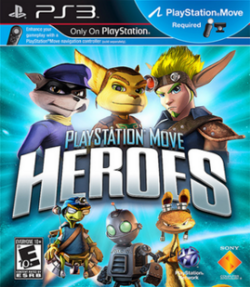

If you've ever wanted Ratchet, Jak and Sly to walk into the same room, wave a PlayStation Move wand around and try to out-embarrass one another, PlayStation Move Heroes is the game that shows up to that party wearing novelty sunglasses. It's a 2011 action-adventure mash-up built for Sony's motion controller experiment, bringing together six familiar faces - Ratchet and Clank, Jak and Daxter, and Sly and Bentley - into fifty bite-sized levels that aim for pick-up-and-play accessibility rather than epic storytelling. The set-up is gloriously silly: two aliens named Lunk and Gleeber kidnap chunks of the heroes' worlds, assemble them into a ring around Planet X and then invite the duos to participate in challenges. Naturally, this devolves into the sort of interstellar athletic pomp you can only expect when your antagonists are named after a failed '90s boy band. The charm card here is obvious: three fan-favorite franchises, canonical nods (the original voice actors apparently turned up to record), and an emphasis on Motion-controlled gimmicks that were still fresh enough in 2011 to make players swing, point and throw with genuine curiosity. The reality card, unfortunately, has a slightly soggy corner. PlayStation Move Heroes is a party-game-ish series of minigames wrapped in levels, with a handful of neat ideas about using the Move controller - and an equal handful of frustrations that make you miss a good old-fashioned analog stick. Think of it as a sleepover with a great mixtape and a slightly broken speaker: fun in bursts, annoying in the long run, but worth the memory if you and a friend can laugh at the glitches.
On paper, the gameplay is a neat little blueprint: fifty levels grouped into five archetypes, five weapon classes, and four environments borrowed from the three franchises (Paris for Sly, Metropolis on Kerwan for Ratchet, Haven City for Jak, plus a new Planet X). You pick a hero duo for each stage, and the game hands you different control schemes depending on whether you toss discs like a frisbee, swing a whip in one-to-one motion, roll a bowling ball and guide it like a possessed Roomba, fire projectiles with guns, or go old-school with melee using each hero's signature tool - Sly's cane, Ratchet's wrench, and Jak's gunstaff. If you've ever wondered what it looks like when a Lombax improvises a bowling technique, this delivers. Controls are the headline experiment. Some mechanics are clever: the disc and bowling classes let you toss an object and then guide it remotely with the Move controller, which can be surprisingly satisfying when the Move cooperates. The whip action uses direct tracking, so it feels immediate when the camera and sensor are aligned. Projectile stages aim to turn you into a temporary sharpshooter, and the melee sections try to recreate the familiar rhythm of each hero's original combat. Co-op is handled with a cute quirk: second players become the sidekick of whoever the first player picks - choose Jak and the other player gets Daxter - which is a nice, lore-friendly shortcut that saves you from awkward hero duplication. The problem is that the party sometimes forgets the tunes. Motion detection can be spotty: a flick intended to be a satisfying overhead smash might register as a polite handshake. The disc and bowling guidance is clever but can feel like herding particularly spiteful hamsters when the Move tracking gets confused. The camera, too, has an identity crisis; it wants to be cinematic and cooperative, but often prefers to rubber-band into oblivion. That makes some targets annoyingly hard to hit and certain platforming sections more about guessing pixel trajectories than showcasing skill. Levels are short and designed around specific gimmicks, which is great for quick sessions at a party but results in repetition if you try to marathon the whole thing alone. There are a few things the game does right. The level design embraces the different worlds well: Parisian rooftops and Metropolis backdrops feel sufficiently different in tone, even if they sometimes look like Lego versions of their originals. Each character having slightly different playstyles adds some strategy to hero selection; Ratchet's gadgety tendencies feel distinct from Sly's stealthier cane play or Jak's more brutish attacks. The progression encourages replay to beat harder challenges, and there are boss-like encounters that lean into cooperative tactics. The narrative is the most delightfully disposable kind: Lunk and Gleeber's scheme to record the heroes and use a teleporter to impersonate them is comically thin, which suits the game's carnival vibe - you're here for the mini-game show, not an emotional arc. Multiplayer is where this game is at its most defensible. Two-player co-op loosens the sting of camera and control issues because shared laughter, playful blame and someone else missing an obvious target is a social adhesive. It is, in the best cases, a charming couch title for two people who own a Move controller and don't mind waving their arms like overenthusiastic air dancers. For solo players, though, the repetition and the aforementioned control foibles tend to add up into a 'fun for 20 minutes' verdict rather than 'can't put this down.'
Graphically, PlayStation Move Heroes is a mixed bag with a smile. It doesn't try to compete with the AAA blockbusters of its era - instead it opts for a colorful, cartoony aesthetic that echoes the original franchises without pretending to be a love letter to their high points. Environments are recognizable: Paris feels sneaky, Metropolis feels metallic and industrial, and Haven City brings a coastal grit. The new Planet X is serviceable, offering a neutral playground where the crossover can happen without stylistic whiplash. Textures and fidelity are decidedly PlayStation 3 mid-range, which is fine when you're busy chucking frisbees with your hands in the air. Animations are energetic, particularly during melee sequences where each character's signature moves get a little flourish. The game also benefits from having the original voice actors reprise their roles, which adds a layer of authenticity and helps the characters feel not just like skins but like the real deal doing silly stuff. On the downside, the camera and occasional clipping issues work against the visuals - if the tracking and viewpoint betray you, even a pretty scene becomes frustrating because you can't confirm whether your aim is to blame or the game is. In terms of presentation, the UI is clean and the skins (some of which were pre-order exclusives and later sold on the PlayStation Store) are fun aesthetic incentives for fans.
PlayStation Move Heroes is a game that will make you grin, shrug, and argue with your living-room furniture all within the span of a single level. It is strongest as a light-hearted, social experiment in motion-controlled nostalgia: two friends with a Move controller and a couch can wring out a solid hour of fun, laughs and 'remember when' moments. As a crossover meant to satisfy fans of Ratchet & Clank, Jak and Daxter, and Sly Cooper, it plays the IPs like cover songs - recognizable melodies but not the full orchestral performance you'd hope for. Critically, the game's flaws are the ones you expect from ambitious motion experiments circa 2011: imprecise controls, a moody camera, and a tendency toward repetitive mini-game design. Review sites at the time reflected this ambivalence (a Metacritic average around 53/100 and an IGN 5/10), which is a fair reading: charming ideas and a solid cast get tripped up by execution. If you want the definitive Ratchet, Jak or Sly experience, go to their respective mainline titles; if you want a goofy, short-burst motion party with familiar faces and strange alien overlords, PlayStation Move Heroes is worth a rent or a cheap buy. Consider it a novelty at the intersection of nostalgia and motion-control curiosity - occasionally brilliant, often flawed, and best enjoyed with a friend who doesn't mind being blamed when the Move goes on strike.
 Theme Hospital on PlayStation
 PlayStation's 30th Anniversary Events
 Tintin: Destination Adventure on PlayStation
 One Piece Grand Adventure on PS2
 Taiko no Tatsujin: Dokodon! Mystery Adventure on Switch
 Onimusha: Dawn of Dreams on PS2










 Another SquareThought Site