

 Jun 2009
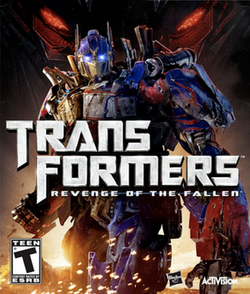

If you handed a giant robot a joystick and asked it to make a movie tie-in game, Transformers: Revenge of the Fallen (PS3) feels like the result: big, noisy, occasionally impressive, and prone to smashing the environment in ways that make you briefly forget the things the game isn't doing very well. Luxoflux shipped the PS3 build on the studio's Lux Engine with a noticeable effort to improve the core gimmick from the last franchise outing - transformation - and to wrap it in a split-campaign shooter that mirrors the film's Autobot/Decepticon structure. On paper that translates to two parallel campaigns, nonlinear hub-style mission selection, and a multiplayer suite with five modes. In practice the PS3 version is a middleweight contender: technically competent in places, hamstrung by conservative art and mission repetition, and saved from mediocrity primarily by a surprisingly solid combat feel and multiplayer that, when it works, is enough to keep you tinkering with builds and character loadouts for longer than the single-player campaign deserves. This review focuses on the PS3 edition, so expect details about the Lux Engine's strengths and limitations, the updated transformation system, and why the multiplayer is both the game's best and its most frustrating feature.
Revenge of the Fallen is architected around two concurrent campaigns - Autobots and Decepticons - a design choice that doubles the number of missions while giving players the illusion of narrative breadth. The PS3 build retains the franchise's core third-person shooting and melee loop but layers it with an improved transformation system. Luxoflux updated the transform mechanics to allow mid-air conversions, momentum conservation across transforms, and direct transforms-into-attacks. Technically this is the most interesting mechanical evolution in the title: animation blending is used to smooth transitions between vehicle and robot states, and the engine carries a velocity vector through the transform, so a well-timed aerial conversion will keep you flying through enemies instead of slamming you into a guardrail and into a 'you died' screen. That sounds small until you memorize the timing and start stringing aerial boomerang slams into ground-pound finishers - then the game briefly becomes a rhythm exercise with rocket launchers. The mission structure on the PS3 is hub-like and nonlinear. Rather than forcing a corridor of scripted beats, the game gives you a set of mission nodes you can approach in different orders. That design should increase player agency and allow better pacing, but in this release the nodes often devolve into permutations of the same objectives: hold points, escort assets, clear waves, or assassinate a named target. The underlying AI tends to favor quantity over quality - expect predictable enemy flanking and scripted armored responses rather than emergent battlefield maneuvers - so diversity of enemy behavior is under-delivered. Enemy spawns and mission pacing are balanced to keep the firefights frequent, which helps the shooty-mashy core stay entertaining, but it also exposes repetition: once you decode the most efficient approach for a mission archetype, the encounter becomes procedural again. Gunplay and melee, however, are serviceable. Weapons have distinct feel profiles; projectiles obey reasonable ballistic arcs at medium range and hit detection is typically tight for chassis-on-chassis hits. The melee system is weighty - big robots should feel like they have mass - and the impact animations sell that scale more often than not. Collision detection sometimes struggles when world geometry is complex (tight urban rubble can cause a limb to clip through an object and cancel an attack), but Lux Engine's physics prioritizes spectacle: destructible elements, breakable cover, and believable rubble physics deliver the expected set pieces. Transform-to-attack animations are the technical highlight: playing with momentum and timing produces knockback vectors and ragdoll responses that are satisfying even if the surrounding mission design is mundane. Multiplayer on PS3 offers five modes - Deathmatch, Team Deathmatch, Control Points, One Shall Stand (leader assassination), and Battle for the Shards (capture-style). From a systems perspective, the game's multiplayer is where the implementation maturity shows. Character classes are tuned with stats that matter: speed, armor, firepower, and transform agility. Networked replication keeps transforms, projectiles, and core state consistent across clients reasonably well, which is impressive given the number of moving parts per player (vehicle model, robot model, particle effects). Matchmaking and connection reliability are the weak points. Reviews from the time noted connection problems and I experienced intermittent latency spikes that amplified hit registration problems in longer matches. The netcode's rollback/authoritative model appears tuned toward peer-to-peer sync rather than dedicated-server reconciliation, which in 2009 made sense economically but sometimes traded latency for divergent object states during explosive chaos. Progression and unlocks are shallow but rewarding in short bursts. DLC support expanded the roster with G1 skins and additional multiplayer characters, which is a neat technical trick: adding alternate art assets and swapping audio/animation sets without rewriting core character logic. That extensibility indicates the engine's pipeline supported modular content additions - a practical win for a licensed IP where cosmetic nostalgia sells. Overall, gameplay is a collection of well-implemented mechanics (notably transformation and combat feel) hamstrung by repetitive mission scaffolding and occasional network volatility.
The visual side of the PS3 version is a classic case of 'serviceable but not showstopping.' The Lux Engine on PS3 produces models with convincing silhouette and mechanical detail, and the character rigs for movie-based bots are faithful enough that you'll recognize Optimus and Megatron at a glance. Texture density is middling: robot surfaces read well in close-ups but suffer from compression and mipmap blur at distance. Lighting is baked-heavy in many levels - static shadowing with localized dynamic lights for muzzle flashes and explosions - which limits scene dynamism but saves on GPU overhead. Particle systems are used liberally for explosions, debris, and energy effects; they mask a fair amount of geometry LOD swaps and happily sell the chaos of big battles. From a performance standpoint the PS3 build targets stable framerates but occasionally drops during large set-pieces where particle counts, dynamic lights, and destructible elements converge. When the game dips visually it tends to do so gracefully: LOD management fades models rather than popping them, and draw-call culling keeps frame-cost spikes under control. The cost is visual monotony: cities and battlefields are presented in a palette of concrete, rust, and burned steel that matches the film's aesthetic but lacks the color contrast to make environments memorable. This visual conservatism likely contributed to contemporary critiques labeling the graphics 'bland' - there are few moments where the game leverages post-process or shader complexity to create signature visuals. Animation is where the title earns its mechanical soul. Transformation animations are blended and interruptible, which is essential because the system supports mid-air conversions and attack chaining. Character rigs handle joint articulation convincingly; servo noise, joint constraints, and mechanical recoil are present in the animated pipeline. The compromise appears in facial and human animation (NPCs and human allies), which are serviceable for mission beats but fall flat next to the polished mechanical animations of the robots. On the audio-visual integration front, particle and sound cues are well-synced for weapons and explosions, improving perceived impact even when polygon counts are modest. PS3-specific memory constraints probably drove the design toward fewer unique textures per level and more reuse, which explains why environments feel same-y after a few hours.
Transformers: Revenge of the Fallen on PS3 is a textbook example of a licensed action game that gets the fundamentals right where it matters to a robot fan: transformation feels purposeful, combat is weighted and satisfying, and multiplayer provides a playground for the core systems to shine. From a technical perspective Luxoflux's improvements to the transform system and the engine's modular pipeline (visible in the DLC additions) are the game's real accomplishments. Weaknesses are equally technical: conservative art direction, repetitive mission archetypes, and networking quirks that occasionally make online play maddening. If you want a tight, cinematic single-player epic, this isn't your go-to - the campaign overstays its welcome and leans on quantity of encounters rather than quality. If you enjoy mech combat and you have friends to test the multiplayer with (or patience for the occasional connection hiccup), you'll find more than enough mechanical depth to enjoy a handful of evenings. Score-wise, the PS3 version sits around a competent 6/10: not a classic, but far from a disaster - ideal weekend fodder for anyone who wants to pretend they're piloting a truck with feelings and a bounty on its head.
 Transformers: Rise of the Dark Spark on PS3
 Transformers: War for Cybertron on PS3
 Beast Wars: Transformers on PlayStation
 PixelJunk Shooter 2 on PS3
 Tom Clancy's Rainbow Six: Vegas on PS3
 Crimson Sea 2 on PS2
 Tower of Guns on PS3











 Another SquareThought Site