

 Jun 2016
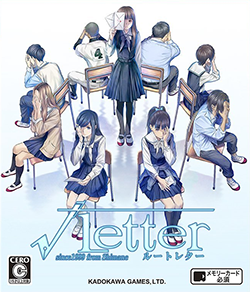

Root Letter is a visual novel detective road trip that starts with a single unsent letter and ends somewhere between nostalgia, suspicion, and too much polite small-town gossip. Developed and published by Kadokawa Games (with PQube handling worldwide publishing), it first saw daylight in Japan in mid-2016 and then politely crossed the ocean to Europe and North America later that year. You play a quiet protagonist who flies to Matsue in Shimane Prefecture to track down Fumino Aya, a pen pal from high school who apparently went full Houdini about 15 years ago. The premise sounds like the start of a tender coming-of-age story. The game mostly delivers a paper trail of memories, choices, and interrogations instead of a high-speed chase. For those who like their mysteries served politely with a side of stationery, it mostly hits the mark.
Root Letter divides itself clearly into two modes: the investigative adventure sections and the letter-simulation sections. In practice, this means you walk around, ask questions, and interrogate (in the most Japanese of ways - softly, with lots of uncomfortable pauses) the people who knew Aya. These conversations are where the plot moves forward and where the game lets you feel like a detective instead of a very concerned tourist. The other half is dedicated to reading and choosing the contents of letters Aya supposedly wrote. The player is asked to make out-of-universe choices about letter contents, which then ripple forward into dialog and outcomes later in the game. Those choices matter because Root Letter has multiple endings; your polite probing and editorial decisions about bygone stationery ultimately decide whether you solve the mystery or get one of the sadder epilogues. This structure gives the game a replayable core: change a line, get a different answer, watch a different person twitch slightly when you finally ask the obvious question. There's also an example of Max mode in the game - a presentation toggle that emphasizes particular lines of questioning during interviews. You'll be shown screenshots in menus explaining how it works, which is useful, because the rest of the time Root Letter assumes you, the player, will know to read every sigh and ellipsis like it contains vital clues. The detective work is more conversational than forensic. If you wanted fingerprints and exploding evidence, you chose the wrong letterbox. From a design perspective the game is refreshingly focused. You won't be juggling inventory or solving environmental puzzles: you collect statements, compare them, and press the conversational screws where necessary. Narrative fans will appreciate the moments when a single choice opens a whole branch. The trade-off is that the manipulative mechanics are simple. Choices feel meaningful, yes, but the toolkit for discovery is limited. That's deliberate: Kadokawa wanted an investigation that leaned on dialogue rather than mechanics, and the result largely works. If you're wondering why the PlayStation Vita crowd seemed to love this more than PS4 owners, the Metacritic scores explain some of it: the Vita's reviews landed around 78/100 while the PS4 version lingered at about 68/100. Part of the split is atmosphere. Root Letter's intimate, letter-by-letter storytelling sits better on a handheld you can cradle on the bus, not a living-room TV where every soft line of dialogue asks for a quieter audience. That said, the PS4 edition is functionally identical in content to its portable counterpart, so this is less a fault and more a matter of reading environment - the game expects you to lean in, not lean back. Once you accept the constraints, Root Letter has satisfying pacing. The game copes with branching endings by folding them into additional short scenarios, and the later 'Last Answer' revamp tacked on new content that plays after various endings - plus a live-action option for people who wanted to watch real actors politely stare at each other instead of illustrated ones. If you like digging through "what she meant" instead of breaking down "what actually happened," the gameplay loop is reliable, occasionally tense, and often quietly rewarding.
The original artwork is by Mino Taro, known for work on Konami's LovePlus series, so the character designs have that clean, familiar anime look: tasteful hair, expressive eyes, and a tendency to convey a lot of backstory with a single melancholic glance. The animated presentation is conservative rather than flashy - the game's strength isn't in flashy polish, it's in clear faces and readable expressions. For those who enjoy novelty, Root Letter: Last Answer offers a live-action makeover, allowing players to switch between animated and real photographic/live-action scenes. This is a neat trick to spice up dialogue-heavy sequences without rewriting the script. On PS4 the photos and live-action sequences are a bit of a showpiece - more of a cinematic curiosity than a revolution in storytelling - but they do add texture. Max mode and its visual cues help guide attention during critical moments, though on a large TV some of Root Letter's subtler expressions can feel slightly underwhelming compared to the intimacy of a handheld screen. There's nothing technically wrong with the visuals, but they are not on the bleeding edge. The art serves the narrative and remains consistent. If you're buying Root Letter on PS4 expecting a graphical showcase, you will be disappointed; if you want readable character art and occasionally striking photographic stills, you'll be fine.
Root Letter is a modest, polite mystery that prefers envelopes to explosions. On PlayStation 4 it occasionally struggles to justify its couch-sized presentation, which helps explain why critics and players tended to favor the Vita for this particular title. Still, the writing - supported by a stable of experienced staff such as producer Akari Uchida and artist Mino Taro - keeps you invested through slow reveals, meaningful choices, and enough branching to make a second or third run feel worthwhile. If you enjoy talky, choice-driven mysteries with an emphasis on reading people rather than scanning rooms, Root Letter is a good, if not perfect, pick. For those who need their detective work served with more velocity or visual fireworks, look elsewhere. My final verdict: a solid 6.8 out of 10. It won't break your heart, but it will definitely make you reread your old messages with a little more suspicion - which, frankly, is probably healthier anyway.
 Crossword on PS2
 Root Letter: Last Answer on Switch
 Tintin: Destination Adventure on PlayStation
 One Piece Grand Adventure on PS2
 Taiko no Tatsujin: Don to Katsu no Jikū Daibōken on Switch
 Taiko no Tatsujin: Dokodon! Mystery Adventure on Switch
 Root Film on PS4
 God Wars: Future Past on PS4
 Root Film on Switch
 Demon Gaze Extra on PS4










 Another SquareThought Site