

 Nov 2020
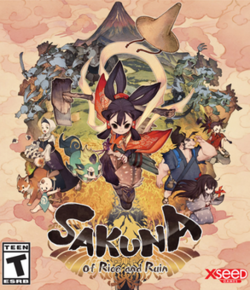

Sakuna: Of Rice and Ruin is the kind of game that will politely ask you to slaughter demons and then hand you a hoe and a very long to-do list about compost. Developed by Edelweiss - a tiny team with suspiciously large ambitions - Sakuna mixes side-scrolling, 2.5D hack-and-slash action with an obsessively detailed rice-farming simulator. On PS4 it arrives like a well-presented lunchbox: pretty, earnest, and occasionally stubborn about how it wants you to eat it. You play as Princess Sakuna, a spoiled harvest goddess exiled to an island of demons and chores. The plot supplies enough personality to make the supporting humans feel like people rather than menu items: Tauemon the samurai who gives farming advice, Kinta the blacksmith apprentice, Myrthe the cook/doctor, and an assortment of kappas and animals who will grudgingly help you pull weeds. The game expects you to care about both the demons you stab and the paddies you till, and it trusts you enough to make both systems meaningful. If that sounds like emotional whiplash, welcome to Sakuna's island. It will change you, or at least your crop yields.
Sakuna splits its time between two very different, but very civilized, activities: murdering things for loot in side-scrolling stages and performing a bizarrely satisfying series of rice-related minigames back at the farm. The stages are built on a 2.5D plane - platforming, grappling with Sakuna's divine raiment (her magic sash), and combat that rewards timing and positioning rather than flailing. Enemies get meaner at night, which the game communicates by increasing the number of ways you can get kicked in the teeth. Combat is smart rather than showy. Sakuna uses farming tools as weapons, swaps stances and skills, and can zip around the environment with that sash to reach ledges or pull off crowd-control moves. There's a lovely tactile feel to landing a combo and finishing with a heavy strike that clears a pack of demon rabbits. You gather resources in the field - plants, critters, demon parts - and those things matter. Ingredients go into cooking, materials go to crafting, and both feed back into your ability to fight and farm better. The rice simulation turns out to be the headline act. Edelweiss spent years researching actual rice farming; one of the artists even grew rice on his balcony. In practice that means rice is not a single harvest number but a multi-step cycle across seasons (a season is three in-game days) that includes tilling, planting seedlings, fertilizing, managing water, weeding, harvesting and hulling. Each step is handled by a minigame that starts off modest and becomes speedier and more nuanced as Sakuna learns techniques. Better care yields higher-quality rice, and high-quality rice permanently boosts Sakuna's stats. Yes, you will cry when a season's worth of work yields only mediocre grains because you forgot to check the water level. You will also feel quietly heroic when you produce a perfect harvest and watch your attack numbers creep up. Meals are not just fluff. Sitting down for dinner with your little human crew restores health and stamina and grants temporary buffs depending on the recipe. Cooking requires real ingredients, which gives you a reason to explore the island and fight demons beyond arbitrary XP. You can also delegate tasks: humans or kappas will help with the rice for convenience, but they're less competent than you. Performing the minigames manually unlocks skills that improve efficiency. So there's strategy in deciding whether to outsource a job or grind it yourself until your fingers have rice-shaped calluses. Beyond farming and fighting, the game encourages base-building in a low-key way: forge for Kinta, weaving hut for Yui, animal pens and a waterwheel. These all feel earned rather than boxed as "build this to unlock a feature." Side quests reveal character backstories and occasionally tug at a heartstring. The story runs a dependable arc: Sakuna matures, friendships form, betrayals happen (Kokorowa's jealousy is a narrative highlight), terrible gods return, and a dragon god named Omizuchi demands a proper beating. The stakes are appropriately mythic, and the game balances them with mundane chores so your emotional highs are punctuated by fertilizer lows.
Sakuna looks like an illustrated scroll that learned how to move. The character art is lush and anime-inflected - credit to artist Ryota Murayama - and the environments are lovingly researched, pulling visual cues from Kyoto and Shirakawa-go to make the hamlet and rice terraces feel lived-in. The 2.5D combat stages are layered and atmospheric: volcanic passes, ruined temples, and rice fields all have personality. Animations are crisp, combat effects pop without being gaudy, and the cooking/dinner sequences are small scenes of domestic warmth. On PS4 the game mostly runs smoothly and maintains consistent visual fidelity. It's not a technical showpiece - this never pretends to be a photorealism demo - but the aesthetic choices work in its favor. The soundtrack by Hiroyuki Oshima is pleasant and fitting: energetic when it needs to be, cozy at the dinner table. If you want shiny polygons for their own sake, Sakuna won't satisfy; if you want a world that looks like someone sketched it on a scroll and then gave it a pulse, this will.
Sakuna: Of Rice and Ruin is an odd, quietly confident hybrid. It asks you to care about plants and people in equal measure and rewards patience with meaningful progression and surprisingly effective emotional beats. Combat won't fool action fans looking for AAA flash, but it's satisfying and pairs well with the farming loop. The rice minigames are the star attraction, turning a routine into a ritual that impacts the rest of the game. On PS4 this combination of domestic simulation and demon-stomping works better than it should, largely because the developers actually did the homework. There are a few rough edges: the pacing can drag when the story needs momentum, and delegating work sometimes feels like choosing the easy way out rather than an interesting trade-off. Reception was broadly favorable (PS4 Metacritic around the high 70s) and the game found a healthy audience - more than a million copies sold by mid-2021 - which suggests people like the hoedown as much as the hoedown likes them. If you enjoy methodical progression, tasteful art direction, and the siren call of perfect rice, Sakuna is worth the time. If you prefer your action nonstop and your agriculture abstracted into an inventory screen, this one will make you feel judged by a goddess who also happens to be very good with a sickle. Score: 8/10.
 Gaelic Football '25 on Xbox Series X/S
 Together! The Battle Cats on Switch
 Crash Bandicoot: The Wrath of Cortex on PS2
 Combat Elite: WWII Paratroopers on PS2
 Onimusha: Dawn of Dreams on PS2
 Disney's Chicken Little: Ace in Action on PS2
 Action Man: Operation Extreme on PlayStation
 Astebreed on PS4










 Another SquareThought Site