

 Dec 2019
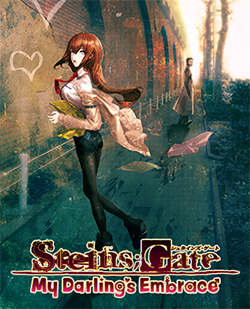

Steins;Gate: My Darling's Embrace is the spin-off romance visual novel that treats the original's time-bending soap opera like an alternate-universe rom-com. It swaps existential dread and conspiracy board meetings for rom-com beats and awkward, earnest flirting, placing Rintaro Okabe in a worldline where SERN's tentacles are dormant, the lab's greatest crisis is paying the electricity bill, and the only time travel headaches come with heart emojis. Released worldwide on PS4 (December 10, 2019) after a staggered debut on various platforms, the fan-disc approach here is deliberate: this isn't a sequel trying to blow your mind; it's a long, affectionate hug for fans who want to sit in the Future Gadget Laboratory, drink terrible tea, and learn what makes each member tick when all the world-ending stakes are taken off the table.
Beneath the fluffy premise, My Darling's Embrace plays like a textbook visual novel with a few modern touches. The core loop is reading, occasionally choosing dialogue paths, and interacting with Okabe's phone - the latter being the game's most playful mechanic. Choosing whether to answer calls, and tapping highlighted words in text messages, nudges you down different romantic routes. There are no dead ends, no 'game over' bronze sculptures of regret; the design is intentionally forgiving, so the focus stays squarely on conversations and character beats rather than punishment for a wrong text reply. Mechanically, if you've played visual novels before you'll feel at home; if not, consider this a gentle introduction optimized to showcase people, not puzzles. Where the gameplay earns its keep is in how it scaffolds character work. Each route functions as a small character study: the choices shape tone and intimacy rather than altering grand plot points. Okabe's own arc is subtle and oddly charming - a mad scientist who, in this timeline, moonlights as a waiter to cover lab expenses. That slice-of-life setup reframes his performative 'Hououin Kyouma' persona: without death-or-despair as a coping mechanism, we watch him rehearse bravado to impress friends and lovers, and occasionally be sincere without the need to save the world. The transformation is less about dramatic redemption and more about small, cumulative revelations. Kurisu's route leans on sharp banter and intellectual intimacy. The chemistry that made her chemistry with Okabe crackle in the main game here becomes warmth and mutual teasing. The scenes where they trade theories about everything from neuroscience to latte art reveal a side of Kurisu that is content rather than obsessive - a softer intellectualism. Luka's route is one of the more interesting tonal experiments: labeled in the source material as an otokonoko route, it upends player expectations by exploring gender presentation with humor and tenderness. The effect is to humanize Luka beyond a catchphrase or comedic relief, making their route a study in identity and unforced acceptance. Moeka's route is perhaps the most narratively surprising. If your memory of Moeka from the original Steins;Gate is a quiet, single-minded presence with an unsettling dependency on the gadget-laden world, My Darling's Embrace intentionally reframes her. The game invites the player to reconsider preconceptions, shifting Moeka from a puzzle-box character into someone whose silences and small gestures acquire weight and context. The result is not a dramatic rehabilitation so much as a reintroduction - you meet Moeka again, but this time with a chance to explore layers that were previously obscured by darker plot needs. Because the writing team here differs from the original (Tatsuya Matsubara supervised while other writers explored the world), the routes feel like fan-fiction with editorial discipline: respectful to canon, but unafraid to place characters in sitcom situations to reveal unseen facets. This is both the game's strength and its limitation. For players craving emotional whiplash or high-stakes resolution, the tone's safety valve might be unsatisfying. For those who want richer interiority and playful role-reversals, it's a delight.
Art and presentation are standout features. The game benefits from polished character portraits and expressive CGs that highlight small emotional beats - a raised eyebrow, a blush that lingers a beat too long, a hand that almost reaches another's. Kotaku called the art excellent, and that praise is deserved: the artists do a lot with line weight and color to sell emotional nuance. The UI cleverly foregrounds the phone interactions, which makes the whole experience feel like living inside social-media-adjacent conversations rather than a dry block of text. The soundtrack and opening theme are more divisive. Some players will find 'La*La*La Labolution' aggressively bubblegum; others will wear it as a badge of lovingly corny fandom. A notable critic at RPGFan described the opening choir as 'wretched' for its nasal, saccharine delivery - which sums up how the game's aesthetic choices can flirt with the overly cute. Fortunately, the in-game score by Takeshi Abo provides decent emotional anchoring, and the visual polish often outweighs any cringe left by the opener. Technically the PS4 port reproduces the original assets faithfully, and Famitsu's awards (Gold for the Vita version) suggest the experience translated well across hardware. If you're particular about animation density or flashy 3D, temper expectations: this is a visual novel built on artwork and dialogue, not polygonal fireworks.
My Darling's Embrace is not an attempt to compete with the existential punch of the original Steins;Gate - which is exactly why it works. It retools the franchise into a character-first romantic comedy that lets you live in the lab's quieter, goofier moments while still delivering meaningful slices of emotional development. The writing, under Tatsuya Matsubara's supervision, gives new writers room to explore established personalities in fresh ways; the result is a compilation of affectionate character studies. Luka and Moeka's routes are the most intriguing experiments, with Luka challenging gendered expectations and Moeka inviting a reassessment of a previously cryptic presence. Kurisu's route rewards fans who enjoy the duo's trademark banter but with softer stakes, and Okabe's arc - from dramatist savior to flustered waiter with a heart - ties the collection together with gentle humor. If you want high drama, conspiracies, or world-shattering twists, look elsewhere. If you want to spend hours in extended, well-written character moments, learning what happens when the lab turns down the doomsday clock and turns up the romance, My Darling's Embrace is a warm, frequently funny detour. The reception (Metacritic ~73, positive Famitsu reviews) reflects that middle ground: well-made, artful, sometimes saccharine, and ultimately rewarding for the kind of player who came to Steins;Gate for the people, not just the plot. For PS4 owners who loved the cast and wanted longer conversations rather than more catastrophes, this is a strong, recommended detour - a rom-com for time-travel nerds that prefers heart over hazard.
 Steins;Gate 0 on PS4
 Robotics;Notes Dash on PS4
 Root Film on PS4
 Tokimeki Memorial Drama Series Vol. 3 Tabidachi no Uta on PlayStation
 DearS on PS2
 Oshiete! Popotan on PS2
 Robotics;Notes on PS3
 Memories Off 6: Next Relation on PS2
 Robotics;Notes Elite on PS4










 Another SquareThought Site