

 Aug 2020
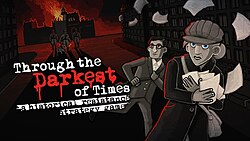

There are games that exist to amuse and games that exist to impress. Through the Darkest of Times is not interested in either goal in the conventional sense. It arrives instead with the solemnity of a newspaper editorial and the economy of a pocket history book, asking the player to shepherd a ragged resistance cell through the ashes of the Third Reich from 1933 to 1945. Paintbucket Games set out on a three-year labour of love - led by Jörg Friedrich and Sebastian Schulz - and what they deliver for the PS4 is a compact, austere experience that reads more like interactive non-fiction than a conventional strategy title. This is a game that wears its seriousness on its sleeve and, in doing so, invites comparison to the likes of This War of Mine and Papers, Please, but it insists on its own terms: moral tension over mechanical complexity, atmosphere over spectacle.
Through the Darkest of Times is a single-player strategy game built around weekly turns, four chapters, and the hairline decisions that separate survival from arrest. You begin in 1933 as a randomized resistance leader - your name, past and attributes are drawn from a hat - and for the next handful of years you assign members to missions that range from distributing leaflets and painting anti-Nazi slogans to sabotaging equipment. Each week is a turn, each mission is a gamble. The game keeps track of supplies, supporters and morale, and the risks you take are measured in chances of failure, suspicion, arrest by the Gestapo or, in the worst outcomes, death. There are a few neat systemic ideas at play. Members carry traits and backgrounds that make certain tasks easier or fraught: an extrovert is better at recruiting, a skilled worker might be your man for a sabotage run. Some missions require items, others require prerequisite actions; larger goals are broken into multiple steps so a long-term operation feels earned. Historically-styled newspaper clippings - introductions to each turn - are a nice touch, conjuring the atmosphere of the era and periodically reminding the player that the game occupies a strict historical frame. Dialogue scenes and short vignettes between turns aim to humanize the cast and to present the moral contexts of resistance. This is also where the game stumbles. Strategy-minded players accustomed to deep resource webs and branching tech trees will find the systems skeletal. Choices rarely alter the broad historical trajectory: you do not change the outcome of major events, you only nudge the fortunes of characters within the framework the designers prescribe. Critics often noted the disappointment here: the storytelling is tight and well-paced, but the strategy feels thin and the interludes do not always register as meaningful consequences of your tactical decisions. Replay value is limited because runs tend to follow similar rhythms, and the randomized leader details only partially mask the repetition. In short: the game trades complexity for a streamlined, almost literary approach to resistance, and whether that trade-off satisfies you depends on what you bring to the controller.
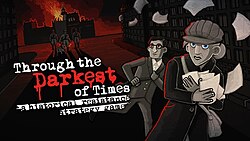
The aesthetic is the game's most distinctive flourish. Paintbucket Games explicitly draws from 1920s German expressionism, and the results are a catalogue of angular silhouettes, stark contrasts and deliberately claustrophobic compositions. Animations are economical rather than showy; characters move like figures in a woodcut, and the palette favors ink-and-shadow over photoreal colour. Some reviewers found the visuals unsettling in a productive way - a mood that complements the anxious, strained world of clandestine activism - while others sniffed that it looks like the fever-dream of a nightmarish cartoonist. On PS4 the art style scales comfortably: the lack of flashy effects feels intentional rather than budgetary. If your affection for visuals is rooted in atmosphere and period evocation, the game's design will feel like a familiar cigarette smoke and a scratched vinyl record. If you crave lush, modern graphical bravura, this will never be the machine to sate that appetite.
Through the Darkest of Times is an honest, sometimes stark experiment in how games can engage with history and moral choice. It succeeds admirably as a mood piece and as a concentrated act of remembrance: newspapers with scrupulous historical detail, tense little missions and a visual language that refuses to be prettified. Those strengths, however, sit beside real limitations. Strategy is deliberately simple, choices rarely rewrite history in any substantive way, and after a few runs the repetition begins to nibble at the experience. The game's place in German publishing history - the first domestic title permitted to depict Nazi symbols after the USK relaxed its rules - adds an extra layer of importance to its release and the debate it ignited, but it does not change how the mechanics play. I recommend this to players who want to feel the texture of resistance rather than to master a complex simulation. For those who want a tight narrative with ethical weight and a memorable art direction, Through the Darkest of Times will offer rewards. For the strategist expecting a deep, branching campaign or a sandbox of anti-fascist guerrilla warfare, the game will feel more like a carefully argued essay than a sprawling toolkit. It is commendable and often moving, and for that I award it a solid 7 out of 10 - a title that earns respect even as it refuses to be everybody's idea of a great time.
 Tokyo Dark: Remembrance on Switch
 Hydrophobia Prophecy on PS3
 UFO: A Day in the Life on PlayStation
 Nobunaga no Yabou Online: Haten no Shou on PS2
 Planets Under Attack on PS3
 Nobunaga's Ambition: Iron Triangle on PS2
 Triangle Strategy on Switch










 Another SquareThought Site