

 Jun 2025
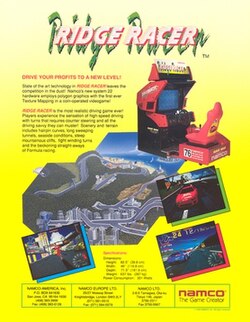

Ridge Racer arrived in arcades in 1993 like a neon-lit, turbocharged manifesto: texture-mapped polygons, techno that sounded like speed given a soundtrack, and drifting as a lifestyle choice rather than a handling quirk. Arcade Archives 2: Ridge Racer on PS5 is Hamster Corporation's respectful museum-piece re-release of that very game - the one that helped sell the idea that 3D in video games didn't have to look like a handful of Legos thrown at the screen. If you come to this version expecting modern conveniences like matchmaking, crossplay, or a teardown of why your opponent rammed you into a wall on purpose, you will leave with the same feeling as any arcade visit in the '90s: exhilarated, slightly short-changed, and convinced the soundtrack is the real winner.
The core loop is gloriously simple and stubbornly old-school. You pick a car (many cheekily named after other Namco IPs), a transmission (automatic or six-speed manual - the manual makes you feel like a competent adult for about five seconds), a song, and then you are dumped onto one circuit presented in multiple configurations: Novice, Intermediate, Advanced and Time Trial. The arcade pedigree is obvious in every design choice: collisions don't wreck your ride, they just punish your ego by stealing speed. There's a time limit. You pass checkpoints. You either reach the finish in time or you learn the existential lesson of running out the clock in spectacular fashion. Drifting is not an optional flourish but the game's raison d'être. Namco's team took the contemporary Japanese mountain-road racing trend and put it in the middle of the arcade; the result is a racer that rewards controlled slides more than line-perfect braking. Opponents - eleven of them in standard races, with a barely believable one-car boss scenario in Time Trial - follow predictable waypoints rather than improvise like sentient racers. That means the thrill comes from mastering corners and your own throttle foot, not outsmarting a cunning AI. Critics at the time noted the restricted AI, and the criticism still holds: once you've learned the rhythm of the track, beating the CPU is a matter of execution, not strategy. The original arcade cabinet had a few theatrical touches: Full Scale units put you in a real Eunos Roadster with wind, gauges, and a ten-foot projection for maximum ego. Hamster's PS5 release doesn't recreate that hardware smell (no arcade operator included), but it does bring the ROM in its original form: first-person arcade perspective, checkpoint-based timer, three-lap races (two on Novice), and that satisfying progression where winning unlocks cars and, in some home versions, mirror modes and secret opponents like the infamous 13th Racing "Devil" car. If you enjoyed the PlayStation port back in the day, remember it ran at half the arcade frame rate (30 fps NTSC, 25 for PAL) and even included a cheeky Galaxian mini-game in loading; the Arcade Archives release returns you to the source - the System 22 arcade logic, textures and tunes - which is exactly what collectors want and what impatient modern players might find a little spare.
Ridge Racer's visuals should be judged by the standards of 1993, because that's the whole point: it was one of the first arcade games to use texture-mapped 3D polygons and Gouraud shading and it genuinely looked like a step into the future. Trees, rocks and roadside scenery felt carefully arranged rather than slapped on as scenery props. When it debuted, publications called it photorealistic; today it reads as a charming, blocky approximation of photorealism - the sort of thing that makes you admire technical ambition and then laugh softly at the polygonal bump in the road. On PS5 the Arcade Archives emulation preserves that hardware-era character: no upscaling frills, no remastered car models, just the original textures and the crisp, arcade-perfect framing that made the cabinet a spectacle. If you want cleaned-up shaders, dynamic lighting, or flares that require a cinematic budget, this isn't for you. If you want the exact grain of the original System 22 presentation and the weight in the steering that comes from design rather than post-processing, you'll appreciate it. The audio, crucially, still bangs - techno and hardcore tracks by Shinji Hosoe, Nobuyoshi Sano and Ayako Saso still perform the job of convincing your brain you are going faster than you are. Edge and other contemporary reviewers praised the dazzling visuals and arcade-perfect music for a reason; the PS5 release keeps both intact.
Arcade Archives 2: Ridge Racer on PS5 is less a modern racing package and more a preservationist's victory lap. It gives you the original Namco arcade experience with the same single-track, checkpoint-driven intensity that made coin-hungry arcades thrive and convinced journalists that texture mapping was the future. You get influential design (the drifting focus that nudged Sega to make Daytona USA "better"), an iconic soundtrack, and a gameplay loop that is tight and unforgiving by choice. You also get what the original reviewers complained about: minimal AI sophistication, no multiplayer in this arcade ROM form, and a single course stretched into variants instead of a continent of tracks. If you love video game history, want to feel the arcade's impatience again, or are curious about the 3D ancestor of modern racers, this is a tidy, faithful package. If you want twenty cars, online leaderboards, or a physics model that rewards being mean to other drivers, look elsewhere. For what it sets out to be - a museum-quality slice of 1993 arcade glamour - it does the job very well. Bring patience, bring throttle control, and maybe, if you are feeling nostalgic, a pocket full of imaginary quarters.
 Street Fighter V: Arcade Edition on PS4
 Oretachi Game Center Zoku: Nekketsu Koukou Dodge Ball Bu on PS2
 Tony Stewart's All-American Racing on PS4
 Roary the Racing Car on DS
 Team Sonic Racing on Switch
 Garfield Kart: Furious Racing on Switch










 Another SquareThought Site