

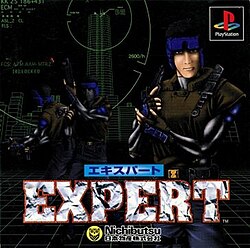

Expert is a PlayStation-only first-person shooter from 1996, made by Nichibutsu and published by Nihon Bussan. It places you, presumably an actual expert, into the surprisingly hazardous business of clearing a government building that has been politely, if illegally, occupied by terrorists. The setting is Tokyo in the near future, which gives you all the reassuring neon and bureaucratic corridors that fuel the dreams of any self-respecting SWAT enthusiast. The game arrived at a time when consoles were still learning how to convincingly make you feel like a human-shaped pixel sweat. Reviews at the time and since have been a contest of opinions where graphics and controls do most of the arguing while the story sits back with a cup of tea and is politely complimented now and then.
You play as a member of EXPERT, a SWAT-like outfit whose job description could be roughly summarized as: 'go in, shoot things, take the elevator.' Before every level you're asked to perform the thrilling ritual of choosing which weapons you'll carry. Choices include the usual suspects - shotguns for when you prefer things loud and close, a grenade launcher for when you prefer things loud and explosive - and the comforting logic that any good shooter requires a small inventory of optimism and ammo. The bottom of the screen houses the HUD: current weapon, remaining ammunition, and your health. It is placed there with the same gentle helpfulness as a note on the fridge reminding you that you are, in fact, still wounded. Levels are corridor-heavy. You'll navigate a chain of rooms and hallways with the goal of reaching an elevator to proceed to the next stage. Welcome to the modern office building of doom. Traps exist, including motion-activated explosives cleverly hidden in walls, which is either a poor architectural choice or an aggressive maintenance policy. Enemies drop health pick-ups and ammo when defeated, which is handy if you like the idea of punishment being rewarded. The game asks you to find key cards for certain doors, rescue hostages, defuse bombs, and occasionally take on more senior terrorist types who will no doubt have more aggressive use of cover and a better dental plan. Some levels change scenery - the parking lot and hotel floors get a shout-out in contemporary reviews - but the strategy rarely deviates beyond 'don't get hit; shoot the hitters.' There is a modest amount of cutscene content, sometimes playing between and during levels, which a retrospective noted is well-drawn and matched by fitting music. The missions try to vary pace and stakes, sliding from hostage rescues to bomb defusals, so there are moments when the tension actually lands. The fundamental loop is straightforward, sometimes to a fault: pick loadout, clear rooms, pick up key, take elevator, repeat. That repetition is the sort of dependable monotony that can be comforting until the frame rate reminds you that comfort has left the building.
If graphics were a courtroom, Expert's visuals would be on trial for contempt of frame rate. Contemporary reviewers complained about low-quality graphics, flickering room textures, and a stuttering framerate that made the game look worse than it probably is. The depth of field was flagged as short by some Famitsu reviewers, meaning enemies could effectively surprise you from across a room like unwanted party guests. Enemy sprites, to give credit where it's due, are reasonably well animated and the cutscene art is notably good; the game occasionally feels like a decent comic squeezed into a struggling 3D engine. Performance issues are the most consistent complaint. When a couple of opponents fill the screen, the controls can feel sluggish while the enemies themselves do not slow their pace; it creates a sensation of being punished by your hardware. Some reviewers were derisive enough to nominate Expert for an award in the 'worst graphics' category. Yet there is charm in the roughness: the pop-in, the jitter, the cinematic attempts during cutscenes - they all convey the earnestness of a title trying to do more than its polygon budget would allow. The net effect is a game that visually underwhelms and occasionally frustrates, but never entirely refuses to show a bit of visual personality.
Expert is the kind of game that will please a niche you didn't know you belonged to: players who enjoy primitive-but-ambitious shooters, like their missions procedural and their frame rate suspicious. It has competent design ideas - weapon selection, mission variety, hostage and bomb objectives - and some well-drawn cutscenes that try to sell atmosphere. The execution is where it falls down: awkward controls, short draw distance, frequent stuttering and flicker, and repetitive level geometry that makes every elevator feel like déjà vu. Contemporary scores were all over the place, from enthusiastic-ish 75/100s in Dengeki PlayStation to a scathing 3/10 in Fun Generation. Modern retrospectives tend to be more forgiving, noting that the game looks worse than it plays. If you are a purist collector of PlayStation oddities or have an appetite for mid-90s console experimentations, Expert is worth a look as an archaeological curiosity. If you expect a silky, modern FPS experience or sensitive strafing that doesn't feel like wading through treacle, this is not the expert you were promised. It is, however, an honest artifact: flawed, occasionally interesting, and stubbornly determined to keep sending you back into elevators.
 Cy Girls on PS2
 Oretachi Game Center Zoku: Trio the Punch on PS2
 Warhammer 40,000: Boltgun 2 on Xbox Series X/S
 PixelJunk Shooter 2 on PS3
 Turok: Dinosaur Hunter on Switch
 Primal Carnage: Extinction on PS4












 Another SquareThought Site