

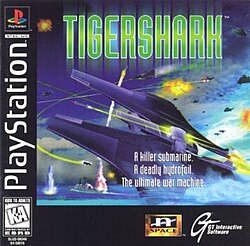

TigerShark arrived in 1997 as n-Space's first outing and pitched itself as a bit of genre mash-up: part submarine sim, part hydrofoil shooter, all 3D cat-and-mouse across the Japanese archipelago. On paper the hook is clean and technical enough to make a sim fan raise an eyebrow - a vessel that toggles between surface hydrofoil and submerged submersible, complete with distinct control sets and weapon behaviors. The execution, predictably, lands somewhere between neat innovation and the era's hardware limits. This review zeroes in on the technical anatomy of TigerShark. I break down the gameplay systems, the control mapping and 3D design that force you to 'think in depth', and the rendering tricks and compromises that give the game its particular late-90s look. Where contemporary reviewers praised the novelty, they also complained about repetition, balance, and the graphical pinch points that made the underwater world feel murky and indistinct. Consider this an engineer's postmortem that still likes to crack a joke or two about square torpedoes.
TigerShark's core mechanical promise is simple and mechanical: you pilot the titular hydrofoil-sub hybrid and constantly toggle between two operational modes - surface and submerged. Surface mode behaves like a high-speed naval craft: higher top speed, surface-optimized weaponry and a handling model that favors lateral movement and dodging. Submerged mode adds true pitch and depth control, essentially elevating the playing field from 2D strafing into a 3D engagement envelope. From a systems-design perspective, that toggle is the game's MVP; it forces the game to manage two distinct sets of physics, collision checks, camera states, and control mappings without the luxury of modern input layers. Controls and player affordances: On PlayStation hardware, the controller mapping is where you feel the compromise. Directional inputs control heading in surface mode and pitch/depth in submerged mode; the same stick has to serve two subtly different locomotion models. That makes for a learning curve that reviewers called 'thinking in 3D' - once you internalize it, movement becomes about vertical positioning as much as lateral threat avoidance. The game expands your toolset with torpedoes, flak, and main guns. Each weapon has situational niches: torpedoes are the heavy-hitters against large ships and fixed installations, main guns provide rapid surface response, and flak attempts anti-air / close-in defense. Weapon switching and aiming while juggling depth is where TigerShark asks the most of the player. Mission structure and progression: The campaign architecture is compact: one training level and nine regular levels. Objectives are typically multi-target: radar arrays, cruisers, gun emplacements and mission-critical installations. Design-wise, this yields a mission checklist model - destroy X radars, sink Y ships, extract before Z timer - which is mechanically clear but thematically repetitive. There are occasional wrinkles: escort assignments, escort defense, and a memorable 'escape a volcanic eruption' sequence, which adds emergent tension via timed environmental hazards. Where TigerShark tries to inject variety, it often relies on enemy density and mission-critical target placement rather than new mechanics. Enemy AI and balance: The technical Achilles' heel in TigerShark is the enemy density and AI aggression. Contemporary reviews described opponents as 'everywhere' and 'practically unstoppable'. From a design perspective this suggests the AI prioritizes engagement over graceful difficulty scaling: spawn density and weapon accuracy stack in ways that punish mistakes heavily. Compounding the problem is an uncompromising checkpoint model: many missions restart from the beginning when you die. That amplifies the perceived unfairness; a tight but balanced AI loop would feel punishing-but-fair, while here it becomes a grind when the enemy 'swarm' behavior overwhelms the player's effective window for tactical decision-making. Multiplayer and modes: TigerShark offers multiplayer on top of single-player missions, which is an interesting inclusion for a primarily simulation-leaning product. On PlayStation, multiplayer is local and focuses on competitive engagements rather than cooperative campaign carryover. Given the game's control complexity and split-mode physics, competitive matches reward mastery of depth transitions and weapon timing more than raw twitch skill. Difficulty curve and pacing: Early missions serve as intentioned tutorials for depth control and weapon prioritization, but difficulty ramps quickly, and the lack of mid-mission checkpoints or conservative enemy scaling means you often replay long segments. That design choice affects pacing: sessions become repetition-heavy, testing patience more than skill refinement. For players invested in mechanical mastery the core toggle and 3D aiming are rewarding; for casual players the repetition and occasional 'unfair' encounters undercut enjoyment.
TigerShark's visuals are textbook late-90s 3D: low polygon models, heavily applied fog and flat shading, and a camera system that prioritizes functional readability over cinematic flourish. The game's sea surface and undersea spaces are presented as distinct visual regimes, but both suffer from limited geometric complexity. Murky depths lack detail and objects often read as 'square' due to low polygon counts - GameSpot's phrasing that 'everything looks square' is blunt but accurate. From a rendering pipeline standpoint, this was a platform-era reality: to maintain a playable framerate on PlayStation's limited geometry throughput, the developers trimmed model budgets and leaned on distance fog to mask popping and LOD transitions. Frame rate and performance: Reviews noted that the game moves 'smoothly enough', which indicates a stable but modest framerate target. On PlayStation this meant the devs were prioritizing consistent timing and input responsiveness over high-fidelity assets. On PC, TigerShark scaled with available hardware: a stock Pentium 133 gave an 'acceptable' framerate but the graphics were merely average. Throwing in a 3Dfx accelerator on PC reportedly made the visuals 'spectacular' by the contemporary standards - that tells you the renderer supported hardware transform/lighting-like benefits or at least benefited from dedicated texture and polygon acceleration. The net effect is that TigerShark's visual quality is heavily dependent on hardware; on the PS1 the compromise is baked in, while the PC could be amped up if you had the right card. Art direction and environment: The environments are functionally readable but not richly detailed. Surface naval engagements are easier to parse thanks to horizon lines and contrast, while underwater scenes use fog and muted palettes which aid performance but blur tactical visibility. This is a double-edged sword: the murk creates atmosphere and justifies limited draw distances, but it also reduces visual feedback when you need to target small installations or dodgy gun emplacements. Particle effects are sparse; explosions are effective as gameplay signifiers rather than visual spectacle. The UI and HUD are utilitarian - instrument readouts and weapon icons are clear but not particularly sophisticated, keeping the player's attention on core mechanical decisions rather than eye candy.
TigerShark is an intriguing technical experiment wrapped in an era-appropriate shell. Its central mechanical ambition - toggling between surface hydrofoil and submerged submersible - is both clever and rare for its time. That design forces the game to juggle two physics and control paradigms and, in that respect, TigerShark succeeds: it makes you think volumetrically in a way many contemporaries did not. However, hardware constraints and design choices blunt the experience. Low-polygon models, murky underwater draw distances and a heavy reliance on enemy density for challenge mean the novelty wears thin when missions loop and checkpoints punish failure by making you redo long stretches. For technical-minded players and historians of 3D-era game design, TigerShark is worth playing to dissect how a small studio implemented dual-mode movement, camera states and weapon behavior on constrained hardware. For those seeking a smoother difficulty curve, more varied mission mechanics, or a prettier undersea, the title can feel repetitive and occasionally unfair. My score sits at 6.5 out of 10 - an honest middle ground that rewards the game's originality and mechanical daring while acknowledging the balance and presentation issues that keep it from greatness. If you like systems that force you to solve spatial puzzles under fire, TigerShark is a competent, if weathered, curiosity; if you want elegant pacing and modern polish, you might prefer to let this tiger nap.
 Combat Elite: WWII Paratroopers on PS2
 Monster Hunter Stories 2: Wings of Ruin on Switch
 Tomb Raider: Underworld on PS3
 Disney/Pixar's Toy Story 3 on DS
 James Bond 007: Blood Stone on DS
 Marvel: Ultimate Alliance 2 on PS2
 Duke Nukem: Time to Kill on PlayStation
 Rugrats: Search for Reptar on PlayStation












 Another SquareThought Site