

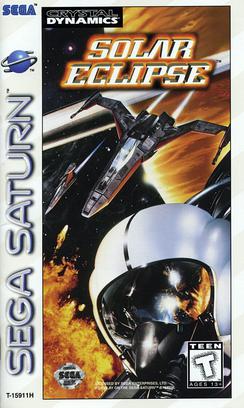

Titan Wars (released as Solar Eclipse in North America) is the sort of mid-90s space shooter that wears its pedigree like a battered flight jacket - confident, a little theatrical, and oddly proud of the smoke stains. Built by Crystal Dynamics in a brisk 16 months, the PlayStation outing blends on-rails spectacle with a surprising allowance for player movement. If you remember shooters that make you feel like you're inside a sci‑fi rollercoaster while still expecting you to aim like a caffeinated hawk, this is that game. The important thing to know for would‑be pilots: Titan Wars is less about blasting everything until it explodes and more about surviving a choreographed barrage. The challenge isn't merely the enemy count; it's the choreography of avoidance, route knowledge, and split-second decision making that keeps the pressure real.
The core loop of Titan Wars is a hybrid dance between being told where to go and being trusted to survive once you're there. The game locks your general flight direction - you're on rails, following large scripted paths - but gives you a generous maneuvering envelope within that path and, at certain forks, the agency to pick a route. That's a deceptively clever design choice if your brain likes the idea of half control and half panic. The result is a rhythm game for people who prefer explosions to maracas: you learn the beat (where enemies spawn, when turrets fire), then you improvise just enough to avoid stepping on anyone's toes. Challenge in Titan Wars is layered. The first layer is raw reflexes. Enemies and environmental hazards appear rapidly, and missions punish hesitancy. You can't just button‑mash your way through; the game rewards players who can keep their thumbs cool while the screen looks like a fireworks convention. Reflexes are the clean, fast-paced skill here - dodge left, roll, thrust forward, and simultaneously pepper targets without becoming space confetti. The second layer is spatial awareness inside a constrained playground. Since you can't fly everywhere, you must master the available lateral and vertical room. Enemies will funnel you, force you near hazards, or create crossfires that demand both micro-movement and macro planning. Imagine being herded through a canyon while being politely asked by a squadron of lasers to reconsider your life choices. Your job: not die. The maneuvering window forces you to make tradeoffs between offense and defense - hold a strafing run to finish a boss turret, or duck behind cover and let it live to fire another salvo? Third is route memory and decision-making. At several junctions the game offers multiple routes; these aren't aesthetic choices. Picking a path becomes an early form of meta-strategy: one corridor might be heavier on enemies but offer more power-ups, another might be safer but longer, and another might push you into a deadly environmental gauntlet. Learning which route matches your playstyle - aggressive, cautious, or reckless-but-determined - adds replay value and a deliberate sense of mastery. On repeat plays you begin to memorize where the ambushes are, which means Titan Wars rewards pattern recognition the same way a speedrun rewards memorizing splits. Fourth: situational strategy and resourcefulness. While the documentation available on the game's systems is lean, contemporary reviews praised the "considerable strategy required to elude enemy fire," which essentially means you will be juggling threat prioritization constantly. Which enemy is the laser you must avoid, and which is the one you can ignore because it explodes into three nastier ones? Sometimes the obvious target is bait. Read the battlefield like a slightly paranoid gambler. The game's partially on-rails nature is double-edged in terms of difficulty. On one hand, it creates cinematic, intense set pieces where timing is everything - dodge a sweeping laser, weave through debris, then dash for the next safe pocket. On the other hand, it limits the creative escape options a fully free-flight sim would grant; you can't always climb over a problem or loop around. That constraint makes the game more of a pattern-learning exercise than an open playground. If your idea of fun is improvising wildly, Titan Wars will sometimes make you simulate improvisation by learning the choreography and executing the same perfect run repeatedly. Expect repetitions. Critics from the era noted the environments and enemies can become a touch repetitious, and that's part of how the game delivers challenge: repetition is the classroom where you learn to survive. Maps, waves, and enemy types reoccur with variations, and mastering them is necessary because the game progressively layers difficulty rather than introducing radically new mechanics every level. For players who enjoy incremental learning curves and the satisfaction of shaving seconds (or lives) off a run, that is a feature. For players who demand constant novelty, it will feel like the galactic version of a bus route. Skills the game trains and tests most: precise timing, acute pattern recognition, route prediction, prioritization of threats, and the cold, efficient calm of someone who knows that panicking will only make the level start over. It's a single-player title that effectively mutates your reflexes into muscle memory, and then rewards you ruthlessly for it. If you go in thinking Titan Wars is a mindless spectacle, be prepared to be schooled by finely tuned enemy patterns and the occasional environmental ambush. Conversely, if you enjoy learning an attractively unforgiving rhythm and beating it, this game scratches an oddly satisfying itch.
For a mid-90s PlayStation title, Titan Wars shows why Crystal Dynamics had a reputation for making things look slick even when polygon counts were having identity crises. Contemporary reviews praised the "solid graphics," and they still hold up as loud and clear examples of era-appropriate visual design: chunky geometry, dramatic lighting, and stages that frame set-piece moments like an action director stroking a beard. The on-rails sections allow the game to stage visual spectacles - sweeping vistas, tunnel chases, and large-scale enemy formations - that mask the technical limits and make the environments feel bigger than their polygons might suggest. Repetition in landscape design was a valid critique, though. Because the game reuses visual themes and enemy models across levels, the first few runs feel cinematic and varied, but prolonged exposure reveals the engine's shortcuts. That said, repetition serves gameplay: familiar vistas become landmarks for timing dodges and planning where to be when the next wave spawns. For players focused on the challenge, the graphics do their job: they provide readable cues for action rather than getting in the way. There's also a certain nostalgic charm to the way explosions and particle effects insist on being dramatic even if the hardware is politely asking them to calm down. If you're picky about frame rates and anti-aliasing, you'll notice that this isn't a modern smooth-as-butter shooter. It wears the technical artifacts of its era like badges of honor. If you care more about visual storytelling during a chaotic run - the sense of speed, the feel of a corridor closing in, the menace of a massive turret mounting its next salvo - Titan Wars delivers those moods admirably.
Titan Wars on PlayStation is a charmingly old-school assault on your reflexes and patience. It isn't perfect: the partially on-rails design and repeated visual motifs limit exploration and novelty, and some players will bristle at the scarcity of off-script freedom. The tradeoff is that the game doubles down on intense, pattern-driven encounters that reward memorization, split-second decision making, and the kind of strategic instinct that turns 'avoid the laser' into an art form. If you like your shooters as organized chaos - where the environment, enemy placements, and route choices combine into a choreography you have to learn and then execute flawlessly - Titan Wars will keep your thumbs busy and your brain pleasantly taxed. Critics like Electronic Gaming Monthly praised its intensity and strategy, GamePro called it fun despite some repetitiveness, and newspapers of the day handed out middling-to-good scores (a B from The San Francisco Examiner, 3/5 from The Charlotte Observer). Those reactions line up with the game's identity: not a revolution, but a tight, challenging spectacle. Final verdict for the aspiring pilots among you: bring your reflexes, bring a notebook (or a great memory), and prepare to learn the map like a cartographer of explosions. If you invest the time, Titan Wars rewards you with tense, memorable runs where surviving feels as good as victory. Score: 7.5/10 - a solid recommendation for players who enjoy skill-based challenge and don't mind repeating a few corridors to get that perfect run.
 Angry Birds Star Wars on PS3
 Lego Star Wars III: The Clone Wars on PS3
 PixelJunk Shooter 2 on PS3
 Rebel Galaxy Outlaw on Switch
 Pro Evolution Soccer 2015 on PS4
 Mars Horizon on Xbox One
 Lara Croft and the Guardian of Light on PS3
 Legacy of Kain: Soul Reaver on PlayStation
 Perfect Dark on Xbox Series X/S
 The Tomb Raider Trilogy on PS3
 Gex on PlayStation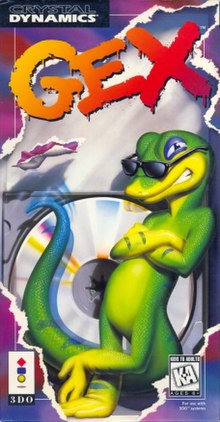












 Another SquareThought Site