

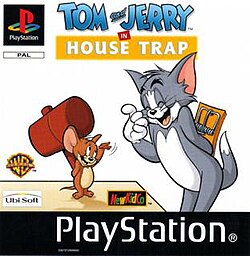

There was a particular kind of optimism in video game magazines of the 1990s whenever a beloved cartoon property landed on a console. You opened the box and hoped for the Saturday-morning magic to translate into interactive fun. Tom and Jerry in House Trap arrives with precisely that pedigree: a Hanna-Barbera-stamped concept, a late-PlayStation release window, and the pragmatic hand of Warthog Games on development. The premise is simple and marketable - re-create the cat-and-mouse warfare by setting traps and scrounging up cartoonish weapons across a domestic battlefield - and for fans of the franchise the idea sells itself before the disc even spins. In practice, the game proves to be a faithful homage to the shorts in decoration and intent, but an oddly timid translation when it comes to play mechanics and lasting appeal. This review will examine what the game gets right (the theme, the multiplayer mood) and what it botches like a cat missing an obvious pounce (the systems and pacing). Expect a review written with the dry, no-nonsense cadence of a '90s console mag - with the occasional wry aside for readers who remember blowing on discs and arguing about reviews in the letters page.
Tom and Jerry in House Trap wears its inspiration on its sleeve. The developers lean into the Spy vs. Spy template: a sandbox-like house where the primary tasks are to set traps, collect props and weapons, and use the environment to best your opponent. The game offers both single-player and multiplayer modes, and across the fifteen areas (each reportedly plucked from or inspired by classic Hanna-Barbera shorts) the core loop is consistent: explore, ambush, and survive. That loop is, regrettably, both the game's charm and its chain. In single-player you face off against AI-controlled opposition (presumably Tom if you play as Jerry, and vice versa in some modes). The satisfaction in the early hours comes from discovering the cartoon arsenals: anvils to drop, mousetraps to deploy, and other slapstick implements that feel straight out of a cel-animated gag reel. The level themes and item designs do a decent job of invoking the franchise; each area feels like a diorama of potential pratfalls and comic violence. If you grew up on the shorts, there's genuine pleasure in recognizing set pieces and seeing them translated into interactive traps. The problem is how thin the underlying mechanics are. The trap placement system is functional but shallow: you pick items up, walk to a predetermined spot, and set them down. There's little in the way of finesse - no physics-based chain reactions, no meaningful risk-reward beyond the immediate satisfaction of watching the enemy trigger yet another canned animation. Enemy AI is serviceable in that it will blunder into traps, but it rarely exhibits the crafty improvisation you'd hope for from a cartoon antagonist. This makes single-player feel like a chore of trial-and-error rather than a tense tug-of-war of wits. Level design swings between brief bursts of cunning design and long stretches of bland corridor-hopping. Some of the fifteen house areas incorporate multiple routes and interactive elements, which allow for creative ambushes; others are oddly linear, recycling the same handful of interactions until the novelty wears off. There is a pacing issue: the game tries to approximate the short-form structure of the cartoons but ends up stretching gags into levels until they feel diluted rather than concentrated. Multiplayer is the game's most defensible feature. Pitting two players against one another in a confined domestic arena captures some of the original cartoons' anarchic fun. When a human opponent is the foil, traps feel mean in the best possible way, improvisation becomes meaningful, and matches can generate real laughs and memorable moments. That said, the multiplayer is hamstrung by limited options - maps are few, match settings are basic, and longevity relies entirely on the players' social chemistry. If you have a friend over with a memory of the old shorts, you'll get a good half-hour out of it. If you were hoping for a deep competitive scene or a suite of modes to sustain solo play, House Trap doesn't deliver. Controls and responsiveness are important in any action title. The game controls adequately for what it asks the player to do; character movement, item pick-up, and trap deployment are all competent, but there's a layer of clunkiness to animations and collision that reminds you this is a PlayStation title from 2000 built on modest ambitions. Moments that should feel crisp and cartoonish instead feel slightly lagged, which dilutes the comedy and undercuts strategic timing. When the whole conceit is timing an anvil-drop to the millisecond, this lack of precision grows increasingly frustrating. Overall, House Trap provides a faithful licensing experience with honest intentions. It gives fans the cheese-and-mousetrap fantasies they expect, but it lacks the mechanical depth and polish to make those fantasies compelling for long. The single-player loop feels like an echo of the cartoons rather than a true reimagining, while multiplayer gives you just enough spark to remind you why the cartoons worked - but not enough substance to carry the package beyond a few laughs.
Graphically the game is a mixed bag that will be familiar to anyone who spent their allowance on late-PlayStation titles. Warthog opts for a style that aims to evoke the cartoon source material rather than realistic interiors, which is the right call. The environments and props are recognizably Tom-and-Jerry: oversized household items become platforms, and the color palettes nod to the simple, high-contrast look of the original shorts. The character models are serviceable caricatures, and the animations lean into acceptable slapstick - when they play out cleanly. Where the visuals stumble is in execution and fidelity. Textures are flat in places, and draw distance limitations show up as pop-in or simplified geometry in larger rooms. Lighting is functional but rarely dramatic; the PlayStation's palette and polygon budgets constrain any attempt at cinematic flair. On the positive side, the art direction-when it sticks to iconic props and exaggerated forms-helps sell the cartoon feel, and weapon animations (anvils falling, spring-loaded surprises) are amusing enough to elicit a grin. The UI and menus are no-nonsense and readable, the sort of thing 1990s readers appreciated in print when credits were scarce and patience even scarcer. Audio and soundtrack fare similarly: they support the mood without standing out. Sound effects are occasionally satisfying - a thunk, a slide whistle, the comedic yelp - but the music and audio design don't leave a lasting impression. Taken together, House Trap looks and sounds like a licensed product that put more effort into faithful representation of set pieces than into technical polish or aesthetic innovation.
Tom and Jerry in House Trap is, at its core, an earnest attempt to bottle cartoon mayhem and pour it into a PlayStation cartridge. The developers understood the franchise's basic ingredients - setups, traps, and escalating slapstick - and they deliver them with a degree of faithfulness that will tickle fans who want to play the roles they remember. However, fidelity to source material is only half the job; the other half is making that material sing as an interactive experience. Here the game is inconsistent. Single-player turns into a repetitive exercise because the systems are shallow and the AI rarely rises to the level of cartoonish cunning that would force players into creative solutions. Multiplayer rescues the package to some extent, offering chaotic, laugh-rich sessions when two humans match wits - but those sessions are short on variety and long-term hooks. The graphical and audio presentation reinforces the cartoon identity but lacks polish, leaving the whole thing feeling like a competent but unambitious licensed title. Critics of the day were unsparing: IGN scored it 4/10, and the Official UK PlayStation Magazine was even harsher. Those numbers are harsh but not entirely unfair. If you're a collector of cartoon-licensed oddities, or you have a roommate who loves creating Rube Goldberg traps with a grin, House Trap has moments of charm. If you're looking for a deep, long-lasting action game to justify another PlayStation purchase, you'll find it thin and forgettable. Final verdict: a nostalgic novelty with sporadic fun, best played in short bursts with a friend who appreciates the absurd. Score: 4 out of 10.
 Gaelic Football '25 on Xbox Series X/S
 Together! The Battle Cats on Switch
 Crash Bandicoot: The Wrath of Cortex on PS2
 Onimusha: Dawn of Dreams on PS2
 Action Man: Operation Extreme on PlayStation
 Door Kickers: Action Squad on Switch
 Combat Elite: WWII Paratroopers on PS2
 Mace Griffin: Bounty Hunter on PS2
 Looney Tunes: Back in Action on PS2












 Another SquareThought Site