

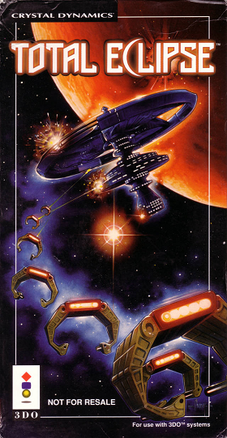

Total Eclipse Turbo is the PlayStation port of Crystal Dynamics' mid-90s space flyer Total Eclipse - a game that dresses up old-school rail-shooter DNA in heightmapped planets and claustrophobic tunnels. If you expect a modern twin-stick ballet, you're in the wrong century; if you expect bite-sized, ultra-precise challenge loops that will repeatedly ask your thumbs whether they are ready to commit to micro-adjustment therapy, then welcome aboard. Released as part of the PlayStation launch window in North America, the Turbo suffix promises speed but mostly delivers the same tightrope of danger the original offered: fixed courses, lethal collisions, stingy shield pickups and a learning curve that doubles as a stamina test. This review zeroes in on the parts of the game that make it feel like a skill gauntlet - the stuff that will either polish your flying chops or convince you to rage-memoir the DualShock into the void.
At its mechanical core Total Eclipse Turbo is a third-person, course-based flyer. You can accelerate, decelerate and strafe - all the ingredients of competent piloting - but you are not given an open sandbox. Each stage is a fixed route across planetary surfaces and through tunnels. That locked path is a designer's not-so-subtle threat: you will have to thread the needle on a script that expects you to be quicker and more accurate than you probably are at first. The game's environments trade space vistas for two very different kinds of hazards: sprawling heightmapped terrain and tight, trap-filled tunnels. Flying over the surface demands spatial judgment: mountains aren't just scenery, they are instant exploding traps if you misjudge your altitude or speed. Tunnels, on the other hand, are the game's anxiety rooms - moving doors, twisty corridors and dead-end entries that will punish sloppy timing. Some tunnels are optional and offer bonuses; others exist only as bait. Missing a tunnel entrance can mean your ship detonates on the terrain like a confused firework, costing a life and teaching you to respect the game's geometry. Resource management is a central skill here. Shields drain not just from enemy fire but from collisions and even the passage of time. Since shield refills are rare, the most reliable way to survive is to dispatch enemies and installations - the game auto-absorbs their energy and converts it into shield replenishment. That design incentivizes aggressive accuracy: you can't just dodge everything and hope for the best; you have to hit targets to stay alive. This creates a tension between evasion and offense that rewards split-second decision making. Bombs offer a safety valve, launching an energy wave that clears large swathes of a stage, but they are finite and their effect is capped by the draw distance. Effective bomb use therefore becomes an exercise in anticipation: when to burn a bomb to avoid a cascade of damage versus when to hoard them for a boss moment. Starting with a single bomb per life and holding up to three means you need to plan your bomb economy like a thriftier, angrier space accountant. Weapon progression is also a test of prioritization. There are five weapon types, each upgradable to three levels by collecting the corresponding pick-ups. Higher levels fire more shots, turning concentrated danger into controlled chaos - but getting and maintaining a high-level weapon requires risk. Grabbing power-ups often places you in harm's way, and since continues are limited (they return you to the start of the current stage), the game discourages reckless farming. Learning the spawn points and ideal paths to snag upgrades without compromising shields is part memory challenge, part adrenaline management. Checkpoint design and the scarcity of continues make memorization a practical survival skill. Lose a life and you restart from a checkpoint; lose continues and the game boots you out. The 20-stage structure, with four stages per planet and a boss at the end of each world (the final world's boss appearing mid-stage), means that consistency beats flashiness. If you want to reach late-game bosses you must develop steady habits: smooth throttle control, conservative risk-taking, and an ability to read enemy attack patterns and environmental cues. Controls are a double-edged sword. Reviews from the era complained that the controls are overly sensitive, and that criticism is valid in the context of the game's demands. Precise, micro-adjusted inputs are required to skim past terrain and pull off aileron rolls for extra points, but the controller response occasionally feels twitchy. That twitchiness raises the skill bar: players who learn to give light, deliberate nudges instead of violent jolts will fare much better. In short, the game demands fine motor control and a thumb discipline regimen that would make a pianist jealous. Lastly, there is the psychological skillset: keeping calm. The game punishes panicked inputs and rewards cool heads. When the screen fills with traps in a tunnel or a boss spams projectiles, the best response is measured correction rather than wild jerking. Developing that zen-like composure is part of the challenge - and part of the satisfaction when you finally clear a stage that previously felt like a personal vendetta from the developers. If you want a checklist of skills Total Eclipse Turbo sharpens: memorization (routes, tunnel entrances), precise thumb control (sensitive steering), resource management (shields, bombs, weapon levels), pattern recognition (enemy/boss behavior), risk assessment (when to grab power-ups or enter optional tunnels), and composure under pressure. Combine those and you have a game that feels like a condensed piloting syllabus with explosions.
When it launched on 3DO, the game was widely praised for its visual look: 3D heightmapped terrain, distinct tunnel interiors and dramatic draw-distance effects all gave stages a sense of scale. Those same visuals made the PlayStation Turbo port look like a competent, slightly aging spectacle rather than a technical showpiece. Graphical design here isn't just for show - terrain readability is crucial because you must interpret mountains and tunnel mouths at speed. Clear contrast between sky, ground and hazard elements helps you react; when the camera or draw distance hides details, the challenge shifts from skill to guesswork. The trade-off is noticeable: the game's draw distance, which defines how far your bomb's wave and upcoming obstacles are visible, actually becomes part of the difficulty. Limited draw means surprises happen, which can be thrilling but also maddening. If you enjoy learning a course's visuals and then performing with near-perfect execution, the graphics serve the challenge well. If you wanted modern clarity and forgiving sightlines, you might feel cheated by the visual limitations that crank up the punishment factor.
Total Eclipse Turbo is less about narrative heroics and more about teaching you how to survive a tiny metallic coffin through sheer piloting competence. Its strengths lie in the way it turns simple mechanics into a layered test of skill: precise movement, aggressive yet calculated offense, smart resource use and memorization. The PlayStation port didn't reinvent the wheel and some decisions (sensitive controls, stingy shield refills, short draw distance) make the learning curve steeper than necessary, but they also create a razor-edged satisfaction when you finally run a perfect stage. If you're chasing nostalgia and want a compact flight-school of frustration and triumph, this Turbo model still delivers. Expect to die a lot, learn faster, and feel oddly proud when you don't. If you prefer your action friendlier or your launch titles to innovate, this is the kind of classic that will make you nostalgic for the 3DO's visuals and impatient with the Turbo moniker. Either way, the game is a tidy, sometimes ruthless skill workout - and for that, it earns its modest 5.6/10: imperfect, occasionally unfair, but undeniably a lesson in how to fly under pressure.
 FlatOut 4: Total Insanity on PS4
 Sniper Ghost Warrior Contracts 2 on PS5
 Pro Evolution Soccer 2015 on PS4
 Rebel Galaxy Outlaw on Switch
 Mars Horizon on Xbox One
 Kerbal Space Program 2 on PS4
 Lara Croft and the Guardian of Light on PS3
 Legacy of Kain: Soul Reaver on PlayStation
 Perfect Dark on Xbox Series X/S
 The Tomb Raider Trilogy on PS3
 Gex on PlayStation












 Another SquareThought Site