

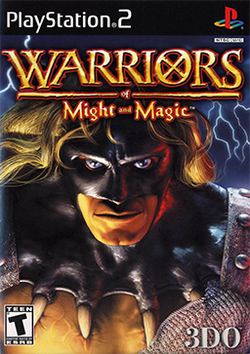

Warriors of Might and Magic is the awkward middle child of the Might and Magic extended family: built by the same house that produced Crusaders, rebranded after a marketing intervention, and shipped to the PlayStation right at the tail end of the console's relevance. You play as Alleron, a necromancy-accused exile forced to wear the Mask of the Accused - a clever narrative device that doubles as an in-game monster magnet. On paper it's an action RPG with sword swings, spells, loot and a canonical wink toward previous Might and Magic lore. Under the hood it's a product of compromise: a team trying to learn from the saga of Crusaders, a marketing team reshaping the vision, and an engine pushed to squeeze 3D fantasy performance out of aging hardware. The result is competent in moments and creaky in others. This review digs into the technical veins - controls, camera, animation, AI, audio and engine choices - to explain why Warriors is fine for a few hours of nostalgia but rarely inspiring beyond that.
Warriors of Might and Magic attempts to sit squarely in the action-RPG lane, trading complex stat juggling for direct melee and spellcasting. Combat is straightforward: button presses map to light and heavy attacks, with context-sensitive moves for ledges and door interactions. From a systems perspective the game favors arcade-friendly metrics over deep simulation. Damage calculation is mostly deterministic and readable, which is good for clarity, but it means build diversity feels thin; weapons alter numbers rather than fundamentally change how encounters play out. Control fidelity is a mixed bag. The developers originally prototyped a first-person perspective and early footage confirms that, but the final PS build is third-person. That history leaves traces: camera priority and player-relative input often behave like a game cobbled between viewpoints. The camera is serviceable in open spaces but struggles in tight corridors and combat clusters, leading to occlusion issues and occasional forced re-aiming. Lock-on systems are minimal; when multiple enemies spawn (a frequent occurence thanks to the Mask of the Accused story-device), hit registration depends heavily on animation windows and hitbox placement rather than smart targeting. Animation blending and hit detection are pragmatic for PlayStation-era constraints. Character rigs use relatively few bones, so transitions rely on frame-by-frame interpolation rather than smooth IK systems you see in later consoles. The consequence is combat animations feel weighty but sometimes twitchy at corners, and attack windows can feel punitive. Colliders are generous in some places and stingy in others; swing arcs will feel fair one moment and entirely out of sync the next, especially against airborne enemies or when the camera is misaligned. Enemy AI is predictable and utilitarian. Pathfinding uses a basic navmesh or waypoint system (hard to confirm publicly but evident in behavior): enemies patrol set routes, aggro when Alleron crosses a proximity threshold and fall into predictable approach vectors. There are no impressive flanking maneuvers or group tactics; most fights resolve into straightforward 'tank-and- DPS' engagements where enemy density is the principal driver of difficulty. That design choice reduces CPU load, which likely helped performance on the PS1, but it also limits emergent combat moments. Level structure balances small hub areas with dungeon runs. The game leans on backtracking in classic action-RPG fashion, with keys, switches and simple puzzles. Streaming and memory management on the PlayStation manifest as small texture pop-ins and occasional loading pauses between larger zones. Checkpointing and save design are conventional and not offensive: frequent enough saves but lacking clever autosave safeguards, so aggressive combat mistakes can cost time. Progression and loot are functional. Items are clearly tiered, and enemy drops encourage exploration. Spellcasting exists but is shallow; spells mostly act as numeric modifiers or crowd-control stopgaps rather than systems you would build a playstyle around. Balancing skews towards keeping the player in the action rather than encouraging meta-level optimization. From a technical design lens Warriors is a lesson in compromise: trimmed systems to keep the game playable on PS1 silicon, plus a few mid-production pivots (marketing-driven perspective changes) that left architectural artifacts in camera and control responsiveness.
Graphically, Warriors of Might and Magic wears its PlayStation pedigree loudly. Character models are low-poly by modern standards, but they are well-constructed for the era: silhouettes readable, armor chunks distinct, and face textures serviceable when viewed at intended camera distance. Texture resolution is predictably low and artists used repeating patterns to save memory. Mipmaps and bilinear filtering are present but limited, so textures can shimmer on camera rotation and look blocky in close-ups. Level geometry is where the PS1's constraints are most visible. Environments are built from modular primitives to minimize draw calls: repeated columns, tiles and wall pieces. This modularity results in efficient culling but also visual repetition across dungeons. Depth sorting and Z-fighting are rare but noticeable in busy scenes; the renderer sometimes struggles with translucency and alpha sorting on particle effects. The lighting model is baked rather than dynamic, relying on precomputed lightmaps for shadowing and local light sprites for torches and spell effects. That choice saves GPU time and keeps framerates steady, but it also flattens scenes and reduces the dramatic punch of spell flares and explosions. Speaking of framerates, Warriors generally holds a playable cadence on PS1 hardware. It isn't a locked 60 fps - more like a consistent 25-30 fps target which is acceptable for the time but contributes to the perception of sluggish inputs during heavy encounters. Particle effects and VFX are economical. Spell and hit effects use sprite sheets and alpha quads; they're readable in combat but lack the layered pseudo-3D depth modern players expect. Sound design is practical: weapon impacts have satisfying thuds, and ambient cues are effective at setting tone. The soundtrack includes a licensed snippet of Sepultura's 'Ratamahatta', which underlines the game's attempt at an edgy audio identity. Audio compression for music and dialogue on the PlayStation is predictable: compressed, looped tracks and limited voice snippets that serve their purpose without being showstoppers. Notable technical footnote: the product's development history mentions a half-finished PC version and that early builds were first-person. Those development pivots appear to have shaped the visual assets and engine choices; some assets feel designed for different camera distances, explaining occasional mismatched LOD transitions and camera clipping.
Warriors of Might and Magic on PlayStation is an honest, technically pragmatic action-RPG. It isn't ambitious in systems design and won't upset the hierarchy of genre classics, but it's competent where it counts: readable combat, clear progression, and a stable engine that respects the PlayStation's limits. The game's production story - marketing-led perspective changes, a scrapped PC port, and a desire to reconcile Might and Magic lore - is visible in the seams: camera compromises, conservative AI and a focus on keeping performance steady over adding complexity. If you approach Warriors as a museum piece - a late-era PS1 title battling hardware ceilings and corporate reshuffling - it's interesting and occasionally satisfying. If you expect a modern-feeling action-RPG with deep build variety and smooth animation systems, you'll be disappointed. The contemporary critical consensus reflected middling aggregate scores (GameRankings ~61% for PS) and reviewer comments that the game was serviceable but not a step up from its troubled predecessor. Ultimately I give it a 6 out of 10: respectable engineering for its constraints, enjoyable in short bursts, but not technically bold enough to be a must-play. Recommended for fans of retro action-RPGs or anyone curious about the technical balancing act of squeezing a 3D fantasy game out of the PlayStation era. For those who enjoy the ending, a direct sequel, Shifters, continues the story on PS2 if you want to see how the next step in the lineage evolved.
 Gaelic Football '25 on Xbox Series X/S
 Together! The Battle Cats on Switch
 Crash Bandicoot: The Wrath of Cortex on PS2
 Onimusha: Dawn of Dreams on PS2
 Disney's Chicken Little: Ace in Action on PS2
 Action Man: Operation Extreme on PlayStation
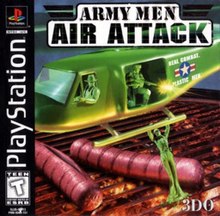
 Army Men: Air Attack on PlayStation
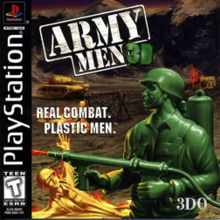
 Army Men 3D on PlayStation
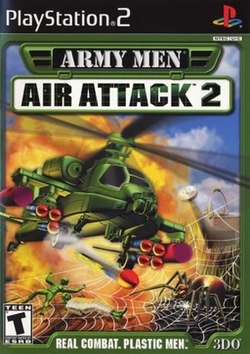
 Army Men: Air Attack 2 on PS2
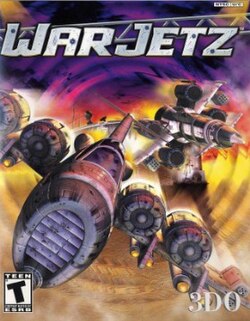
 WarJetz on PlayStation
 Army Men: Sarge's Heroes on PlayStation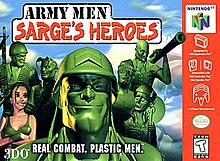












 Another SquareThought Site