

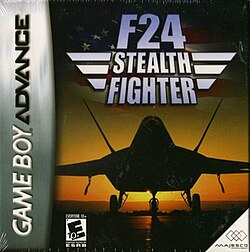

F-24: Stealth Fighter landed on the Nintendo DS in early 2007 as a compact, handheld take on the combat flight sim. It promises the usual mix of carrier operations, air-to-air dogfights and strike missions - twenty of them in the campaign - presented through a first-person cockpit view. On paper the DS version tries to use the system's signature features: dual screens and a lower touchscreen control stick. In practice the experience is a study in how control schemes, interface scale, and visual clarity collectively define whether a flight sim feels precise or simply unplayable. This review looks specifically at the technical choices Skyworks made for the DS port: input mapping, HUD and text legibility, mission structure, and the graphical and performance compromises that shaped critical reception.
F-24 is straightforward in its mechanical scope. You're in an F-24 (a fictional U.S. fighter) flying first-person from the cockpit, tasked with stopping a weapons sale to Iran via a 20-mission campaign. Each mission follows a classic flight-sim loop: take off from a carrier, navigate to objectives, deploy ordnance, and return for a carrier landing. On the DS that loop is implemented with a mix of physical buttons and touchscreen input. Movement and basic pitch/roll/yaw are mapped to the D-pad and combinations with the B button; L and R are repurposed for weapon charge and for looking forward/behind. The DS adds a touchscreen control stick option for players who want analog-like input. From a technical-control perspective the implementation suffers from two main faults: granularity and feedback. The D-pad + button-combo approach forces discrete input steps rather than fluid analog control, which is notable when a game claims to simulate fighter handling. The touchscreen stick is a sensible idea in theory - giving the player proportional input - but in execution the DS's limited touch resolution and the game's sensitivity curves produce 'twitchy' motion. Critics described the controls as "touchy" and "nearly impossible to fly," which aligns with the observed lack of well-tuned input scaling and deadzone configuration. A robust handheld flight sim needs adjustable sensitivity, clearly defined deadzones, and smooth interpolation between input and control surface response; F-24 lacks those refinements. The HUD and cockpit interface compound the control issues. All essential readouts - speed, altitude, radar, weapon status - are crammed into a small cockpit overlay with tiny text and iconography. On a 256x192 pixel top screen, the interface elements are legibility-challenged; reviewers noted "small text" and a "lousy" interface. The practical consequence is that players must divert cognitive resources from flying to deciphering instrument readouts. There is little in the way of scalable UI or zoom-in options, so situational awareness suffers. For a genre where split-second decisions and target identification are crucial, an illegible HUD is more than a nuisance - it breaks the gameplay loop. Mission design shows signs of ambition but limited variety. The set piece of carrier launch/landing bookmarks the missions, but objectives tend to repeat: intercept enemy jets, destroy ground bases, return to carrier. The enemy roster and mission goals are reportedly narrow, which lowers tactical diversity. On the technical side this suggests limited asset and AI variety; enemy behavior appears scripted and interchangeable rather than adaptive, reducing the incentives for nuanced weapon selection or complex maneuvering. Multiplayer is a DS-specific feature worth noting: up to four players can engage in deathmatch-style dogfights. The technical implementation is basic - peer-to-peer local wireless matches with simplified enemy logic and map layouts - but for what it is, it at least uses the DS's strengths. Performance in local multiplayer is stable enough, though the same legibility and control sensitivity issues persist in multiplayer combat, where precision is arguably even more critical.
Graphically F-24 is utilitarian to the point of frustration. The DS version uses a dual-screen layout with the cockpit and forward view on the top screen and supplementary data accessible below. The engine's polygon counts and texture resolutions are conservative, which is understandable given hardware limits, but the rendering choices result in sparse environments and indistinct enemy models. Reviewers labelled the visuals "pain and boring," and the screenshots align with that verdict: low-detail terrain, flat lighting, and pop-in where distant objects appear with little transition. The game's frame pacing is inconsistent; while the DS can handle low-poly scenes well, F-24 sometimes introduces dropped frames or stuttering during object-heavy moments (multiple missiles, explosions, or clusters of AI aircraft). Those performance hiccups harm the player's ability to track targets and assess missile lead. Cockpit fidelity is limited as well. Textures for switches and instruments are small and low-resolution, which, combined with minuscule font usage, creates the earlier-mentioned legibility problem. The radar and targeting symbology are functional but not particularly readable at a glance. A modern handheld flight sim compensates with clear high-contrast symbology or scalable UI elements; F-24 opts for an honest-but-cramped cockpit that expects the player to squint. Audio is not documented extensively in the source, but the overall presentation feels generic. Explosion cues and weapon effects exist, but they don't provide distinct audio signatures that could assist in situational awareness. This removes a helpful layer for identifying threats when the visual channel is noisy or ambiguous. Taken together, the graphical and audio packages are sufficient to convey the game's core ideas, but they lack the clarity and polish required for confident, precise flying.
F-24: Stealth Fighter on the DS is a case study in how small technical compromises multiply. The control mapping - D-pad combos supplemented by a touchscreen stick - is a reasonable concept that fails in the details: sensitivity tuning and UI legibility are undercooked, which turns routine maneuvers into a fight against the interface. Mission variety and AI depth are limited, making the experience feel repetitive and derivative of better flight sims. The graphics and HUD are serviceable but not helpful; low-resolution textures, cramped text and inconsistent frame pacing all subtract from playability. Critics' consensus (Metacritic: ~34%) reflects these core technical weaknesses rather than aesthetic taste. If you're hunting for a handheld flight sim that rewards precision and tactical depth, this one is not it. If you want a DS curiosity with local multiplayer dogfights and twenty quick missions, F-24 might provide a short-lived diversion - but be prepared to wrestle with the controls and squint at the instruments.
 Thief on PS4
 Never Stop Sneakin' on Switch
 Neverway on Switch
 Project Awakening on PS4
 Orphen: Scion of Sorcery on PS2
 Combat Elite: WWII Paratroopers on PS2
 B-17: Fortress in the Sky on DS












 Another SquareThought Site