

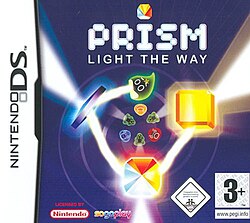

Prism: Light the Way arrives on the Nintendo DS like a tiny, adorable stage-play where everyone is made of glass and desperately needs a hug. On the surface it's a tidy puzzle game about guiding beams of light from emitters into sleepy little targets; underneath it's an ensemble cast of objects with more personality than some licensed platformer mascots. Morpheme Game Studios fashioned a system of characters - the Bulboids, the Glowbos, and a gossiping choir of Gluons (mirrors, T-splitters, filter blocks, prisms, cycloids) - each with a specific existential crisis that only player intervention can resolve. If you came looking for flashy cutscenes or an epic narrative you'll probably be disappointed. If you came for a surprisingly emotional examination of how inanimate items find meaning through reflection, splitting, and occasional color therapy, then get comfortable: this review reads like a postgraduate seminar in object-oriented melodrama.
At its core, Prism is a relationship simulator dressed up as a puzzle game. The Bulboids are the protagonists: dependable, uncomplaining light sources who turn up in the corner of every stage, glowing with the single-minded ambition to make the Glowbos feel whole. Their arc is a classic hero27s journey in miniature - they start as plain white beams, naive and earnest, and with the right guidance they learn to be many colors and to sacrifice continuity for the greater good. Your job, the player, is less "player" and more "therapist/conductor/optical matchmaker." The Glowbos are the heart of each vignette: round, needy nodes that only sleep soundly when bathed in the correct hue. Each puzzle is an episode in which a Glowbo27s needs must be met. Their story arcs are short but satisfying: lonely, then lit, then smug. When you finally coax the exact red, blue, or green into a Glowbo, it doesn27t just light up - it sighs contentedly, effectively delivering the catharsis you didn27t know your tactical brain needed. Gluons are the supporting cast, and this is where the game earns its emotional subtleties. Mirrors are the mentors, stoic and reflective, teaching beams how to change direction without changing their essence. Mirrors27 dual-sided nature becomes a metaphor for self-acceptance: both faces can reflect, neither judges - they simply redirect. T-splitters play the role of dramatic twins or ambitious collaborators, taking one beam and producing two copies; they can feel like overachievers when you need more light in the room, or like reckless opportunists when you27ve accidentally doubled a problem. Filter blocks are identity-changers with an attitude. They turn vanilla white light into specific colors, and watching a beam pass through a filter is like watching a shy intern emerge after a makeover montage. Filters are where your strategy becomes ethical: do you convert a beam to suit a Glowbo, or reroute and preserve raw white light? Prisms are the wise elders - they split a beam into a spectrum, scattering possibilities in three directions at once. They27re generous, perhaps a little theatrical, but reliable in their wisdom. Cycloids cycle through colors like someone who can27t decide what to wear, introducing timing-based puzzles and mood-swing dynamics that keep the narrative from becoming too complacent. Gameplay modes frame these arcs into formats. Puzzle mode is the serialized drama: five acts (15 levels of 8 stages each - 120 puzzles total) where character development is deliberate and measured. Tutorial mode is the gentle origin story, introducing your cast and their basic beats. Time and Hyper modes are the action-packed spinoffs: compressed, intense, and unforgiving, revealing which cast members crumble under pressure. Infinite mode is the indie experimental piece where the characters improvise forever; it27s the game27s equivalent of a midnight coffee-shop reading. Mechanically, the game keeps things accessible without patronizing. You drag and drop Gluons, rotate mirrors, plan splits, and deliberate on color filtration. There27s a scoreboard that records your best times - the modern-day critic27s applause meter - so each solved puzzle not only completes a Glowbo27s arc but also feeds your ego. The DS controls are serviceable: the touchscreen makes placement tactile, which helps you feel personally responsible for every mirror27s emotional labor. Prism rewards lateral thinking and attention to cast dynamics. Sometimes the solution is about brute forcing more light; sometimes it27s about subtle manipulation of color identity. The variety of Gluons guarantees that no episode feels identical, and the steady introduction of new pieces throughout Puzzle mode keeps the dramaturgy fresh. Critics who called the game "above-average" (its DS Metacritic score sits in the low-70s) were right insofar as the systems are polished, though the minimal presentation and repetitive sets mean the series occasionally hits a formulaic beat. Even then, the compact, almost theatrical pacing of each level means the emotional payoff of lighting every Glowbo still lands.
Graphically, Prism looks like an art-school animation student27s dream: clean, minimal, and very intentional. The DS27s resolution isn27t going to show fur or faces, but Prism doesn27t need to; personality is sculpted from shape, color, and motion. Bulboids glow with satisfying bloom, Glowbos emit that little relieving chime and ripple when filled, and Gluons have distinct silhouettes that read instantly on the touch screen. The DS27s dual screens are used mostly functionally rather than theatrically - the top screen can play a supporting role in showing puzzle thumbnails or scoreboards, while the bottom is the active stage for your cast. There27s a certain charm in the restraint: the soundtrack and visuals never try to outshine the puzzles, and that27s appropriate for a story about light finding its place. If you were expecting jaw-dropping 3D or flashy animations, you won27t find that here. What you get is a tasteful paper-theater where every sprite has a job and performs it with dignity. Even critics with mixed feelings still praised the presentation for being neat and purposeful, and honestly, the Glowbos deserve that kind of considerate staging.
Prism: Light the Way isn't trying to be a sprawling narrative epic, yet it delivers one of the more idiosyncratic "character-driven" puzzle experiences you'll find on the DS. By anthropomorphizing light and its conduits, it turns otherwise dry mechanics into tiny morality plays about identity, cooperation, and the art of redirecting responsibility. The game27s strengths lie in its clever Gluon cast, its steady increase in puzzle dramaturgy across 120 stages, and its tactile DS controls that make you feel like a director micro-managing a troupe of luminous actors. If you want action, spectacle, or complex narrative twists, look elsewhere. If you want to shepherd adorable bulbs to their destinations and appreciate the poetry of a well-placed mirror, Prism rewards patience and curiosity. It earned respectable reviews for being polished and smart, and while it occasionally repeats beats, its charm and the satisfying click of puzzle resolution make it worth the play. Score-wise, I27m giving it a 7.3/10: a dependable, heartfelt little production that knows what story it wants to tell and tells it with competence and style. Light your Bulboids, placate your Glowbos, and enjoy the tiny dramas that unfold in beams and prisms. You might leave the theater surprisingly uplifted.
 Theatrhythm Final Bar Line on Switch
 This Way Madness Lies on Switch
 Puzzle by Nikoli 4: on PS4
 Professor Layton and the Last Specter on DS
 Puzzle Kingdoms on DS
 Puzzle de Harvest Moon on DS












 Another SquareThought Site