

 Jul 2025
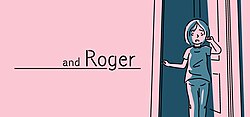

This is a game about love, memory, and doing the dishes while your brain politely declines the invitation. And Roger (stylised as and Roger) is a short narrative adventure from Japanese indie developer Yona - operating under the name TearyHand Studio - that asks you to play as Sofia, a woman seen alternately as a child, an adult, and an older person suffering from dementia. You will be asked to complete basic household tasks, press mysterious unmarked buttons, trace lines, and occasionally feel uncomfortable in a way that is clearly meant to be meaningful rather than a bug. People who review games professionally called it moving, occasionally clunky on purpose, and a clever example of gameplay-as-empathy. The wider world agreed: it cleaned up at Tokyo Games Show Sense of Wonder Night and picked up a handful of awards and nominations afterwards. If you like tidy pixel-perfect inputs and being rewarded with a high score, this is not that. If you like games that use interactions to make you feel something rather than simply tell you about it, this might be the precise emotional ambush you didn't know your Switch 2 needed. The art is deliberately cute and minimal, the mechanics intentionally fiddly at times, and the narrative ruthless about sadness while clinging fiercely to tenderness. It is short, it is earnest, and it will make you reassess how you feel about toothbrushes.
Gameplay is quietly stubborn. You progress mostly through point-and-click style interactions: press things on the screen, follow prompts, solve tiny puzzles meant to stand in for the mental effort of everyday life. Tasks are simple on paper - wash your hands, brush your teeth, eat breakfast - but the execution is where the game does its work. Buttons are often unmarked. Sometimes the rightness of the order matters. Sometimes the rightness dissolves into a pattern-tracing minigame that asks your finger (or joystick) to follow a shape as if that shape were an answer key to being human. That might sound like a pretentious way to make you swipe a line across a picture of a sink. It is. Pretentious and effective. The occasional clunkiness and moments of confusion that critics complained about are not unwelcome bugs so much as design choices intended to simulate the disorientation of cognitive decline. Press a sequence in the wrong order and you get feedback; press the right one and the scene snaps forward. Repeat sequences gain layers: a sequence that was once straightforward becomes foggy, or refuses to behave the way you expect, and the game responds by shifting visuals and text to show Sofia's inner state. There are flashback vignettes where Sofia meets Roger at a bakery, they fall in love, marry, and try to navigate the reality that care can be written in kindness and compulsion in equal measure. Later puzzles invite tracing and pattern recognition, which might be the gentlest form of finger gymnastics ever used to make an emotional point. If you're impatient, the pacing will feel deliberate; if you're paying attention, the mechanics will feel like the vocabulary the game uses to talk about memory, help, and the small cruelties that can come with caregiving. Some critics (Kotaku among them) called certain minigames clunky and frustrating. That frustration is almost certainly deliberate: it is the sensation of trying to do a simple thing while the world insists on adding friction. The point-and-click base is familiar enough that the Switch 2's touchscreen and controller layouts handle it without fuss, though players used to entirely intuitive UI will notice the game's insistence on making the mundane feel like a small puzzle.
The visuals are pleasing in an unthreatening, deceptively minimalist way. Yona created the art in Adobe Illustrator and aimed for a 'simple but super cute' look. Characters are drawn with pared-down lines and expressive, economical faces; Sofia's reflection slipping between child and adult is handled with a few deft strokes rather than paragraphs of dialogue. That pared-down aesthetic helps the game carry weight without becoming graphic or melodramatic. Backgrounds are tidy and intentionally non-photorealistic; the visual language is more diagram than realism, which works because the emotions here are internal and the art is a map. There are moments when the style leans into subtle distortions: colors shift, outlines waver, and the interface itself can become part of the story as menus, buttons, and simple animations reflect Sofia's mental state. The decision to use such a clean visual approach is smart: it doesn't cloud the narrative with unnecessary detail, it gives the minigames enough clarity to be playable, and it underscores the game's emotional thrust without performing emotional outbursts. If you liked Florence, you'll see the resemblance - critics noticed it too - but And Roger has its own quieter cadence and a more explicitly weighty subject matter. The game runs on Unity, and the Switch 2 ports handle it with no technical fouls to report; frame rate and responsiveness are competent, which is exactly what you want when the point is to feel friction occasionally and not suffer from it constantly.
And Roger is the sort of small, focused game that acts like a tiny, precise instrument for empathy. It isn't flashy. It doesn't need to be. Its intention is to use interactivity as a means of crafting emotional experiences: the awkwardness of an order of button presses, the irritation of a clumsy minigame, the gentle glow of a remembered bakery - all of it conspires to make you feel the push and pull of care and memory. There are things to grumble about if your primary hobby is ergonomic perfection: some mechanics are intentionally non-intuitive, and if you expect every puzzle to be a rewarding brain teaser you'll sometimes meet irritation. If you approach it on the game's terms, those frictions are the point. Critics praised its narrative and emotional impact, and it picked up awards at Tokyo Games Show's Sense of Wonder Night and nominations at larger ceremonies for good reason. TearyHand Studio's Yona has made a short experience that lingers. Play it on your Switch 2 when you want a gentle, occasionally uncomfortable reminder that games can teach you how someone thinks by making you do the same small, imperfect things they do. Also, you'll never again take a toothbrush for granted.
 Gaelic Football '25 on Xbox Series X/S
 Together! The Battle Cats on Switch
 Crash Bandicoot: The Wrath of Cortex on PS2
 Tintin: Destination Adventure on PlayStation
 One Piece Grand Adventure on PS2
 Taiko no Tatsujin: Dokodon! Mystery Adventure on Switch
 Taiko no Tatsujin: Don to Katsu no Jikū Daibōken on Switch










 Another SquareThought Site