

 Jan 2020
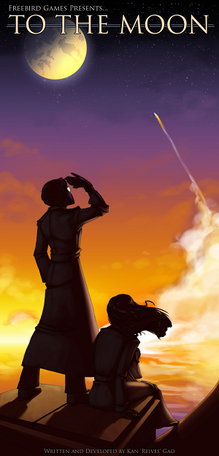

Welcome to a game that will try to make you feel things, then make you question whether you packed tissues, and finally whisper in your ear that video games are allowed to be art. To the Moon is an indie adventure about memory, regret, and an oddly specific promise to rendezvous on the Moon. You play as Dr Eva Rosalene and Dr Neil Watts, employees of the less-than-subtle-sounding Sigmund Corp., who fulfil dying people's last wishes by planting artificial memories. On the Switch, this tiny, heartfelt RPG-style experience sails in on a remastered engine (Unity), shedding its original 16-bit game-maker sweater for something a little smoother on modern screens. Don't expect mad button-mashing - unless your emotional defenses count as buttons.
To the Moon is the sort of game that treats gameplay like a polite guest: it appears, contributes something meaningful, and then lets the story do all the heavy lifting. Built originally in RPG Maker XP, the experience was never about combat or leveling up; in fact, the only battle you fight is a brief, clearly joking skirmish early on that exists mostly to make you smile and then immediately remind you this is a narrative-first title. The real meat is exploring Johnny Wyles's memories, collecting emotionally charged objects called mementos, and using them as anchors to hop backwards through his life. Each memory is a tiny diorama of someone's past - a high school corridor, a lonely back porch, a carnival where two kids invent a constellation shaped like a rabbit - and your job is to poke around until the memory strengthens enough to connect to the next one. Mechanically it's simple and deliberately low-friction. You look, you talk, you pick up objects, and occasionally you solve light puzzles or find a clue in Johnny's house to unlock a stubborn memory. The energy-collection system is charmingly literal: find things that matter, and the memory becomes stronger. Once you find linked items across memories, you can jump between them fluidly and even start rearranging scenes. This is where the game's moral gears begin to grind: manipulating memories isn't a neutral puzzle mechanic; it's the core ethical engine of the story. You and your partner are not tinkering with Lego; you're editing a life. The plot unfolds in reverse chronology, which cleverly mirrors the procedure you're performing. You start with an old man on a hospital bed and rewind through decades to adolescence and childhood, peeling back layers until the real reason Johnny wants to go to the Moon becomes heartbreakingly clear. The mystery is well paced - not by frantic cutscenes but by slow, accumulating details that recontextualize everything you've seen. Two things keep the narrative so taut: the interpersonal chemistry between Eva and Neil (their banter and differing approaches to ethics are a little like watching an office sitcom about existential tinkering), and the constant sense that something crucial is missing. That missing piece turns out to be a terrible, human accident and a mother's desperate choice: Johnny's twin brother Joey dies in a car crash, and his mother administers beta blockers to erase the memory of Joey. The side effect is broader memory loss, including the earliest meeting between Johnny and River, the woman who becomes central to his life. Where most games would lean on spectacle to sell emotional beats, To the Moon uses small, intimate moments: a paper bunny folded over and over, a hair cut that was supposed to be a signal, a pair of hands in a rocket cockpit. The climax - a revised life where the doctors choose to alter a crucial event so Johnny never loses those memories - raises thorny questions about identity, consent, and whether a manufactured memory can be more merciful than a painful truth. The game doesn't force you to be okay with the choice, but it makes the consequences feel devastatingly real. Expect to pause and stare at the screen more than once, trying to reconcile the ethical discomfort with the emotional relief the new memory brings. If you're someone who wants a lot of mechanical complexity, To the Moon will feel like a light meal: tasteful, perfectly seasoned, but not a feast. If you're here for a story that hits the chest with the subtlety of a shuttle launch, it's hard to overstate how effective it is. Critics agreed: Metacritic scores hover in the low-to-mid 80s, and the game took home GameSpot's Best Story award in 2011. In short, the gameplay serves the tale rather than the other way round, and for a lot of people, that's the point.
The Switch version benefits from the Unity-powered remaster that also brought the game to mobile platforms. Gone are the blocky RPG Maker pixels of the original PC release - not because the old style wasn't charming (it was), but because this edition cleans up character portraits, backgrounds, and UI for modern displays. The result is a pleasantly polished presentation that keeps the original's quaint aesthetic while making facial expressions and small details more readable on the TV. It's still essentially a 2D, sprite-driven affair, so don't expect dazzling lighting engines or photorealism; the art direction aims for warmth and clarity rather than flexing graphics horsepower. Sound design and music, meanwhile, deserve a paragraph of their own because they're half the reason this game made so many people cry in public transit. Composer Kan Gao provides the score, and Laura Shigihara's theme song, Everything's Alright, is a tiny, perfect earworm that anchors the game's bittersweet tone. The soundtrack weaves through memory sequences and plays like an emotional cheat code: familiar motifs return at exactly the right times to turn a quiet scene into a gut punch. On Switch the audio mix is clean and the songs are as affecting as ever; this is the sort of soundtrack you'll want to keep in your phone for emergency nostalgia sessions.
To the Moon on Switch is not a blockbuster - it doesn't need to be. It's a compact, thoughtful experience that proves video games can tackle grief, memory, and moral ambiguity without needing blockbuster budgets or motion-capture drama. The Unity remaster smooths the rough edges and makes the story more accessible to players who missed the original release, and the Switch's portability is an ideal home for this quiet, scene-by-scene journey. If you'd like a game that will make you laugh, make you think about mothers and promises and paper rabbits, and maybe make you wipe your eyes with the nearest controller strap, this is a safe bet. The ethical questions it asks - is it better to live a shorter life full of constructed joy, or to live with painful truth - will linger longer than the playtime. I give it an 8.4 out of 10: a near-essential narrative experience for anyone who enjoys games as stories, with a soundtrack that will stalk your feelings in the best possible way. Keep tissues nearby, and if anyone asks why you're staring at a pixelated moon with watery eyes, tell them you were just fulfilling a last wish. It's honest work.
 Moon: Remix RPG Adventure on Switch
 Rainbow Moon on PS4
 Moon Hunters on Switch
 Tintin: Destination Adventure on PlayStation
 One Piece Grand Adventure on PS2
 Taiko no Tatsujin: Don to Katsu no Jikū Daibōken on Switch
 Taiko no Tatsujin: Dokodon! Mystery Adventure on Switch










 Another SquareThought Site