

 Sep 2022


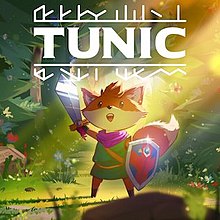
Tunic greets you like a polite mystery novel delivered by a particularly cute taxidermist. You play a small, decidedly furry fox who wakes up on a shoreline with no manual on how to be a hero - so the game gives you one instead, written mostly in an alphabet that looks meaningful and politely refuses to be decoded without a PhD in obfuscation. On the Nintendo Switch, Tunic dresses classic Zelda-ish exploration and Soulslike rhythm in pastel diorama clothes, hands you a sword and a notebook, and patiently waits to see how creatively you will misunderstand everything.
The basic loop is simple: run, roll, stab things, collect pages, become marginally more competent at being a fox. The camera sits at an isometric angle that looks like someone put a diorama in a glass cabinet and then decided to add a few surprise staircases. That angle is Tunic's favourite party trick: it hides paths the way curtains hide plot holes, and rewards curiosity with chests, hidden merchants, and routes that seem to have been cut in when the map designer sneezed and genius happened. Combat sits in an elegant grey area that borrows manners from both Zelda and Bloodborne. You swipe, you roll, you time things with the grim determination of someone who once beat a boss by accident and intends to replicate that exact accident. There are stamina, health, and magic meters - stamina is spent on rolls and blocking, health shrinks like a personal GPA after exam season, and magic powers some satisfying weird toys (projectiles, time-slowing, and a lash that looks like it borrowed emotional baggage from a grappling hook). Weapons vary between comfortingly familiar and delightfully odd: swords for the obvious stabbing, bombs that cause both fiery chaos and personal regret, and magical items whose descriptions are mostly drawings and interpretive gestures. Shields block at the cost of stamina, which the game expects you to treat like an ecosystem: farm it responsibly or the enemies will eat it all. Enemies are not shy; they sprint at you with the single-mindedness of someone on a lunch break. Shrines are the game's rest stops. Kneel at a fox statue, and play gets generous: health restored, enemies revived, and your last known good decision recorded. If the fox dies, they drop some coins and leave behind a sad little spirit - recover it and you're not as sorry as you could be. There are golden platforms that act like teleport express lanes to another plane called the Far Shore, which is useful when you want to move quickly or dramatically misplace yourself. The manual pages are the star and the hook. They are collectible items you find in the world and file under 'clues' and 'artful obfuscation' in your interface. Rather than telling you plainly what to do, the manual offers drawn diagrams, maps, and half-explained rituals that make you feel like an archaeologist decoding someone else's IKEA instructions. Some pages show the fox offering an item to a shrine, which is handy because the shrines themselves have the social skills of a bathroom stall: useful but silent unless someone reads the manual. Exploration is Tunic's social contract with the player: we won't hold your hand, but we'll hide a ladder behind a painting and let you glow with the satisfaction of discovery. This can be magic and occasionally a headache. The puzzles, especially the so-called "golden path" puzzle that requires assembling manual pages out of order, are fantastic when they click and infuriating when they don't. The game's choice to keep most text in a constructed script fosters collaborative sleuthing - communities will swap notes like modern-day conspirators - and it preserves the sense of being an outsider in a world that used to be more competent. Accessibility options are present for the practical-minded: unlimited stamina or health toggles exist for anyone who wants to enjoy the scenery without also performing precision parries. It doesn't feel like cheating so much as politely asking the game to stop acting like it knows you better than you know yourself. Boss fights are where Tunic turns up the dramatic music and the difficulty dial simultaneously. They are tense, often more refined than the ambient skirmishes, and divisive: some reviewers loved their ferocity, some felt they were rooms where the game's gentle hand temporarily forgot to be gentle. Expect patterns, expect gratification when you finally execute a strategy you scribbled into your heart, and expect occasional profanity aimed at beautifully animated foes.
Tunic looks like a children's book that studied architecture and then decided to become moody. The isometric diorama aesthetic is clean, colorful, and coyly underdesigned - each area is a little stage set with crisp edges and carefully chosen clutter. The art direction favors suggestion over photorealism: trees, ruins, and machinery are painted in a palette that convinces your brain you're in a fragile, ruinous fantasy world without the need to show you every brick being sad. The perspective shifts occasionally, and when it does the game uses it to reveal hidden paths or to reframe a puzzle like someone rotating a Rubik's cube for dramatic effect. Animation is economical: the fox's movements are expressive without a calendar full of frames, and enemy animations telegraph intent clearly, which is useful when your survival depends on telegraph-reading. Audio work and music deserve a ledger entry for calmness. Composers Terence Lee and Janice Kwan crafted a soundtrack that is serene and quietly insistent, like a background score for a life choice you half understand. It gives the tough combat moments an oddly consoling bed, so when you fail spectacularly you can at least be accompanied by gentle strings and tasteful chimes. All in all, the Switch version is a compact package: it preserves the visual charm and the tactile joy of discovery while running with the platform's portable dignity. If performance on handheld is your priority, Tunic mostly behaves itself; if you're playing docked, it looks like it could star in a miniature art exhibition and expect modest admission money.
Tunic asks you to be brave, curious, and occasionally confused. It rewards experimentation, hoards secrets like a cunning collector, and wraps challenging combat in an aesthetically sweet coat. The manual-as-gameplay device is both Tunic's greatest flourish and its mildest cruelty: it gives you the tools to solve things without ever telling you why you should care, which is precisely the point. There are moments when the puzzles and bosses will make you feel stranded - intentionally or not - but the game provides enough accessibility options and exploration-based pleasures to keep most players engaged. It's not the longest adventure on the Switch, but it makes efficient use of every diorama tile. If you want a game that combines the satisfying rhythm of precise combat with the glee of discovery and the thrill of reading a manual written by someone who likes to make you think, Tunic is an excellent, quietly smug choice. It is, in short, adorable, occasionally cruel, and very good at making you feel like a small fox in a world with a very complicated instruction manual. Score: 9/10.
 Atelier Ryza 2: Lost Legends & the Secret Fairy on PS4
 Ken Follett's The Pillars of the Earth on PS4
 Tintin: Destination Adventure on PlayStation
 One Piece Grand Adventure on PS2
 Taiko no Tatsujin: Dokodon! Mystery Adventure on Switch
 Onimusha: Dawn of Dreams on PS2










 Another SquareThought Site