

 Nov 2021
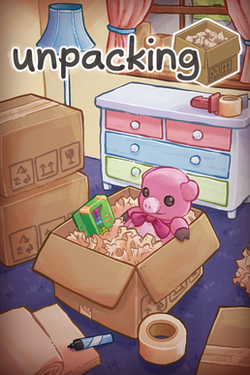

There was a time when a game review began with a stern sentence about polygons and frame rates, then loosened into gush over boss battles and cheat codes. This review arrives in that spirit of disciplined seriousness, except it concerns a game whose central drama is whether a mug goes in the kitchen or the bedside table. Unpacking is an exercise in domestic forensics disguised as a puzzle game. It is the sort of small, impeccably crafted title that in the 1990s would have been the hidden gem in a mail-order catalogue, and today it arrives on the Switch with the quiet confidence of something that knows it does not need flashy fireworks to make you pay attention. Developed by Brisbane's Witch Beam and published by Humble Bundle, Unpacking invites you to become an archivist of an anonymous woman's life. The game is divided into chapters marked by years, beginning in 1997 and progressing to 2018. Each chapter is a new dwelling, a new set of boxes, and a new chance to deduce biography from socks. It is an almost entirely wordless narrative told by objects, by placement, and by the small, meaningful decisions you make when you decide where the headphones belong. For a reviewer raised on magazine spreads and cardboard boxes full of demo discs, the premise is both disarmingly simple and, in practice, devastatingly effective.
If you have ever moved house you will recognize the procedural rhythm here: lift, place, adjust, curse at the thing that will not quite fit. Unpacking translates that into tidy mechanics. Each stage presents a room or a series of rooms and a stack of cardboard boxes. You pick up items and position them. Some objects are free-form, others have explicit slots or obvious homes. The screen is a microcosm of life; a toothbrush placed on the sink tells you about hygiene and routine, a concert poster tacked to the wall hints at taste, and an old photo left on a dresser hints at relationships. There are 35 distinct rooms across the whole game, and the game cleverly evolves its puzzles so that the act of arranging becomes a language. Some stages have rules needed to complete the level, such as special places where certain items must be put. More often the challenge is interpretive: you are invited to interpret the protagonist through the residue of daily life. The game moves through time so the same dwelling type returns with different accretions, and the collection of items grows into a timeline. It is amateur sleuthing with gentle constraints; you do not chase high scores, you chase coherence. There is no dialogue, no pop-up codex entries, and that is the point. The designers deliberately made Unpacking nearly wordless so that it would be accessible to players with language barriers, and the game includes thoughtful accessibility options to ensure that as many people as possible can engage in this quiet investigation. Mechanically the Switch controls are lean and reliable. The cursor and placement feel crisp on Joy-Con, and the tactile pleasure of slotting an item into its place is enhanced by sound design so meticulous you can almost feel the cardboard give. Witch Beam recorded over 14,000 foley effects and it shows: every action has a distinct audio signature, from the soft thud of a book to the satisfying clack as a tile finds its groove. The audio is not merely cosmetic; it is a key part of feedback and narrative. The composer, Jeff van Dyck, provides a restrained backdrop that never tries to overwhelm the act of arranging but instead punctuates the small emotional beats. The game is short by conventional standards; a single run can be finished in a few hours, and completionists may stretch that slightly by hunting for exact placements. But Unpacking is not measured in hours. It is measured in that sensation when a room finally reads like a life, when a shelf stops feeling empty and begins to tell a story. The pace is deliberate, the stakes domestic, and the satisfaction is quietly enormous. There is also a sad-modern postscript in the clones section of the game's history: an imitator appeared on mobile app stores and briefly topped charts, a reminder that elegant ideas are often quickly copied. Witch Beam weathered the episode with dignity, and the original remains the sincere article.
Graphically Unpacking favors readable pixel art and tidy 2D environments over technical showboating. This is not a visual showcase in the sense of pushing the Switch's GPU until it squeals, and yet that is exactly the point. The art direction is meticulous, focused on legibility and personality. Objects are drawn with small details that reveal themselves as you interpret the game: a chipped mug, a faded sticker, a shirt pattern that repeats across years. The IGDA awards for 2D animation and 2D environment art were not given for decoration alone; these are recognitions of how animation, staging, and environmental storytelling cohere into a single communicative unit. On the Switch the palette is pleasing and the framerate steady. The rooms are composed like dioramas; the camera is content to be stationary and let you rearrange the scene like a stage director. This restraint is a virtue. In the mid-90s a serious reviewer would note whether a sprite sheet had personality, and Unpacking's sheets do. The animation is used sparingly but with purpose: a drawer that opens, a lamp that clicks on, a cat that wanders in during certain chapters. Those moments of motion bring the space to life without demanding your full attention away from the puzzle at hand. Accessibility in the visuals is commendable. Because the narrative is delivered visually, clarity is paramount. Objects read well, even for players who might struggle with visual clutter. The nearly wordless presentation doubles as an inclusive design choice, allowing the game to speak to a global audience without translation woes.
Unpacking is a peculiar masterpiece of modest ambitions. It does not try to be the biggest or loudest game on the Switch; it does something rarer and more difficult, namely it uses tight mechanics, impeccable sound, and careful visual design to turn the quotidian into narrative. Witch Beam has crafted an experience that won accolades for good reason: BAFTA recognition for narrative, a DICE Award for outstanding independent achievement, and Eurogamer's Game of the Year among them. The game sold impressively well out of the gate, moving over 100,000 copies in its first ten days, proof that players respond to games that trust them to pay attention. If you crave explosions and boss fights, Unpacking will not scratch that itch. If you have an appetite for subtle storytelling, meticulous design, and the odd pleasure of perfectly placed socks, it will repay your time many times over. It is a reminder that games can be intimate, that objects can speak, and that sometimes the most affecting stories are told without a single line of text. Put on your reviewer monocle or your favorite flannel, set the Switch to handheld or docked as you please, and give this small, serious, and unexpectedly moving game a place on your shelf. It is, in short, nearly perfect at what it sets out to do.
 Heaven's Vault on Switch
 Tadpole Treble Encore on Switch
 Puzzle by Nikoli 4: on PS4
 Twinbee Taisen Puzzle Dama on PlayStation
 Tokimeki Memorial: Taisen Puzzle-Dama on PlayStation
 Professor Layton and the Last Specter on DS
 Assault Android Cactus on PS4










 Another SquareThought Site