

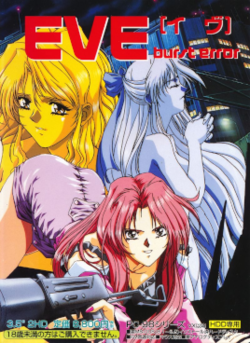

If you like your mysteries served with a side of melodrama, a sprinkle of political intrigue, and the kind of branching narrative that makes you feel like a timeline-juggling octopus, then EVE Burst Error Plus on PS2 is probably the visual novel equivalent of a midnight snack you will regret in the best possible way. Originally born in 1995 as an eroge by cult studio C's Ware and masterminded by the late Hiroyuki Kanno, EVE became famous for being weirdly addictive: two protagonists, two perspectives, and a story that insists you play smart - and fast - if you want to piece it together. The 'Plus' tag on the PS2 entry is essentially the series' way of saying "we're back on consoles," bringing a notorious PC title to living room couches, memory cards, and the occasional family-member-glance-over-your-shoulder panic.
The part of EVE Burst Error Plus that will make you clap your hands like someone who understands narrative design is the dual-protagonist mechanic. You rotate between Marina, a hyper-competent government agent assigned to protect a diplomat's daughter named Mayako Mido, and Kojiroh, a jaded private investigator whose 'I just want a simple case' life is promptly demolished by an absurd chain of murders and thefts. What makes this system delightful is that you can switch between the two characters at nearly any moment rather than grinding through one full route then the other like some visual-novel conveyor belt. This free-switching idea means the plot frequently expects both protagonists to tacitly cooperate: Marina will secure a scene while Kojiroh snoops through a principal's missing painting case, and suddenly both threads hemorrhage into the same conspiracy. The result is a dance of timing and perspective - you often finish a scene as one character and realize the other person has the missing clue in their pocket. I will not pretend this doesn't occasionally feel like trying to assemble IKEA furniture while blindfolded, but the payoff is properly clever. Branching narrative is the name of the game here. Choices lead to different beats and discoveries, and because the story flips perspectives, you get the thrill of dramatic irony: you know more than a single character does, which turns some scenes into deliciously tense sequences where you can sit back and smugly judge someone who is about to make a poor life choice. The PS2 port keeps this structure intact, so if you enjoyed getting both sides of the same coin in other VN classics, EVE's interplay will feel familiar and yet fresh because it's so insistently cooperative. The game doesn't hold your hand with tutorials about why switching matters; it assumes you either enjoy detective legwork or you like being bewildered and stubbornly trying every option until the plot finally unlocks. There is a mechanical simplicity to Burst Error that is part of its charm. This is not a puzzle game that will exhaust your gray matter with obtuse inventory combinations - it's an investigation-adventure hybrid where dialogue, scene choices, and knowing when to switch perspectives drive the experience. Fans praised the original for its clever structure, and that pettiness of design has aged well: it's less about flashy gimmicks and more about delivering a tidy narrative machine that keeps you turning pages (or in this case, pressing X) to see what happens next. If you ever wondered how a game could make two solo narratives feel like a co-op mission without a second controller, this is your masterclass. The storyline itself is gloriously baroque. Marina's assignment to guard Mayako, the daughter of a diplomat from the fictional Middle Eastern nation Eldia, quickly escalates into a complicated political tangle involving governments, murders, and people whose motivations are as slippery as a greased eel. Kojiroh's accidental entanglement via a missing painting that snowballs into murder connections is delightfully noir. The juxtaposition of international stakes and small-town sleuthing keeps the tone varied: one moment it's cold-blooded political intrigue, the next it's Kojiroh complaining about his pay while sneaking into a school office. Both protagonists have personalities that play off each other nicely - the competent cold agent and the grumpy gumshoe form a surprisingly effective narrative partnership that begs to be moved between constantly.
Visually, EVE Burst Error Plus sits somewhere between nostalgia and functionality. The PS2-era presentation doesn't aim to be a tech demo; instead it leans into character sprites, evocative backgrounds, and carefully framed stills that get the job done. The original game's chiptune-ish compositions by Ryu Umemoto (and Ryu Takami) give the title an audio identity that manages to be both retro and suitably moody for a thriller. Expect dramatic close-ups, expressive portraits, and occasional stills that hit with cinematic timing. If you're judging by modern standards, it's cute to watch - this is art direction that favors story beats over polygon counts, which is exactly what the game needs. You celebrate its dramatic panels the way you celebrate a good comic book - because the moment lands, not because the pixels are flexing their biceps. Port-wise, Burst Error Plus doesn't dramatically overhaul the aesthetic palette of the original releases. If you own a PS2 and crave a narrative-heavy experience, the visuals will feel more than adequate. The PS2 also helps to place the game in the living room comfortably: no need for weird keyboard acrobatics or PC configs, just pop the disc in and let the conspiracy unfold while you eat something you shouldn't during dramatic reveals.
EVE Burst Error Plus on PS2 is not an exercise in graphical pyrotechnics or twitchy gameplay; it's a narrative itch-scratcher that knows its strengths and plays them well. The ingenious dual-protagonist mechanic and tight branching structure keep you engaged and guessing, while the story's blend of espionage, political skulduggery, and private-eye grumbling creates a tone that's as addictive as it is occasionally melodramatic. The game's historical status is deserved: it was a massive hit in Japan, sold impressively on the Saturn, topped reader polls, and has influenced later visual-novel luminaries. If you're in the mood for a detective story that rewards attention, timing, and a willingness to play both sides, then EVE Burst Error Plus is an excellent PS2-era time capsule and a smart pick for anyone who loves story-first gaming. Score: 8/10 - a classic mystery that still knows how to drop a mic (and then hand it to both protagonists so they can argue about who actually owns it).
 PlayStation Plus August Drop: Mortal Kombat 1, Spider-Man, Sword of the Sea and Two Resident Evils — Sony’s Buffet of Beatdowns and Beachside Introspection
 Constructor Plus on PS4
 Tintin: Destination Adventure on PlayStation
 One Piece Grand Adventure on PS2
 Taiko no Tatsujin: Don to Katsu no Jikū Daibōken on Switch
 Punch Line on PS4
 EVE: New Generation on PS2
 Eve: Rebirth Terror on Switch
 Desire on PS2
 Desire: Remaster Version on Switch











 Another SquareThought Site