

 Jun 2011
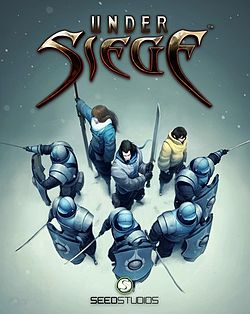

Under Siege arrives on PS3 like a compact, stubborn board game that somebody fitted into a console controller and then dared you to win without unplugging it. Made by Portugal's Seed Studios and running on Sony's PhyreEngine, this 2011 real-time tactics title leans heavily on skirmish-level combat, user-generated content and an oddly proud refusal to be an economy sim. Single-player skirmishes, a campaign framed by a tie-in comic, split-screen local battles and two-player online matches make up the package, and there's even a level editor for players who prefer to design deathtraps rather than play through them. The game supports PlayStation Move as an optional control scheme - more a novelty than a necessity - but its heart is the adaptation of RTS-like micromanagement to a DualShock layout. Critics landed around a 7/10 consensus and Metacritic put it at 69/100: respectable, occasionally brilliant, and frustrating in ways that probably say more about the genre's translation to consoles than about Seed's competence.
Under Siege is built around short, intense battles rather than base-building or resource chains. That design decision is visible everywhere: unit rosters are persistent between battles (you level up armies by fighting), and progression is measured in battlefield experience rather than economic growth. This delivers a crisp feedback loop - kill stuff, get choices, tweak your army composition - which suits a pick-up-and-play console player, but it also raises expectations for controls and clarity that the game occasionally struggles to meet. Control mapping is the game's most consequential technical challenge. Seed Studios attempts a controller-first RTS layout: radial menus, contextual shoulder-button commands, and touch-and-point selection with the right stick. The result is competent for basic squad orders, but it cannot compete with the precision of mouse-and-keyboard. Group selection and unit targeting require extra button presses and menu navigation, which introduces latency into decisions that, in a clash-heavy title, need to be immediate. The developers knew this and tuned battles for console pacing, yet those tuning choices produce moments where the input abstraction feels coarse - a small, but constant, friction. Fog of war and camera framing are two design elements that directly influence tactical clarity. The fog sits close to your units, which sounds cinematic until you accidentally march a unit into an unseen enemy swarm because they were just outside the camera cone. Several reviewers highlighted that the fog-of-war radius is too conservative. From a systems perspective it's a tuning issue: the fog density affects perceived difficulty far more than the raw AI aggression parameter. Tight fog reduces information bandwidth to the player, and with a controller-limited selection model that bandwidth is already constrained. Pathfinding is reasonable for a small-budget studio on a console engine; the units generally navigate obstacles and re-route when blocked. There are occasional cases of jittery micro-adjustments during large group movements, which is likely to be caused by the collision avoidance heuristics rather than the underlying navigation mesh. The upshot is that small skirmishes feel precise enough, while the most chaotic engagements become a pile of slightly confused models doing believable-but-not-ideal avoidance maneuvers. Unit design favors archetypes: melee tanks, ranged skirmishers, specialized support units and hero-like characters with abilities. Since armies level through combat, there's an implicit meta loop that incentivizes specific unit usage for experience optimization. Balancing is decent considering the game allows mixed-race armies - a clever feature that expands tactical options but complicates match balancing. Multiplayer modes - Deathmatch, Capture Point, Capture Treasure, and Survival - take the mechanical foundation and refocus it around objectives. With only two players online and two-player split-screen supported, matches are intimate and technical: you're rarely overwhelmed by chaotic numbers, but every misclick or mistimed ability costs you. The level editor is where Under Siege makes its most modern-sounding promise: user-generated content and online sharing. The editor is functional and focused on map layout and objective placement rather than scripting deep AI behaviors. It integrates well with the game's skirmish rules, which means custom maps remain playable without modders needing to write new logic. For a console title the presence of a shareable map editor is technically notable - it requires serialization of maps, a server-side sharing component, and UI to browse community maps. Seed's implementation is straightforward and serviceable, though the absence of a robust in-editor tutorial means the creation curve sits higher than necessary. Network performance for two-player matches is adequate. With a small player limit and straightforward sync requirements (unit states, health, ability cooldowns), the network model is predictable and less punishing than large-scale RTS synchronization. Split-screen local multiplayer sidesteps this entirely and proves to be the most stable multiplayer experience. The PS Move compatibility is an interesting footnote: it works for direct-pointing interactions but doesn't meaningfully improve command throughput versus a DualShock. It's a novelty for one-off sessions rather than a competitive input method.
Visually, Under Siege punches above its weight for a downloadable PSN title from 2011. Running on PhyreEngine - Sony's cross-platform middleware - the game presents a clean isometric-like viewpoint with detailed unit models and readable ability effects. Production values are one of the areas that critics consistently praised, and that praise is deserved: textures are generally crisp for the era, animations are expressive (unit attacks and ability casts have clear telegraphs), and the particle effects for spells and explosions are visually satisfying without being performance-killers. On technical metrics the developers made sensible trade-offs. The camera is fixed enough to keep unit models legible while providing decent battlefield overview, but it's not a free-roam cinematic. Level geometry is stylized rather than highly detailed; this keeps draw calls down and helps maintain frame stability during congested fights. There are rare CPU spikes when many abilities trigger concurrently, which momentarily drop animation fidelity but seldom impact gameplay hit detection. Art direction favors readability over realism - an excellent choice for a tactics game where clear visual communication beats photorealism every time. The user interface follows this philosophy, with bold icons and high-contrast HUD elements that are easy to pick out on a television from a couch. The level editor's UI is utilitarian; it's clear where to place objectives and terrain, but fine-grained sculpting or decorative placement is limited, which again feels like a deliberate engineering constraint to ensure community maps remain performance-friendly across consoles.
Under Siege is a case study in careful constraint: a small studio translating a traditionally PC-centric genre to console controls, adding a map editor and insisting on tactical depth over resource minutiae. Where it succeeds, it does so by keeping battles readable, production values high and multiplayer intimate. Its shortcomings are also surgical: controller-driven selection is never going to match a mouse for speed and precision; the fog-of-war tuning sometimes punishes players more than it challenges them; and difficulty spikes make the learning curve feel like a narrow path with a few surprise pits. For an 18-year-old looking for a strategy fix on a couch without hauling a keyboard to the living room, Under Siege is an engaging, if occasionally prickly, experience. It rewards patience, tactical thinking and a willingness to accept a different pacing than PC RTS veterans expect. If you value solid presentation, a functioning map editor and tight two-player skirmishes, Seed Studios' little medieval battlefield offers more than enough content to justify a download. If you require instant responsiveness and a forgiving fog-of-war, this title will remind you why certain genres grew up on PC hardware. Either way, Under Siege is proof that smart design and sensible engine choices (hello, PhyreEngine) can make a small, focused strategy game worth your time - even when it refuses to hold your hand.
 Under Night In-Birth II [Sys:Celes] on PS5
 Under Night In-Birth Exe:Late on PS3
 Nobunaga's Ambition: Iron Triangle on PS2
 Time Commando on PlayStation
 Time Crisis on PlayStation
 Prince of Persia: The Sands of Time Remake on PS4










 Another SquareThought Site