

 Oct 2025
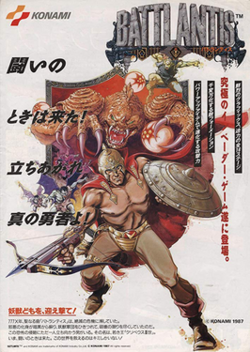

Battlantis is Konami's little late-80s love letter to fixed shooters: a tight, stage-based arcade game first dropped in July 1987 that borrows the disciplined enemy formations of Space Invaders and Galaga while throwing in its own idiosyncratic flourishes (an ark that drops powerups, aggressive dive-bombers, and a two-loop 16-stage campaign). The Arcade Archives release on PS4 (October 9, 2025) resurrects that cabinet feel for modern hardware. If you like your shooters distilled to geometry, timing and a strict punishment/reward loop, Battlantis is a comforting relic. If you want modern conveniences like checkpoints and aim assist, Battlantis will remind you that arcades were built to make quarters cry.
Underneath the cute monster sprites and the biblical-ark gimmick sits a machine of disciplined rules. You control Cripeuss III on a single horizontal axis; enemies march in patterns that look like spreadsheet choreography until they suddenly wobble into dive runs. The formation logic is explicitly derivative of classics - think column/row sweeps, periodic dives, and staggered charging - but Konami spices things by mixing in two mechanics that meaningfully affect player agency: ark-dropped powerups and the 'sideways' shot state. The ark is the game's probabilistic dopamine dealer. Two monsters occasionally ferry an ark across the top of the playfield; shooting it releases a temporary powered shot. This is not a permanent evolution: the power timer forces the player into a tactical economy - do you spend the power clearing a wave or save it for the bosses and the dive-bombers that puncture your formation? That decision loop is where the game shines on a mechanical level. The mechanics are cleverly tuned so that a single powerup increases your DPS and temporarily changes your hit-sap dynamics, but the real mechanical payoff comes from collecting two powerups. That unlocks sideways firing, which is essential when enemies reach the bottom row and begin lateral attacks. This design creates micro-goals in every level: secure the ark, preserve the power, and disengage when the screen becomes legally a warzone. Collision detection in Battlantis is classic arcade precision: hitboxes are conservative around shots and sprites, which rewards pixel-level dodging. Enemies that charge toward the bottom then transition to lateral movement, which effectively changes the frame of reference for collisions - bullets that used to intersect predictable trajectories now must account for sideways velocity, presenting an increased CPU demand (in 1987 terms) for relative motion checks. That feels faithfully preserved in the PS4 port. Enemy AI is deterministic rather than probabilistic, meaning learned patterns translate into repeatable outcomes; speed and aggression scale with stage index and on the second loop, enemy positions and boss designations alter just enough to break rote repetition. The difficulty curve is old-school steep: 16 stages, then a second loop with remixed backgrounds and harder encounters. Permadeath and the absence of modern safety nets mean the score-chasing and survival loop are front and center; multiplayer is present in the original release, but Arcade Archives' treatment focuses on the single-machine competitive spirit rather than cooperative modernizations. Controls on DualShock/DUALSHOCK4 are simple - left/right movement and a single fire - which keeps input pathways minimal and lets input latency be the defining variable. Fortunately, the port maintains tight input responsiveness; there's no discernible button-to-screen lag that would corrupt the original timing windows. For players who tinker with preservation-level details: the game requires the classic twitch-of-thumb timing to thread narrow formation gaps, and mastering it is satisfying in a way that more forgiving shooters rarely replicate.
Graphically, Battlantis is a paper-cut diorama of 8-bit arcade sensibilities. Sprites are limited, chunky and well-animated within the constraints of arcade RAM budgets. On PS4 the Arcade Archives release upscales the original tilemap and sprite sheets cleanly without trying to 'modernize' the art; this port leans into fidelity over embellishment. That means pixels are preserved and sprite edges remain crisp instead of being smeared by aggressive filtering. For purists who want the CRT patina, Arcade Archives usually provides display options - scanline overlays and aspect ratio toggles - and those tools are crucial here: the game was designed for a 4:3 arcade cabinet, and stretching it to widescreen without preserving vertical real estate turns it into an oddly spacious bullet-hell viewing gallery. Technical fidelity is most visible during fast enemy dives. Sprite priority and layering are preserved so that bullets, explosions and character sprites never visually clip incorrectly, which is a testament to a faithful emulation core. Particle effects are modest - explosions are announcer-level pixel pops - but the animation timing is retained, and that timing is what sells the feedback window for hit confirmations. There is no high-resolution redraw here; instead, the port gives you exactly what the board output: palette-limited backgrounds, repeated stage tiles, and a few sprite sets reused across enemy types to conserve memory. The second loop's altered backgrounds are a clever, low-cost way to reinject visual variation without changing the fundamental asset set. Audio isn't elaborated on in the source doc, but the original's sound design follows the fixed-shooter textbook: short melodic hooks and punchy SFX that serve functional roles - cueing dives, power pickup, and death - rather than aiming for atmospheric depth. The Arcade Archives release typically preserves these cues with clean samples, so expect tight, lo-fi percussion and bleeps that still hit the same synaptic triggers they did in arcades.
Battlantis on PS4 as part of Arcade Archives is a technically faithful preservation of a late-80s Konami fixed shooter. Its strengths are mechanical clarity, deterministic enemy patterns, and a well-designed micro-economy centered on the ark powerups that forces meaningful split-second choices. The port does the important thing: it keeps input latency low, preserves sprite layering and collision fidelity, and offers display options suited to a game born on CRTs. It's not revolutionary - it never intended to be - but for players who appreciate the exacting design of older shooters, Battlantis is a rewarding test of pattern recognition and twitch timing. If you're scoring it as a modern PS4 purchase, temper expectations: the package is thin on bells and whistles, and its challenge is unapologetically old-fashioned. If you're scoring it as a technical emulation and as a historical artifact, it succeeds admirably. For people who enjoy memorizing patterns, savaging high scores, and watching an ark clip out a powerup like a slot-machine miracle, Battlantis will scratch an oddly satisfying itch. For everyone else, it's a compact, occasionally brutal lesson in why arcade games used to be short, repeatable, and designed to demand mastery.
 Oretachi Game Center Zoku: Rabio Lepus on PS2
 Arcade Archives 2: Battlantis on Xbox Series X/S
 PixelJunk Shooter 2 on PS3
 PixelJunk Shooter on PS3
 Air Twister on PS4
 Tesla vs Lovecraft on PS4










 Another SquareThought Site