

 Oct 2025
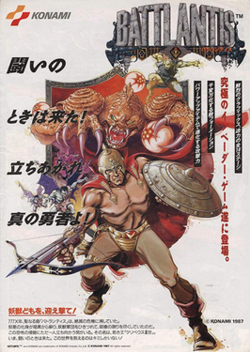

Arcade Archives 2: Battlantis is the sort of thing that makes you appreciate how compact and ruthless early arcade design could be. Originally spat into the world by Konami in July 1987, Battlantis arrives on the Nintendo Switch 2 under the Arcade Archives banner - a tidy preservation job that parks a 16-stage fixed shooter in your handheld, portable TV, or living-room shrine to nostalgia. It wears its influences on its sleeve: Space Invaders and Galaga are the most obvious antecedents, and Konami peppers the game with enough unique quirks (most notably the ark-bearing monsters and the sideways-firing gimmick) to keep the experience from being a mere retread. If you remember dropping quarters and waiting for a two-minute run to end in a puff of smoke, Battlantis will feel reassuringly familiar. If you came of age with analog joysticks and CRT geometry, it will feel like a compact sermon on how arcade games taught players to die quickly and learn faster.
Battlantis is a fixed shooter distilled to its essentials: you control Cripeuss III at the bottom of the screen and blast increasingly aggressive formations of monsters. The enemy waves are straightforward in concept but crafty in execution. Standard foes march in formations reminiscent of the genre's greats, while darker designs break formation to dive toward the bottom row. Two monsters occasionally carry an ark across the playfield; striking that ark releases a temporary power-up that upgrades your shot. The upgrade economy is deliberately stingy. One power-up is helpful, but the real tactical pivot arrives once you've captured two: only then do you gain the ability to fire sideways, which becomes crucial in later stages. The tension in Battlantis is not built on a sprawling move-list but on positional advantage and timing. When enemies reach the lower bounds of the formation they don't simply stroll along the floor - they begin to fly sideways toward Cripeuss III, turning the screen into a corridor of death. Without the sideways shot, those flank attacks are nearly impossible to counter, which forces the player to hunt for arks and manage risk. The result is a game that rewards short-term aggression and long-term planning: you cannot simply sit back and chip away. You must decide when to risk exposing yourself to collect a power-up or when to bunker and conserve lives. There are 16 stages in a loop, and after you clear all sixteen you are rewarded with staff credits - an old-school flourish that Konami fans will recognize. The real test begins if you survive the credits: a second loop of 16 stages returns with altered stage backgrounds, shifted enemy positions, and rejigged boss designations. This second loop raises the skill floor and makes mastery feel earned rather than handed out. Multiplayer support is listed in the original arcade documentation, and while the Arcade Archives port on Switch 2 is primarily a single-player nostalgia trip, the original hardware allowed for shared screens and partner dynamics that added replayability. Battlantis wears its difficulty like a badge. Progress is iterative; expect to die a lot, learn patterns, and eke out slightly further runs each session. The game is short on modern comforts - no checkpoints, no gradual unlocks, and certainly no save-scumming - but it delivers a concentrated arcade lesson in risk management, spacing, and the brutal arithmetic of humble power-ups.
Graphically, Battlantis is a snapshot of late-1980s arcade modesty. The sprites are compact and functional: monsters are distinct enough to telegraph behavior, and the ark icon is satisfyingly obvious when it crosses the screen. Backgrounds are spare, serving the gameplay rather than attempting to dazzle; this is a game that expects you to focus on hitboxes and timing, not scenic wonder. When ported to the Nintendo Switch 2 under the Arcade Archives banner, the pixel work holds up because the aesthetic was never about photorealism - it was about clarity. On a modern display the colors are bright and the action reads cleanly, though purists will want to toggle CRT filters if they miss the soft bloom and scanline geometry of an arcade cabinet. The stage-to-stage variation is economical: after the first loop the second round tweaks backgrounds and enemy placement to prevent total monotony, but Battlantis never pretends to be a visual tour de force. It is, instead, an honest little machine built around readability and quick comprehension.
Arcade Archives 2: Battlantis is not a forgotten masterpiece so much as a compact, competent example of Konami's late-80s arcade craft. It borrows the comfortable framing of Space Invaders and Galaga but insists on a couple of clever wrinkles - the ark power-up and the sideways-firing condition - that make each playthrough a negotiation between desperation and opportunism. The 16-stage structure and the punishing second loop give the title just enough longevity for players who enjoy incremental mastery and score-chasing. For players steeped in modern design sensibilities, it may feel terse and occasionally unforgiving; for anyone with a soft spot for coin-op economy, Battlantis is a tidy bite-sized lesson in arcade discipline. The Arcade Archives port on Nintendo Switch 2 preserves that feel faithfully, making it an easy recommendation for collectors and curiosity-seekers. If you want a game that teaches you how to die with grace and come back with a better plan, Battlantis will do the job - and it will do it in under thirty minutes, if you insist on perfection.
 Arcade Archives 2: Ridge Racer on PS5
 Street Fighter V: Arcade Edition on PS4
 PixelJunk Shooter 2 on PS3
 PixelJunk Shooter on PS3
 Tesla vs Lovecraft on PS4
 Plants vs. Zombies: Garden Warfare on PS3
 ISS Pro Evolution 2 on PlayStation
 Pro Evolution Soccer 2 on PlayStation
 Metal Gear Solid 3: Snake Eater on PS2
 Metal Gear Solid: Integral on PlayStation
 Pro Evolution Soccer on PS2










 Another SquareThought Site