

 Oct 2025
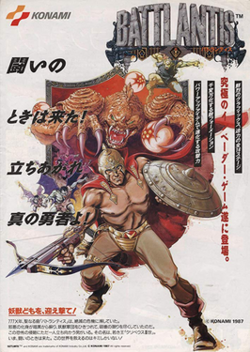

Arcade Archives 2: Battlantis is a tidy little time capsule of Konami's 1987 fixed-shooter sensibilities, repackaged for the Xbox Series X/S as part of the Arcade Archives line on October 9, 2025. On the surface it's familiar territory: a single-screen shooter in the lineage of Space Invaders and Galaga, but with enough mechanical twists (ark-carrying enemies, power-up capture mechanics, and a two-loop stage structure) to make it worth a look for fans of precision, pattern recognition, and brutally honest hitboxes. This review approaches Battlantis like a hardware engineer with a joystick fetish - I care about timing, hit detection, sprite priorities, and whether the port preserves the exact behavior that made the original arcade cabinet tick.
Battlantis is mechanically conservative by late-80s arcade standards and precise where it needs to be. Enemy formations move in tight waves across a single-screen playfield; their baseline behavior will read familiar to anyone who has stared down Space Invaders columns or danced with Galaga dive patterns. The design flips between predictable wave sweeps and burst aggression: some monsters charge straight to the bottom of the screen and, crucially, once they reach that lower stratum they switch to lateral flight aimed at your ship. That change in trajectory isn't just cosmetic - it alters hit windows, forces you to think in two axes, and elevates the importance of controlling the horizontal plane. Power-up systems are central to Battlantis' mechanical loop. Occasionally two enemies ferry an ark across the screen; shooting it releases a temporary upgrade that strengthens the player's shot. The upgrade stacking is binary and tactical: capture one power-up for a short-term firepower boost, capture a second to unlock sideways firing. That second power-up is effectively a cooldown-free directional augment that dramatically changes your survival envelope because sideways shots allow you to intercept enemies that pivot laterally after reaching the bottom - the game's main difficulty spike. This creates a tight risk-reward cadence: do you spend lives and screen real estate trying to secure the ark early, or do you play conservatively and engage waves with raw weaving and micro-positioning? From a systems perspective, the game's 16-stage loop is compact and efficient. Each stage is a set piece of enemy patterns and palette swaps; after clearing all 16 the game runs staff credits and then offers a second, slightly altered 16-stage loop. In the second loop backgrounds, enemy positions, and boss designations shift subtly, which is a classic arcade way of increasing longevity without creating entirely new content. For speedrunners and score-chasers this is a crucial point: the second loop is where pattern memorization and frame-perfect actions really pay off. Technically the arcade original relies on consistent frame timing and deterministic enemy AI. That means the port's fidelity to the original game's timing model is the single biggest factor in feeling 'authentic.' If enemy entry timing, ark spawn cadence, or shot cooldowns deviate by even a few frames, the game's risk calculations change drastically. On modern hardware the biggest potential issues are input polling, frame pacing (even when locked to 60Hz), and how the emulator handles sprite overflow and priority. A faithful port preserves the precise windows for ark shots and the exact moment when charging enemies flip to lateral pursuit - that's the difference between 'challenging' and 'cheap.'
Visually, Battlantis is a late-80s Konami sprite stack: compact, readable sprites with limited but effective animation frames and a palette chosen for contrast on CRTs. The original arcade's art direction leans into bold outlines and simple color blocks, which makes the game tolerant of upscaling but sensitive to interpolation. On an Xbox Series X/S display (a modern LCD/LED), the raw pixel art benefits from nearest-neighbor scaling and optional scanline emulation. Any bilinear smoothing will thin out the sprite outlines and muddle timing cues (visual motion blur can make dive-frames harder to parse), so purists should prefer crisp scaling modes. Sprite priority and overlap are also worth calling out. When multiple enemy sprites converge toward the bottom and a charging enemy switches to sideways motion, there are tight occlusions where shots and sprites intersect. The original hardware handled these with explicit priority bits; the exact timing of draw order can influence whether a shot registers as a hit in those micro-moments. A good Arcade Archives release will replicate those priorities faithfully; a lazy implementation might reorder draw calls or mishandle transparency, introducing phantom invulnerabilities or phantom hits. The stage backgrounds are functional and fade into the periphery; they exist to give the player spatial context rather than steal attention from the action. The palette and parallax (if any) are minimal, which is a plus for legibility. If the port includes display filters, toggling between 'CRT' and 'pixel-perfect' modes will change the perceived hit windows - again, a reminder that what looks 'nicer' isn't always what plays 'right.'
Battlantis is a concise, mechanically disciplined fixed shooter that rewards spatial planning, timing, and the kind of micro-decision making arcade designers used to squeeze quarters out of players. Its novelty comes not from flashy new mechanics but from the way a simple power-up rule (capture two ark drops and you can shoot sideways) interacts with enemy pathing and the two-loop structure. For technical-minded players the port's fidelity to frame timing, input latency, and sprite priority are the key evaluation criteria. If the Arcade Archives release on Xbox Series X/S preserves those behaviors - and the release notes indicate the game was ported on October 9, 2025 as part of the series - then what you have is a faithful, compact shooter that shines in short, tense bursts. If you're into high-score chasing or speed strategies, Battlantis is worth the price of admission; if you expect narrative depth or sprawling levels, its 16-stage loop (and the slightly altered second loop) will feel intentionally austere. In pure mechanical terms it's a well-made relic: tight hitboxes, meaningful power-ups, and a brutal but fair escalation. My score of 7.0 reflects an appreciation for that engineering - and a hope that the port maintains the original's deterministic heartbeat. If you fire this one up, set the display to pixel-perfect, map your triggers cleanly, and then try not to cry when the ark floats by and you miss the shot by a single pixel. It's a small, unforgiving masterpiece of arcade logic - and sometimes that's precisely what you want on a rainy evening with a controller and no excuses.
 Oretachi Game Center Zoku: Rabio Lepus on PS2
 Arcade Archives 2: Air Combat 22 on Xbox Series X/S
 PixelJunk Shooter 2 on PS3
 PixelJunk Shooter on PS3
 Air Twister on PS4
 Tesla vs Lovecraft on PS4
 ISS Pro Evolution 2 on PlayStation
 Pro Evolution Soccer 2 on PlayStation
 Metal Gear Solid 3: Snake Eater on PS2
 Metal Gear Solid: Integral on PlayStation
 Pro Evolution Soccer on PS2










 Another SquareThought Site