

 Oct 2020
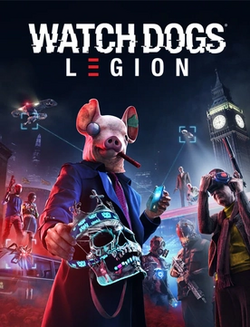

Watch Dogs: Legion is an ambitious engineering exercise disguised as an open-world hacking thriller. Ubisoft Toronto took the series' existing toys-hacking, guns, cars, drones-and rewired the architecture around one headline mechanic: recruit-anyone. On PS4 this feels like both a clever systems design and a stress test for a half-decade-old hardware platform. Expect creativity, systemic depth, and the kind of technical rough edges that bloom when a sprawling, procedurally-flexible sandbox meets a console that doesn't have headroom to spare.
Legion's gameplay is a long checklist of subsystems interacting in non-linear ways, and that's where its technical interest lies. At the highest level you still have third-person shooting, driving, parkour and classic stealth; the distinct shift is that the player is no longer one protagonist but a roster of operatives recruited from London's simulated populace. Each NPC has a set of traits, perks and occupations that change what tools and approaches are viable. Mechanically this is impressive: the game has to synthesize hundreds of AI profiles, weapon/gadget combos, and procedural recruitment missions without hard-coding outcomes. From a systems perspective, that requirement creates several constraints and trade-offs. NPCs have modular trait packages (spy, hooligan, builder, adrenaline-junkie, first responder, etc.) and the game resolves those modules into functional abilities and inventories at runtime. That lets the player approach a mission using orthogonal strategies-remote hacking through cameras and devices, brute force gunfights, or pure stealth-because the engine routes each operative's available affordances into the mission's possible solutions. Operatives also gain XP and can unlock abilities, and the global tech tree (tech points gathered in-world) augments all operatives, which is a neat separation of per-operative progression versus shared upgrades. Permadeath is another interesting technical decision. When enabled, it requires the game to track an evolving roster state that can end a campaign if you mismanage it. That statefulness is deceptively complex: the engine must persist operatives' locations, injuries, arrests, and timers (incarceration/hospitalization cooldowns), while also ensuring the world continues to behave coherently around their absence. In non-permadeath games, operatives are arrested or hospitalized with cooldowns, which creates yet another state machine the game must service. The system is generally solid, and it produces emergent stakes; you can develop an attachment to a character precisely because the code can obliterate them. Hacking is Legion's connective tissue. The ctOS network and Bagley AI provide an in-world interface to cameras, turrets, drones, ventilation shafts and other environmental nodes. The game's camera and device graph is well-designed for tactical play: once you gain line-of-sight via a camera, the world fragments into actionable nodes (open a gate, fry a drone, short a turret). That modular device graph allows for multi-stage approaches-e.g., hack CCTV to locate a target, drop a trap in a vent, then trigger it with a remote drone. The camera network's usefulness makes recruitment strategy matter: operatives who bring stronger remote tools are far more valuable than the curry-tasting NPC who can kick down doors. Combat and enemy AI are mixed. Enemies shift tactics based on player actions-melee if you start punching, ranged if you draw a gun-and that dynamic is a small but meaningful AI flourish. However, firefights on PS4 can reveal the platform's limitations: enemy counts, animation transitions and cover behaviors can feel inconsistent at times. Driving is the least refined mechanical area; many reviewers called the driving 'chunky', and on PS4 the vehicle physics and handling respond with a sense of latency and imprecision compared to tighter racing or action games. Vehicle AI and traffic density also had to be scaled to keep the PS4's CPU from melting, which manifests as simplified traffic behavior and occasional pop-in. The online layer, added months after launch, introduced cooperative tactics, city events, Tactical Ops and a Spiderbot arena. Technically, merging single-player progression with multiplayer required careful syncing of operatives, influence currency and unlocks across sessions-this was non-trivial and the team delayed the mode to avoid releasing a broken product. The seasonal progression for the online roadmap is also a server-side mechanism layered on top of client progression; it works, but you can still feel the seams when weekly collectible locations change server-side while players on PS4 with inconsistent connectivity experience lag and longer load times. Underneath the systems, Legion is an enormous data streaming challenge. London is divided into boroughs, landmarks and Underground stations; the engine streams assets, NPCs and AI states while you traverse on foot, in vehicles or via transport hubs. On modern hardware that streaming is invisible, but on PS4 you will catch LOD transitions, texture pop, and occasional asset streaming stutters-symptoms of pushing a dense, NPC-heavy simulation onto limited RAM and I/O bandwidth. Ubisoft patched many of the worst performance issues post-launch, but the fundamental trade-offs remain: diversity and systemic NPC simulation in exchange for some visual and performance concessions on last-gen hardware.
Graphically, Legion aspires to a photoreal London but hits the PS4's ceiling. The city layout includes well-known landmarks and eight boroughs of London, which gives the world a believable silhouette, and the texturing and lighting do a decent job conveying a near-future dystopia. Where the PS4 shows its limits is in texture resolution, draw distance and crowd density-textures are often blurred at close range, distant geometry pops, and crowds reuse models more than the PC/next-gen versions. Animations benefit from motion-capture-Ubisoft even used Stormzy for an in-game mission-but when you zoom across the Thames or zoom into high-action set pieces, frame pacing hitches and lower-detail LODs become more evident. The PC/next-gen builds support ray tracing and NVIDIA DLSS, but those features are irrelevant to PS4 owners. On PC and new consoles they can dramatically improve lighting fidelity and performance (DLSS trades spatial resolution for temporal upscaling on NVIDIA hardware), but PS4 gets a baked version of Ubisoft's lighting model without those enhancements. Particle systems, reflections and volumetrics are scaled down; however, the art direction is strong enough that the city's aesthetic survives the downgrade. In short: the PS4 render pipeline prioritizes stable framerate and memory-friendly assets over cutting-edge lighting, which is sensible but not glamorous. Performance was a major talking point at launch-bugs, server issues and odd AI behavior led to a buggy opening window. Ubisoft's post-launch support patched many of these issues and added content, but the baseline PS4 experience remains technically constrained compared to newer platforms.
Watch Dogs: Legion is fascinating from a systems-design perspective. Its multi-agent recruitment mechanic, permadeath options and device-based hacking form a web of interacting subsystems that produce emergent gameplay moments-sometimes brilliant, sometimes awkward. On PS4 those emergent highs are tempered by the hardware's limits: texture pop-in, reduced crowd fidelity, tepid driving physics and occasional frame hiccups. If you're intrigued by sandbox simulations where the player's toolbox is shaped by who you recruit, Legion offers a generous playground and the satisfaction of solving problems with available systems rather than rote combat. If you value pristine visuals, tight vehicle handling or a protagonist with a scripted personality, Legion on PS4 will feel like a trade-off. Technically ambitious, narratively sprawling and occasionally brittle, Legion is worth playing for its ideas more than its polish on PS4. Consider it a clever experiment that mostly works-especially after patches-and one that points the way toward how open worlds might behave when NPCs stop being wallpaper and start being tools. Bring patience, enjoy the systemic toys, and don't get emotionally attached to your favourite operative unless you actually mean it-those permadeath options are real, and the PS4 will remind you why engineering compromises are a developer's daily bread.
 Watch Dogs 2 on PS4
 Watch Dogs on PS4
 Watch Dogs: Legion on PS5
 Project Awakening on PS4
 Tintin: Destination Adventure on PlayStation
 Digimon World Data Squad on PS2
 Action Man: Operation Extreme on PlayStation










 Another SquareThought Site