

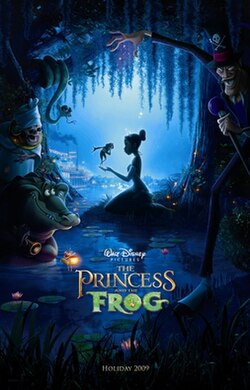

Licensed tie-ins have a reputation. That reputation is not invited to tea and will not be staying for second helpings. The Princess and the Frog on Nintendo DS is a November 2009 tie-in companion to Disney's hand-drawn return to form - a film celebrated for its artful backgrounds and jazz-soaked soundtrack. Disney Interactive Studios describes the handheld game as an "adventure through the exciting world of New Orleans," which is marketing-speak for "yes, you will visit several very pretty locales and play a lot of minigames." The game promises family-friendly content and events pulled from the film's story: Tiana's restaurant dreams, Prince Naveen's unfortunate amphibian status, a villain with a top hat and questionable friends on the other side. If you own the DS and enjoy Disney, the box copy reads like a comfortable dinner invitation. If you are the kind of person who likes handheld games to be little self-contained miracles of clever design, the invitation is more along the lines of a polite RSVP: 'Maybe, depending on the weather.' This review looks less at the movie's return to traditional animation (that got its own Oscar chatter) and more at what showing up on a DS cartridge does to Tiana's world: how the plot is distilled, which characters get spotlight time, and whether the gameplay actually complements the film's strengths (music, atmosphere, and character). Spoiler: the DS is not big enough for Randy Newman's full brass band, but it tries.
The document Disney released alongside the film is refreshingly frank: the DS game is an 'adventure through the exciting world of New Orleans' and includes events from the film and 'challenges for Princess Tiana.' That level of modesty is useful, because at face value the DS version is exactly what you'd expect from a licensed family title on Nintendo's handheld in 2009: a loosely connected sequence of story beats stitched together with minigames, simple fetch-object mechanics, and the occasional light platforming section. You play primarily as Tiana. The core loop revolves around moving between locations - the bayou, Mama Odie's hut, the steamboat, and Charlotte's ballroom - and completing scene-appropriate tasks. If the film's emotional spine is 'work hard, dream harder,' the game's spine is 'tap the stylus, collect the thing.' It's efficient. Tiana collects ingredients, solves small puzzles to unlock the next cutscene, and occasionally takes part in rhythm or cooking minigames that imitate her culinary ambitions. These segments are simple: follow prompts, mash the stylus in time, rinse, repeat. Younger players will find the difficulty curve gentle; older players may file these segments away as 'pleasant distractions.' The DS's dual-screen setup is used for inventory and map information, which is sensible, if unimaginative. The touch screen keeps the controls approachable: tap to interact, drag to mix, slide to emulate cutting or stirring. There are short sections that let you control other characters - Louis gets a jazz-based minigame that is the closest the game comes to honoring the film's musical heart, and Ray features in earnest fetch-and-escort tasks. Dr. Facilier appears in boss-like set pieces that play out like quick-time events; the game never attempts to make Facilier genuinely scary, which is appropriate for its target audience and frankly wise given the DS's tendency to render 'spooky' as 'mildly concerned shading.' A small unlock system offers costumes and simple cosmetic goodies: a beignet recipe card here, a fancy dress there. These unlocks do not much alter gameplay, but they provide a sense of progress. There's also a character-unlock gimmick that mirrors other Disney games of the era: perform well in a challenge and you might 'earn' access to another character's mini-adventure. This creates an illusion of variety without requiring the developers to build deep, character-specific mechanics. The narrative structure is faithful to the movie in broad strokes. Tiana wants a restaurant, Naveen is a frog, Facilier is plotting, Ray is tragically optimistic - the beats hit, sometimes in compressed form, occasionally with odd leaps between scenes that read like reading the synopsis out loud while someone else hits the 'next' button. Cutscenes use still images and limited animation with voice samples rather than full-motion sequences. If you were expecting the film's theatrical choreography and long musical numbers to feel 'cinematic' on the DS, you will be disappointed; the system is good enough for the gist, not the grandeur. Challenge variety is the game's saving grace and its weakness. There are cooking minigames, rhythm sequences, simple stealth sneaks (sneak past a hunter to avoid capture), and a couple of short chase scenes. Each is competent enough to avoid boredom for a couple of hours, which is the sweet spot for licensed handhelds: they entertain the children, keep grown-ups sane for car rides, and then quietly exit the stage. For completionists, there are collectibles scattered around each map: recipe pieces, beads for Mardi Gras, and hidden letters. These extend playtime but mostly reward grinding rather than discovery. Multiplayer? The DS game is a single-player experience. Given the film's emphasis on community and shared music, a local co-op mode would have been a charming addition, but the decision to focus on single-player keeps development tidy and predictable. Overall, the gameplay doesn't reimagine Tiana's story; it repackages it in bite-sized interactive forms aimed at a young audience. It is competent, unambitious, and occasionally thoughtful when a minigame mirrors a movie moment - like the serene 'help the bayou critters find their rhythm' bit that feels like the developers read the film and tried to remember what made them smile.
The DS isn't a canvas for Randy Newman's brass or Disney's hand-painted backgrounds, but the game tries to replicate the film's visual identity in a scaled-down form. Character sprites are cartoonish and rounded, more 'storybook sticker' than the film's sculptural 2D drawings, but they are expressive enough. Backgrounds are simplified, painted on the top screen with cute, block-colour versions of New Orleans facades and bayou brush. The art direction borrows from the movie's inspirations: Lady and the Tramp-era warmth in the city scenes, and a Bambi-like softness in the bayou sequences, but everything is flattened for the DS's sprite-based limitations. Animations are economical. Expect a walk cycle, a few reaction poses, and a flourish for completed minigames. The 'Almost There' sequence from the film - the one with the art-deco, Harlem Renaissance-inspired visuals - is reduced to a stylized menu card. That is not a failure so much as a translation decision; the DS can suggest style, it cannot replicate it. Sound does what it needs to do. The DS's speakers are tinny, and full-band jazz is inevitably condensed into staccato loops and midi approximations. Voice clips are sparing, used to punctuate cutscenes rather than deliver extended lines. For the target audience, the music cues and character zips are satisfying enough to maintain atmosphere. For anyone who loved the film's lush orchestration, the DS soundtrack will be a reminder that some things are best experienced in a theater with actual brass instruments.
The Princess and the Frog on Nintendo DS is a faithful, modest translation of a beloved Disney property into the limitations and expectations of a 2009 handheld. It neither reinvents the genre nor commits any cardinal sins. It offers simple, accessible minigames, an agreeable if thin linking narrative, and art that politely nods to the film without trying to outpaint it. If you are buying this for a child or as a gentle, short diversion during travel, it serves its purpose. If you are the person who demands that every licensed game be an auteur-level reinterpretation, the DS cartridge will not make you reconsider your life choices. There is real value in a game that provides two to four hours of pleasant content, which is what this is: a dessert course after a big theatrical meal, not the full-cooked dinner. Score: 6/10. Solid, serviceable, and occasionally charming - like a well-made beignet that leaves you satisfied but not slapped by culinary genius.
 Crash Bandicoot: The Wrath of Cortex on PS2
 MLB The Show 22 on Switch
 Ōkami on PS2
 Tintin: Destination Adventure on PlayStation
 One Piece Grand Adventure on PS2
 Taiko no Tatsujin: Dokodon! Mystery Adventure on Switch
 Taiko no Tatsujin: Don to Katsu no Jikū Daibōken on Switch
 Disney's Meet the Robinsons on DS
 Sonny with a Chance on DS
 Disney Planes on DS
 Jonas on DS












 Another SquareThought Site