

 Feb 2019


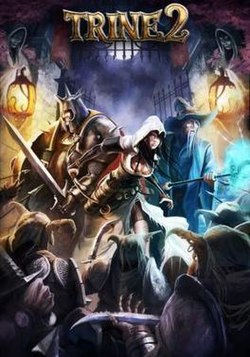
Trine 2: Complete Story on Switch arrives like a well-crafted mechanical pocket watch - charming, precise, and a little heavy for its size. Frozenbyte's sequel refined the three-hero puzzle-platform formula from the original and bundled in the Goblin Menace expansion plus the Wii U Director's Cut exclusive Dwarven Caverns for the Complete Story edition. On Switch, this package gives you the full content library in a handheld-capable form factor. From a technical perspective the headline is simple: you get the same core physics-based puzzle design and deterministic interactions driven by Frozenbyte's Storm3D engine, wrapped in the portability of the Switch hardware. For players who geek out over collision stacks, interpolation, and how a grapple hook handles microstutter, this port is an opportunity to evaluate an indie's approach to multi-platform scaling rather than a flashy next-gen showcase.
Under the hood Trine 2 is essentially a mechanical symphony of role-switching, object spawning, and vector math. You control one of three heroes at a time - Amadeus the wizard, Zoya the thief, and Pontius the knight - and you can swap freely to combine their toolsets. The wizard's ability to spawn physical primitives (boxes and planks) is the game's most interesting systems-level mechanic: those objects obey the physics engine, create new collision bodies, and change the way momentum transfers through the level. From a technical standpoint that means every spawned plank adds to the solver cost every frame. On consoles and PC that was temperamental; on Switch you can see why Frozenbyte packaged a lot of tuning into the Complete Story: they had to make the physics determinism stable across multiple platforms and framerate targets. Combat and mobility are less CPU-heavy but still expose the engine's event model - Zoya's grapple hook is a client-side input with server-like consequences in local co-op. The game supports up to three players in co-op, and crucially the skill tree and session persistence are host-centric. That design is typical for small studios: keep authoritative state with the host to reduce desync complexity. It also means if you're playing multiplayer on Switch with friends and the host drops, you can expect a resume behavior tied to the host save rather than seamless handoff. It's a pragmatic approach that minimizes network edge cases but has UX implications for long co-op sessions. Lives and checkpoints are simple but mechanically fair. Each character has an independent life meter, and individual death removes that character until the next checkpoint. If all three go down you reload the checkpoint - a design choice that reduces save-write frequency (less wear on cartridges, theoretically) and keeps the game loop tight. Skill points are awarded for collecting magical vials (fifty per point), and the shared pool mechanic lets you shift upgrades between characters. That shared currency design both reduces save complexity and creates an obvious single-source-of-truth for progression state, which is safer for a cross-session environment on a portable console. Level design in Trine 2 is a showcase of mixed-modal puzzles. The Goblin Menace DLC introduces puzzle variants based on light, water, low gravity, and magnetism. These mechanics are interesting because they layer additional solver constraints on the physics engine: reflective surfaces change raycasts, buoyancy forces alter rigid body integration, and magnetic zones apply external force fields. From a technical viewpoint, each new element increases the per-frame complexity and the chance of emergent bugs - and yet the Complete Story edition bundles these reliably, which says something about Frozenbyte's QA loop for the final builds. The only major caveat for speedrunners and latency hawks is that deterministic physics across frame drops is hard; you'll notice slight changes in object behavior if the framerate dips noticeably, but gameplay rarely breaks because the puzzles are forgiving rather than twitch-dependent.
If you're grading Trine 2 visually on artistry rather than raw pixel density, it still holds up. The Storm3D engine leans on painterly lighting, lush parallax layers, and hand-authored background art that masks lower polygon counts. For a technical review the important bits are LOD strategy, post-process, and lighting cost management. Frozenbyte uses multiple depth layers and modest post-fx to create depth without demanding GPU firepower. That's efficient on Switch hardware: instead of brute-forcing resolution they favor stylistic shading and composited layers, which scales down well in handheld mode. The Director's Cut Dwarven Caverns level and Goblin Menace content add more varied material to the rendering set - lava pits demand bloom and emission, underwater scenes use desaturation and caustic overlays, and magnetic puzzles often layer particle systems on top of rigid-body interactions. Each of these increases draw calls and shader permutations, so smart batching and texture atlasing become important. In practice the game presents as a carefully budgeted title; there are no extravagant shader effects, but the art direction compensates. The Metacritic score for the Switch edition (87/100) reflects that players and critics saw the port as competent and faithful. For pixel peepers: expect resolution and framerate compromises compared to high-end PC, but the visual language and physics fidelity - the things that matter for puzzle clarity - are preserved.
Trine 2: Complete Story on Switch is a textbook example of how to port a physics-heavy indie title responsibly. Frozenbyte bundled the base game, Goblin Menace, and the Dwarven Caverns content into a single package and made technical choices that protect puzzle integrity while fitting the Switch's performance envelope. The shared skill tree and host-centric save model reduce synchronization headaches in co-op, and the Storm3D-driven physics, while not immune to the usual frame-rate-dependent quirks, remain deterministic enough to keep puzzles solvable and emergent behavior entertaining rather than game-breaking. You won't get photorealism, and you may notice the occasional physics wobble if the hardware gets stressed, but what you do get is a coherent, well-tuned experience with a ton of content. Score-wise this is an 8.7 out of 10 because the game nails the technical priorities of a puzzle-platformer - stable physics, readable visuals, and robust co-op design - while holding back only in absolute graphical fidelity and the inevitable port compromises. If you care about mechanical consistency and portable co-op, Trine 2: Complete Story is a very smart purchase. If you expect bleeding-edge graphics or a flawless, frame-rate-agnostic physics engine, pack some patience with your joy-con. Otherwise, grab a friend, spawn a plank, and enjoy watching the laws of virtual physics be convincingly broken for your benefit.
 Trine 2 on PS3
 Trine 4: The Nightmare Prince on Switch
 Trine: Enchanted Edition on Switch
 Puzzle by Nikoli 4: on PS4
 Twinbee Taisen Puzzle Dama on PlayStation
 Tokimeki Memorial: Taisen Puzzle-Dama on PlayStation
 Professor Layton and the Last Specter on DS
 Has-Been Heroes on PS4










 Another SquareThought Site