

 Nov 2018


Trine: Enchanted Edition on the Switch is like a tiny medieval brain-gym wrapped in fairy-tale frosting. It's the 2014 remake of Frozenbyte's 2009 cult hit, rebuilt on the Trine 2 engine and blessed with online co-op - and yes, it still wants your eyes to trick your thumbs and your brain to do geometry on the fly. If you enjoy puzzles that demand equal parts timing, tinkering, and three-character choreography, this game will scratch that itch. If you prefer button-mashing your way through a fantasy, you might be tempted to toss the controller into the nearest enchanted pond. This review focuses on the challenge aspects and the skills required to beat the game rather than fluff about plot or nostalgia. You'll be switching between Zoya the Thief, Amadeus the Wizard, and Pontius the Knight a lot - and the degree to which you enjoy Trine will largely depend on how pleased you are by mastering their idiosyncratic tools and the physics engine that makes the whole thing hilariously volatile.
Trine's central mechanical beast is its character-swapping puzzle-platform loop. The player toggles between three heroes, each tuned for different kinds of thinking and muscle memory. The thief is your precision specialist: bow and grappling hook require fine aim, measured shot-charging, and a real feel for trajectory. The grappling hook introduces momentum puzzles that reward a light touch - fire at wooden surfaces, swing, time releases, and pray physics doesn't implode. If you can reliably line up a charged arrow for a narrow opening while juggling a moving platform, congratulations: you've entered Trine's sweet spot. The wizard is the pure problem-solver. His core power is conjuring and telekinesis. He starts with a single cube and later gets planks and floating platforms. Mastery here is spatial reasoning and patience: spawn an object, nudge it where gravity, weight, and momentum will carry it, then use that temporary geometry to bridge gaps or crush enemies. The physics engine (PhysX) is not a predictable block-tile system - it behaves like real objects. That's brilliant because it allows creative solutions, and terrifying because a slightly off-angle shove can turn your carefully placed bridge into a pile of rolling cubes that take you and your progress with them. Success with the Wizard rewards foresight: visualize the sequence of events, anticipate how a block will bounce, and stop expecting modular, deterministic responses. Trine punishes assumptions. Pontius the Knight is the reflex and brute-force option. Close-quarters combat, shield blocks, and heavy lifting are his domain. He's your go-to for pushing, heaving, and charging through traps, but the Knight's usefulness extends into puzzle-solution territory when you need a weight to hold down a switch or someone to toss a boulder into an enemy's skull. Timing matters here: shield blocks can deflect projectiles and falling objects, but you'll need reaction speed to use them effectively in sequences that pair platforming with combat. Resource management adds a light meta-layer of challenge. Health and energy are separate, with energy consumed by the Wizard's magic and later by flaming arrows or fire swords. Blue bottles refill energy, hearts restore health, and both are limited. Experience points are shared across characters and grant upgrade points at fixed thresholds, so choosing which abilities to improve involves planning. Do you invest in faster bow charge, better conjured platforms, or more sledgehammer attacks? Your choices materially alter how hard certain sections feel. Trine invites you to play to your strengths: upgrade what helps you solve the puzzles you like. Enemy and environmental threats are straightforward but effective: skeletons (with swords, shields, bows, or fire), spiders, bats, bosses, lava, pendulums, fireballs, and booby traps. None are wildly inventive individually, but they combine with platforming and physics to create memorable gauntlets. The real challenge is sequencing - mixing combat with puzzle-solving so you're thinking three steps ahead while also keeping your timing razor-sharp. Checkpoints are silver orbs that resurrect dead characters and replenish a portion of health/energy depending on difficulty. If all three die, you respawn at the last checkpoint, so the game nudges you toward conservative play rather than punishing experimentation. That said, higher difficulties give you tighter margins, demanding more precision and better resource juggling. Multiplayer changes the skill set. Trine's puzzles are designed for three characters, and co-op lets friends control each hero simultaneously. This ramps up both the fun and the chaos: cooperative play rewards communication, role discipline, and synchronized timing. Someone has to be the lifeline who conjures platforms while another times a grappling swing and the third holds off enemies. Online multiplayer (added in the Enchanted Edition) also means you can rely on other people's problem-solving styles, which can be an asset or an exercise in frustration if teammates disagree on the physics-based solutions. The single-player mode, however, is a masterclass in multitasking: you will frequently act as a one-person band, switching characters mid-fall, juggling cooldowns and energy, and mentally mapping how a cube you place now will affect the situation two seconds later.
Graphically, Trine looks like a moving storybook that occasionally throws sharp spikes at your ankles. The Enchanted Edition benefits from the Trine 2 engine: lush backgrounds, parallax layers, and animated touches make the environments feel lived-in. The art style hides the fact that the game's meat is its mechanics - everything looks fairytale-pretty while being mechanically devious. On the Switch, the visuals are faithful to the Enchanted Edition, though you should not expect bleeding-edge frame rates or ultra-resolution textures. The visual clarity is good enough to read geometry and spot traps, which is essential - misreading a platform's size or a pendulum's arc will lead to repeated deaths. Importantly, animation cues are clear: enemy tells, trap motions, and object reactions are readable, which is crucial when timing and precision are the heart of challenge.
Trine: Enchanted Edition on Switch is a charming test of practical problem-solving. The challenges are less about twitch-only reflexes and more about combining fine motor skill (for aiming and timing), spatial imagination (for conjuring and constructing), and resource/upgrade planning. The physics-driven puzzles reward curiosity and punish sloppy assumptions; a slight misplacement or mistimed swing can cascade into catastrophe or glorious success. Multiplayer adds cooperative coordination as a skill to master. If you like puzzle-platformers that make you feel smart and occasionally mortified, Trine is worth the ride. If you want a pure combat gauntlet or an enemy buffet that reinvents itself every level, the game's relatively limited enemy variety and predictable foe types might disappoint. Overall, it's a satisfying, brainy adventure that's best appreciated by players who enjoy learning the rules and then gleefully breaking them with clever solutions - preferably before the lava does it for you.
 Trine 2 on PS3
 Trine 4: The Nightmare Prince on Switch
 Tintin: Destination Adventure on PlayStation
 One Piece Grand Adventure on PS2
 Onimusha: Dawn of Dreams on PS2
 Taiko no Tatsujin: Dokodon! Mystery Adventure on Switch
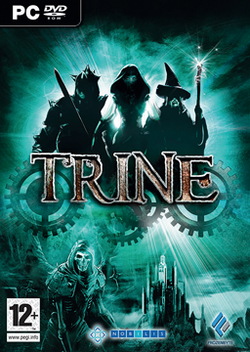
 Trine on PS3
 Has-Been Heroes on PS4










 Another SquareThought Site