

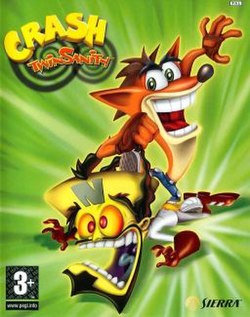

Crash Twinsanity tried to do two things at once: give the legacy platforming mascot a breath of open-world air, and let the franchise's main villain embarrassingly hog the spotlight. On PS2 this produced a game that is mechanically creative in patches, narratively giddy, and technically uneven. The title was reborn mid-development from a darker 'Evolution' concept into the slapstick-heavy Twinsanity we got, and that fork in the road shows in the codebase - there's ambition everywhere, but also a patchwork of systems that don't always agree. If you're the kind of player who inspects hitboxes like fine china and can forgive a temperamental camera for a smart concept, Twinsanity is worth dissecting. If not, you'll probably be swearing at invisible walls while Cortex monologues at you in a very excited voice.
At its mechanical core, Twinsanity is Crash Bandicoot trying to behave like a lightweight 3D action-adventure rather than the strict corridor-run-and-jump formula of earlier entries. The most significant systemic change is the move to free-roaming zones with seamless transitions between encounters, abandoning the old hub-room/strict-stage model. This architectural shift opens up design benefits - emergent pathing, multi-direction exploration, and level sequencing influenced by narrative beats - and also raises technical complexity: streaming assets, level-of-detail (LOD) transitions, and more dynamic camera placement. The game cycles control between Crash, Cortex, and Nina (in a few sections), plus hybrid modes where Crash and Cortex function as a single controllable unit. That dual-character integration is where Twinsanity is most interesting from a systems perspective. Crash's platforming kit is textbook: spin attack, slide, body slam, and stomp - simple inputs, predictable outputs. Cortex introduces ranged mechanics with a limited-ammo raygun and physics interactions: being hurled to trigger switches, used as a battering hammer, or strapped to create the HumiliSkate snowboard. The combined-control segments are effectively state machines: player input toggles active actor, but many actions spawn context-sensitive animation sequences that must lock both characters into shared ragdoll/kinetic states. When those states were well-implemented the result is satisfying choreography; when not, animations fight for control, input buffering goes haywire, and the player experiences what I like to call 'rubber-band bandicoot' syndrome. Design-wise, the inclusion of distinct gameplay modes (HumiliSkate, Doc Amok, RollerBrawl, and RollerBrawl-like brawls) is intelligent because it lets the engine recycle core assets while presenting different mechanical constraints: timed escort (Doc Amok), Lemmings-esque path clearing, and corridor-constrained brawling with physics interactions. The Doc Amok levels are a highlight because they flip control expectations: you're clearing the way for an AI Cortex rather than directly managing the protagonist's traversal. This demands solid AI state machines for pathfinding and obstacle negotiation - and Traveller's Tales pulled it off well enough that reviewers compared it favorably to Lemmings. However, technical debts erode the experience. Collision detection is inconsistent; reviewers noted finicky collisions and invisible barriers, a symptom of either inaccurate collision meshes or sloppy layering between trigger volumes and physical geometry. Long animation sequences with limited interruptibility create the sensation of sluggish controls: when Crash is mid-body-slam or shunting Cortex along as a snowboard, player agency is often temporarily suspended by non-cancellable animations. On PS2, this contributes to a perception of sluggishness that the Xbox version avoided to some extent. Checkpointing and autosave behavior were another sore spot. Sparse or poorly placed checkpoint crates amplify the friction of repeated platforming failures, and the game's save model (world crates for progress, checkpoint crates for respawn) sometimes mismatches player expectations. From a UX engineering standpoint, Twinsanity could have benefited from more granular autosave hooks and smaller respawn radii to reduce punitive repetition. Collectibles (Wumpa Fruit and gems) serve dual roles - health/lives economy and meta-progression to unlock extras - and are implemented cleanly. TNT and Nitro crate logic (timed fuse vs. contact-triggered explosion, plus plunger crates that chain-detonate Nitro) are simple and deterministic, which is a good thing when the camera and collisions are unreliable. Determinism in explosive logic reduces perceived unfairness, because if a TNT always behaves the same way you can adapt. It's the invisible collisions and camera that make those predictable systems feel capricious.
Visually, Twinsanity is a classic mid-generation PS2 affair: bold, cartoon-like art direction masking platform hardware limits. Character models - especially Crash and Cortex - received notable attention. Animations are more expressive than in earlier series entries, using smoother interpolation and more distinct poses to telegraph personality. These are the moments where the game's production values shine: facial expressions, snappy choreography when the pair bicker, and FMV sequences that reviewers called polished. Unfortunately, the FMVs are unskippable, which is a design/implementation choice that democratically torments anyone replaying levels to farm gems. On the technical rendering side, the PS2 port lags behind the Xbox version in particle effects, lighting fidelity, and frame pacing. Multiple outlets pointed out inferior particle/lighting on PS2 - not surprising given the PS2's more limited fillrate and shader-like capabilities (remember, this is before real programmable shaders were widespread on consoles). The art team compensated with saturated textures and clear silhouette work, which helps readability but doesn't hide the low texture resolution and short draw distance. A short draw distance and aggressive LOD reductions are evident in open zones: distant geometry pops, and the level streaming prioritizes immediate collision geometry over scenic detail. That's a predictable tradeoff for streaming levels on PS2, but it reduces the sense of scale the free-roaming architecture attempts to sell. Engine-wise, occlusion culling and LOD seem tuned conservatively, likely to preserve frame rate during the heavier scripted sequences (Robot fights, Uka Uka encounters, and RollerBrawl physics). The PS2 suffers occasional frame dips where many NPCs, particle systems, and scripted physics events collide. TeamXbox and GameSpot both noted that the Xbox version maintains cleaner frame stability, which implies Traveller's Tales targeted a common codebase and then scaled down assets and certain effect contributions for the PS2 build. Collision and hitbox design reappear here: reviewers observed that invisible walls and awkward collisions (especially during platforming) felt like arbitrary constraints. From a technical perspective that can stem from separate collision meshes for navigation and visual geometry, or poorly tuned capsule colliders that don't match mesh silhouettes. Either way, the result is player frustration when trajectory and perceived impact points don't line up. Audio is a mixed bag but technically interesting. The soundtrack is performed by a cappella group Spiralmouth and recorded/mixed by Gabriel Mann - an unusual choice for a platformer. The vocal arrangements create a distinctive sonic identity (barbershop quartet meets jungle percussion), but the production is polarizing: some tracks are inventive and add character; others grate after repetition. Voice acting, on the other hand, is consistently praised: Lex Lang's new take on Cortex adds performance nuance that writing and direction leaned into. From an audio engineering viewpoint, the voice mix and FMV audio are well integrated; it's the looping music beds that suffer from repetition and lack of dynamic layering to mitigate listener fatigue.
Crash Twinsanity on PS2 is a study in ambition tempered by platform constraints and mid-development course correction. Mechanically it earns points for inventive level designs (Doc Amok, HumiliSkate, RollerBrawl) and for integrating dual-character interactions that can feel novel and mechanically rich. The engine and art team did admirable work creating expressive characters and polished FMVs, and the a cappella soundtrack gives the title an identity rarely seen in licensed platformers. On the flip side, the PS2 build shows its compromises: shorter draw distance, weaker particle/lighting, frame dips during scripted sequences, and - most importantly for a platformer - camera and collision problems that undermine the precision the genre requires. Sluggish control responsiveness and occasionally punitive checkpointing turn some clever design into frustration. In short: Twinsanity is more interesting on paper and in parts than it is consistently fun to play, at least on PS2. If you're evaluating it from a technical purist's perspective, appreciate its architectural pivot to open zones and the complexity that added, but don't be surprised when platforming falls prey to animation lockouts, hitbox mismatches, and camera tantrums. If you're buying it for Cortex's performance, the unusual soundtrack, and smart mode variety - and can tolerate a finicky camera - you'll get an entertaining, if imperfect, experience. If you need tight, unambiguous platforming, this is probably not the Crash for you. As a piece of mid-2000s console engineering, Twinsanity is worth examining: it shows how gameplay ambition, engine limitations, and production timelines collide - sometimes with hilarious results, sometimes with the character walking into an invisible wall and dying. Either way, it's memorable.
 Crash of the Titans on PS2
 Crash: Mind over Mutant on PS2
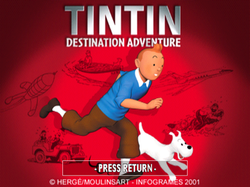
 Tintin: Destination Adventure on PlayStation
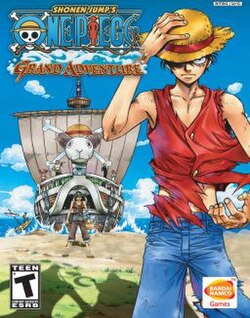
 One Piece Grand Adventure on PS2
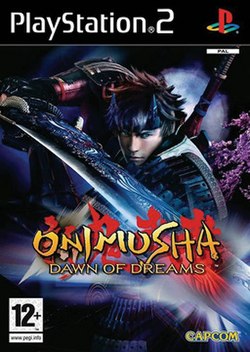
 Onimusha: Dawn of Dreams on PS2
 Taiko no Tatsujin: Dokodon! Mystery Adventure on Switch












 Another SquareThought Site