

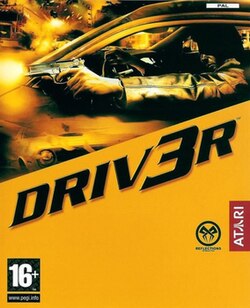

Driver 3 arrives wearing sunglasses and a leather jacket, promising the cinematic car-chases of the series but with the audacity to also hand you a pistol and a pair of walking shoes. On PlayStation 2 this was the version most players remember - not always fondly. The game expands the Driver formula: three free-roam cities (Miami, Nice, Istanbul), on-foot sequences, gunplay, boating, motorbikes and a director mode that lets you re-edit your own chaos. It also comes with the kind of narrative ambition that wants to be a pulpy noir movie and sometimes behaves like a fever dream written on a napkin. For anyone interested in characters and story arcs, Driver 3 is equal parts intriguing sketch and unfinished painting: the bones of memorable arcs are present, the execution occasionally gets rear-ended by clumsy controls and puzzling design choices.
Driver 3 grafts new gears onto an existing chassis. At its core it is still about being John Tanner - the FBI's undercover wheelman - and using cars as your primary language. Missions in 'Undercover' send you in and out of vehicles, often under strict conditions: timed getaways, chase takedowns, and the occasional mission-critical car that demands you treat it like a fragile celebrity. 'Take A Ride' opens the throttle for exploration in three partially faithful city recreations, while 'Driving Games' supplies challenge modes if you miss the thrill of being chased down yet another winding alley. Mechanically, the game tries to be many things at once. The addition of on-foot sequences and gun combat is narratively welcome - Tanner isn't a cartoon car; he's a person who sometimes needs to run, shoot, and sneak - but these segments are where Driver 3's personality clashes with its engineering. Shooting feels awkward, with aiming and animation transitions that often remind you you are playing a title primarily designed by people who love cars more than hand-to-hand combat. Swimming, speedboats and motorcycles broaden the palette and the map feels alive with traffic and NPCs, yet the controls can be stiff: a car that once handled like a dream in a predecessor might now feel like a shopping cart with delusions. The notoriety system does its job: do illegal things and the cops will make your life difficult, and the varying police responses add texture to otherwise repetitive pursuits. From a story-structure point of view, gameplay choices are tied to character beats. Tanner is the puppet master behind the wheel and the moral fulcrum in the narrative: he must perform acts of criminality to maintain cover, yet his choices steer him toward a cliff. The missions that force him to choose between following Interpol protocol (Vauban and Dubois) or keeping Calita's trust drip-feed small ethical crises into the driving missions. This interplay between duty and deception is subtle and often overshadowed by cockpit chaos, but when it lines up - you escaping a botched deal while internally wrestling with whether to expose a cartel contact - it gives the action a welcome human edge. The on-foot sections are where character relationships most visibly evolve. Tanner's interactions with Tobias Jones, the loyal partner who carries the badge of a straight-playing FBI man (and the voice weight of Ving Rhames), create an odd-couple dynamic. Jones is the moral echo Tanner keeps losing and finding. Dubois and Vauban, the Interpol sides, operate as both procedural obstacles and narrative mirrors: Vauban represents the 'by-the-book' temptation to arrest early, whereas Dubois' fate becomes the dramatic pivot that forces Tanner to choose to go rogue. Bad shooting mechanics and occasional clumsy stealth do sometimes undercut emotional moments, but the plot still delivers: capture, betrayal, and revenge are presented with a cinematic cadence that is bolstered by strong casting - Michael Madsen as Tanner, Mickey Rourke as the slippery Charles Jericho, and Michelle Rodriguez as Calita - even when the camera or the AI fails to cooperate. The pacing is predictably episodic: Miami sets the scene, Nice complicates loyalties, Istanbul detonates the consequences. Missions that should feel character-defining - like the attempt to assassinate or save 'The Gator' - sometimes become just another checkpoint because the mechanical difficulty overshadows narrative weight. Still, the game nails one crucial thing: each gameplay genre addition serves plot beats. Drive-bys and vehicle chases aren't just fun toys - they are how Tanner proves himself, wins trust, or gets boxed into a corner. That marriage of gameplay and story concept is the title's best trick, even if the join sometimes squeaks.
Driver 3 brags about its cityscapes and, most of the time, it can back that brag up. Miami's sun-drowned avenues, Nice's seaside boulevards and Istanbul's labyrinthine streets feel distinct, with an attention to scale that makes you believe you're driving through real places. The crashes, which reviewers at the time praised, look spectacular for a PS2 game; cars crumple and chaos blooms across intersections in a satisfyingly kinetic way. The environments are detailed enough to reward free-roam driving and director mode edits, and the fact you can slam into '30,000 buildings' - a line that made the PR department very happy - helps sell the illusion of scale. Character models and animations are where the visual ambition exceeds the console's best competencies. Faces during cutscenes and on-foot animations can be stiff, and voice performances sometimes outshine the lip-sync. This is particularly noticeable in emotional beats: the script and actors push for noir-tinged gravitas while the animations cling to a canyon of awkwardness. Lighting and weather effects do a lot of heavy lifting in mood-setting, and the director mode is effective; it lets the player reframe their own mistakes into cinematic masterpieces (or blooper reels). On balance, the graphics excel at spectacle - crashes, vistas and vehicle variety - while falling short in the more intimate human moments, which is telling: Driver 3 is visually confident at distance and uncertain in close-up.
If Driver 3 were a movie it would be a stylish B-movie with Oscar-worthy guest stars and a plot that occasionally forgets who the protagonist is. John Tanner's arc - an undercover man who slips from controlled operator to a rogue figure framed by betrayal - is genuinely compelling. The supporting cast, from Tobias Jones' steady loyalty to Calita's double-edged charm and Jericho's theatrical villainy, gives the story the noir flavor it craves. The ending, with Tanner and Jericho both taken to the hospital after a final confrontation, is a deliciously bleak cliffhanger that preps a sequel while refusing tidy catharsis. Where the title falters is less in story ambition and more in the executional grease: on-foot controls, awkward shooting, and some performance issues turn potentially powerful scenes into frustrating chores. Critics at the time noted those flaws, and the reception was as bumpy as a high-speed collision - mixed reviews domestically and a notably harsher reception on PC. Controversies like 'DRIV3Rgate' and debates about early preview builds only added to the sense that this game had more promise than polish. For an 18-year-old looking to experience Driver 3 on PS2, here's the TL;DR: play it for Tanner's noir descent, the memorable voice cast, and those crashes you'll want to re-edit in director mode. Skip it if you demand rock-solid third-person shooting or seamless on-foot controls. This is a game that is more interesting for what it tries to do than for how cleanly it does it. It earns a generous 6/10 for narrative ambition, moments of genuine cinematic thrill, and personality - even if the gearbox occasionally sticks and the handbrake squeals.
 Truck Driver on Switch
 Pro Race Driver on PS2
 Tintin: Destination Adventure on PlayStation
 Disney's Chicken Little: Ace in Action on PS2
 One Piece Grand Adventure on PS2
 Taiko no Tatsujin: Dokodon! Mystery Adventure on Switch
 Driver: Parallel Lines on PS2
 Driver 2 on PlayStation
 Thunder Truck Rally on PlayStation












 Another SquareThought Site