

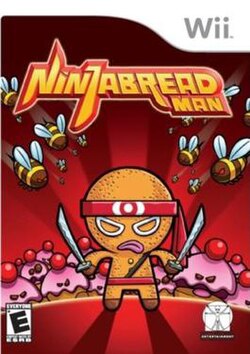

Ninjabread Man arrives like a dessert you did not order and definitely do not want: a gingerbread cookie with a headband, a sword, and the emotional range of a biscuit. Released by Data Design Interactive in mid-2005 for the PlayStation 2, it was marketed as a light-hearted platformer for younger players and bargain-bin impulse buys. What it actually offers is a tiny handful of levels, a bafflingly barebones story (read: none), and a control-and-camera combo that makes basic platforming feel like advanced origami. If you are wondering whether this is a deliberate ironic experiment in game design, the answer is no. The game plays like a prototype was shrunk down to retail size and slapped into a box with colourful art and a confident subtitle. Ninjabread Man is not trying to be edgy; it is trying to be a game. It fails at that task with admirable consistency. Critics were unambiguous: the PlayStation 2 version averaged roughly 31% on GameRankings and packed the kind of flaws that invite group mockery rather than solitary pity. It is the kind of game that makes you nostalgic - for better, older platformers that knew what they were doing. There is a quirky backstory to the game's existence. Evidence suggests Ninjabread Man began life as an intended sequel or entry in the Zool series - a 2D Amiga platformer - before the license was pulled. Leftover Zool assets and a leaked intro hint that this was once something more fully imagined. Whether that origin story explains the game's identity crisis or simply compounds it is a matter of taste. The rest of this review will treat the PS2 release as it is: a short, flawed platformer that occasionally remembers it should be fun, then promptly forgets again.
Mechanically, Ninjabread Man is straightforward and stubbornly hollow. The whole game consists of a tutorial and three main levels. Each level is a scavenger hunt: find eight power rods, feed them to a teleporter, and move on. Repeat. Rinse and repeat. If you like the feeling of checking boxes, the structure is at least predictable. It wears its inspiration on its sleeve: platforming staples-running, jumping, occasional combat-are present in rudimentary form. The main character can attack and throw projectiles, there are enemies and pickups, and completing levels unlocks additional modes (Score Pickups, then Time Attack, then Hidden Pickups!). Those unlocks give the illusion of depth. The reality is that the levels are small, the enemies are forgettable, and the modes feel like padded content more interested in adding minutes to a playtime counter than in making anything enjoyable. The controls are where the PS2 experience most noticeably frays. On the Wii port the developers leaned into motion gestures - shaking the controller to swing a sword, flicking to jump - but the PS2 lacks those gizmos, so its control scheme is conventional. "Conventional," here, does not mean "competent." Input feels imprecise. Jumps are floaty and often mismatched with the camera, which frequently adopts angles that are either too distant to judge a platform or too awkwardly close to give any meaningful spatial information. You will die not necessarily because the level is hard but because the game forgot to make the physics clear. Level design oscillates between mildly charming and suspiciously lazy. There are attempts at themed worlds - candy-coloured terrains and toy-like set pieces - remnants of the Zool pivot show up in odd textures and objects. Those elements could have lent the game character, but they instead feel pasted on. Enemies include drum and cymbal parts in the game's asset-flipped cousin, Rock 'n' Roll Adventures, which underscores how these worlds were reused across multiple budget titles. Length is the game's quiet admission of defeat. With only three levels and a tutorial, completion empties your memory card faster than a sale at a bakery. Some collectors will enjoy replaying with Score Pickups or Time Attack, but those are rules applied thinly over the same handful of areas, like sprinkling sugar on stale cake. The game's progression is not so much a ladder as a short step-stool that wobles when you stand on it. Enemies and bosses are generic cardboard cutouts of obstacles and, in combat, the game is forgiving to an extent - because it has no appetite for challenge, not out of compassion. When the PS2 version tries to do anything remotely skill-based, camera issues and awkward controls conspire to turn execution into an exercise in patience. Players aiming to get any sense of mastery will find themselves inventing challenges just to make the experience meaningful.
Visually, Ninjabread Man resembles a Sunday morning children's TV show rendered in low budget. Models are blocky, textures are muted and repeat a lot, and environments lack the kind of polish that makes even a simple level feel alive. The animation loop is short and the facial expression of the protagonist is permanently 'mildly alarmed cookie.' The frames-on-screen are competent enough to communicate what is happening, but not enough to make it pleasant. The PS2's hardware could have likely done more with this art direction than the final product shows. Lighting is flat, draw distances are short, and there's an air of incompletion to a lot of set pieces. Some leftover Zool assets create odd continuity where one moment you're in a candy-themed world and the next you are standing next to a texture that clearly belonged to a different game. That patchwork aesthetic is not charming; it reads as a cost-saving measure. Oddly, the Wii port is the one usually singled out for worse technical issues - frame problems, motion-control frustrations, and general bugginess - yet the PS2's failings are more subtle and therefore more irritating. The PS2 version doesn't crash spectacularly as often; it simply lumbers along, committed to mediocrity. That quiet underachievement might actually be the game's most honest technical statement. If you are the sort of person who finds solace in seeing a game's shortcomings and cataloguing them like a nature documentary on endangered mechanics, there is a kind of bleak beauty here. Otherwise, the graphics are simply serviceable in the very narrow sense: they tell you where to go and what to do, but they will not make you want to linger.
Ninjabread Man on PS2 is the kind of game that can only exist when a company decides speed-to-shelf is preferable to playtesting. It has three levels, a tutorial, a handful of modes unlocked by replaying the same content, and a presentation that suggests many late nights and too few quality-control checks. Critics were mostly merciless, and the game earned low aggregate scores across platforms - the Wii version fared worse, but the PS2 edition is no hidden gem. The game is defensible only as a curiosity. If you are into exploring how licensed or repurposed assets can be stretched into multiple products, or if you collect every oddball title from the early 2000s, pick it up for a laugh and a photo. If you want something that respects the basic promises of platformers - satisfying jumps, responsive controls, interesting level variety - look elsewhere. The market and reviewers agreed: Ninjabread Man's ambition never quite rose from dough to cake. My final recommendation is mercifully short: try a better platformer. If you insist on trying Ninjabread Man, do it for the novelty of playing a gingerbread ninja. Bring patience, low expectations, and maybe a real ginger biscuit to eat while you play. It will perform better as a snack than as a game.
 Pac-Man World Re-Pac on PS5
 Iron Man 2 on PS3
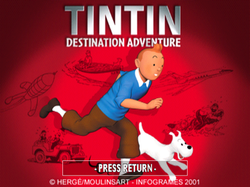
 Tintin: Destination Adventure on PlayStation
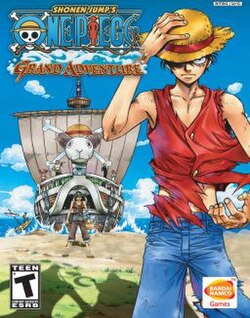
 One Piece Grand Adventure on PS2
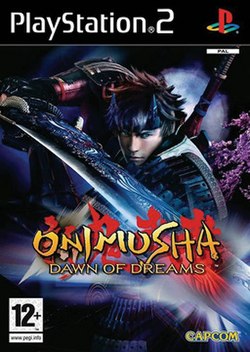
 Onimusha: Dawn of Dreams on PS2
 Taiko no Tatsujin: Dokodon! Mystery Adventure on Switch
 An American Tail on PS2
 Classic British Motor Racing on PS2
 London Taxi: Rush Hour on PS2
 Anubis II on PS2












 Another SquareThought Site