

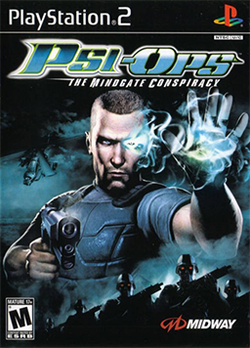

There are two kinds of video game pitches that used to get magazine editors' eyes to widen in the 1990s: 'we can do something no one has done before' and 'we can make a tech demo feel like a full game.' Psi-Ops: The Mindgate Conspiracy lands squarely between those promises and, most of the time, delivers on them. Developed by Midway and released in 2004 for the PlayStation 2 among other platforms, Psi-Ops is not a polished, triple-A behemoth in the modern sense; it wears its ambition in plain sight. What distinguishes it is a mechanical core built around psychic abilities - telekinesis, mind control, pyrokinesis and the like - grafted onto competent third-person shooting and stealth scaffolding. This review is written with a bit of the old-school skepticism that defined 1990s print criticism. Back then, a game's gimmick had to earn its keep. Psi-Ops' gimmick does. The game was conceived partly as a way for Midway to stretch its physics and animation tech, and those engineering decisions show up in gameplay that often feels like a sandbox wrapped in a linear skin. The plot is the familiar amnesiac-agent affair, a serviceable excuse to unlock powers through memory flashes. Critics at the time rightly praised the game's ideas even while grumbling about its rough edges; that dichotomy is still the clearest way to sum up Psi-Ops today.
At its heart Psi-Ops is about possibility. The player controls Nick Scryer, a Mindgate agent whose memories and powers are stripped away to infiltrate a rogue psychic cabal called The Movement. As story beats restore Scryer's recollections, new powers trickle into the player's toolkit. Each new ability is introduced via a flashback sequence that doubles as a tutorial - a tidy design choice that keeps the learning curve moving forward without hauling the player into an instruction manual. The six headline abilities (telekinesis, remote viewing, mind drain, mind control, pyrokinesis and aura view) vary in tone and utility, and the game encourages combining them with the modest arsenal of firearms. Telekinesis is the crown jewel: lift guards into the air, hurl explosive barrels, build crude scaffolds or simply use an enemy as a human projectile. The Havok-driven physics backbone was the thing reviewers salivated about, and with good reason - ragdoll deaths and flying debris are a sustained source of emergent fun. Mind drain is the blunt, slightly gruesome energy battery that keeps powers from becoming unlimited; drain a living enemy and their head very emphatically confirms the transaction. Mind control is the game's chess move: hijack a foe to flip switches out of reach or to sow chaos among ranks, while your own body remains dangerously exposed. Remote viewing unfolds like a stealth mini-game: you leave your body to scout adjacent rooms, which creates risk and reward without overstaying its welcome. Pyrokinesis gives a more arcade-y flavor, turning combustible set pieces into traps. Aura view is a utility power - spotting hidden routes and whether a guard has clocked you - the sort of clarity that prevents psychic wizardry from tipping into blind confusion. Combat blends run-and-gun with stealth flourishes. Early levels, before Scryer gets his full suite of powers, lean into sneaking; later, the game becomes a playground for creative destruction. Environments are linear chapters, but they're studded with opportunities to improvise: crates, barrels, loose scaffolding and environmental hazards reward experimentation. Boss encounters punctuate the campaign by pitching you against Movement lieutenants who wield abilities that mirror your own, forcing you to apply everything you've learned. Psi-Ops keeps controls accessible - you can access powers quickly without digging through menus - though the PS2 controller layout sometimes feels crowded and the camera, a perennial third-person bugbear, misbehaves now and then. The multiplayer mode, an odd split of movement-versus-abilities, existed more as an afterthought than a lasting feature, and unlockable bonus rooms (including the delightful sandbox test chamber) are small delights for completionists. The game is short by modern standards, but it rarely overstays its welcome; several reviewers at release argued that concise pacing worked in its favor.
Graphically, Psi-Ops occupies a middle ground. It is neither a showcase nor an embarrassment for the PlayStation 2. Character animations and psi effects get the lion's share of praise: telekinetic swirls, fiery eruptions and ragdoll choreography look lively and sell the fantasy. Those moments of spectacle are what the team clearly prioritized; the Havok engine wasn't integrated for wallpaper decoration. On the other hand, level aesthetics tilt toward the utilitarian. Many areas are serviceable, sometimes bland: industrial corridors, military compounds and generic caverns that read as backgrounds designed to facilitate physics rather than to carve memorable visual identities. Textures and set dressing are competent but rarely inspired; lighting does its job but seldom composes for posterity. Some critics at the time called the later stages more generic, with new mechanics shoehorned into otherwise unremarkable spaces. Technical performance generally holds up - load times are short, animations are mostly solid, and the physics rarely falters. AI is inconsistent: enemies can be bafflingly alert one moment and sluggish the next, and spawning can feel unfair when foes pop into existence behind you. Sound design is a mixed bag: the score often underwhelms, but impact sound effects, particularly the satisfying thud and splatter of violent telekinetic encounters, deliver the visceral feedback the game needs. Voice work swings between competent and occasionally cringe-worthy line reading, a reminder that good scripts are as important as good animation.
Psi-Ops: The Mindgate Conspiracy is the sort of game that would have made for an excellent cover story in a late-1990s print magazine: bold in concept, mechanically novel and imperfect in execution. Its chief triumph is systemic: a small set of psychic abilities combined with solid physics creates a playground where players find their own solutions. The plot and characters are functional rather than transcendent; the cliffhanger ending and middling sales meant the sequel never arrived - a casualty of marketing and timing rather than design. If you play Psi-Ops for what it tries to do - give you the sensation of being a telekinetic secret agent in a physics-rich world - it succeeds often enough to be memorable. If you expect cinematic storytelling or opulent visuals, you'll leave wanting. For a PS2 title that still feels like a hidden gem to contemporary eyes, it earns its place in lists of underappreciated sixth-generation experiments. Score it an 8.4 out of 10: a brilliant concept, a mostly satisfying execution, and a nagging sense that with more time and polish it could have become a franchise staple rather than a footnote.
 ESP Ra.De. Psi on PS4
 Puzzle Quest: Galactrix on DS
 Tintin: Destination Adventure on PlayStation
 Disney's Chicken Little: Ace in Action on PS2
 Pirates: The Legend of Black Kat on PS2
 One Piece Grand Adventure on PS2
 Mortal Kombat II on PlayStation
 NFL Blitz 2000 on PlayStation
 Mortal Kombat 3 on PlayStation
 Dr. Muto on PS2
 Mortal Kombat 4 on PlayStation












 Another SquareThought Site