

 Aug 2018
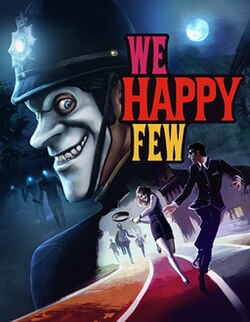

Reading about We Happy Few in 1994 would have been an exercise in skepticism and delight. The box art promises a jaunty, smile-masked dystopia and the back cover copy hints at moral rot beneath a pastel veneer. On PlayStation 4, Compulsion Games' long-gestating oddity finally lands as something of a divided child: at once ambitious, spectacularly strange, and not entirely sure what it wants to be. The game is a first-person concoction of survival mechanics, stealth trappings, and episodic narrative, told through three protagonists whose short arcs together form the whole. It looks, sounds, and often plays like a love letter to dystopian fiction battered against the design sensibilities of roguelikes and survival sims. The result is fascinating enough to keep you curious, flawed enough to make you put down the controller, and weird enough to make you come back.
We Happy Few plays out as three acts, each centered on a different protagonist: Arthur Hastings, the everyman censor; Sally Boyle, a resourceful chemist and secret mother; and Ollie Starkey, a haunted ex-soldier. Each character brings distinct strengths to the table. Arthur blends in and runs well, Sally is the sneaky crafter who can concoct medicines and poisons, and Ollie is the bruiser who builds explosives. Those differences matter because the game leans on its division of labour to pace variety across what is essentially a repeating townscape. The Wellington Wells of We Happy Few is its star and its trap. Compulsion uses a retrofuturistic 1960s Britain as a stage to explore themes of enforced cheer and historical wrongdoing, and it stages gameplay around Joy, the ubiquitous hallucinogenic pill. Take Joy and the town becomes bright, conformist, and complacent: you can walk past citizens without provoking suspicion, but your abilities are dulled and there are long-term consequences as withdrawal kicks in. Refuse Joy and the streets expose rot and hostility; you gain full abilities but are labelled a Downer and hunted. This tension is the conceptual backbone and provides some sharply written moments where moral choices and survival concerns intersect. Mechanically the game mixes scavenging, crafting, stealth, and occasional combat. There is an old-school inventory feel to gathering parts for lockpicks, balms, and other DIY tools. Food, thirst, and sleep are represented as buffs and debuffs rather than full-blown micromanagement, which keeps resource management accessible without turning every sortie into a spreadsheet. Hatches serve as safe houses and as fast travel nodes once repaired, while clothing plays a surprising role in social stealth: wear the right outfit and you can bluff or avoid detection in restricted zones. A divisive decision in design is the procedural generation of parts of the world. Compulsion wanted the player to feel paranoia and to keep runs nervy; the randomised layouts deliver that unpredictability. Unfortunately, the marriage of procedural town generation to a crafted narrative sometimes feels like two games glued together. Vital moments, character beats, and unique encounters are hand-authored, but they must slot into variable geography, which occasionally makes pacing and discovery feel uneven. Early access feedback clearly shaped this: Compulsion added more bespoke narrative encounters and pulled survival elements toward a lighter, more accessible set of systems, but the tension between roguelike replayability and a fixed story remains perceptible. Arcade Mode, introduced in a later update, is a sensible concession for players who want the mechanics in condensed form. Survival islands, the Night Watch combat gauntlet, and a freeform Sandbox give players bite-sized ways to enjoy the systems without committing to the campaign. DLC expands the world narratively as well, with short playable stories that explore other corners of Wellington Wells and provide some welcome variety in tools and tone. Combat and stealth are serviceable rather than revolutionary. Melee weapons are visceral but swingy, stealth feels satisfying when it works, and encounters can be tense when Joy and clothing mechanics are properly played. Occasional bugs and rough edges that linger from the lengthy early access period ensure that the experience can sometimes feel rough around the seams. Permadeath is optional, which is a wise user-friendly touch: toggle it on if you want old-school stakes, leave it off if you prefer to see the story through.
We Happy Few runs on Unreal Engine 4 and dresses its engine in a bold, uncanny style. The aesthetic is one of cheerful grotesquerie: clean mid-century signage, manicured hedges, and immaculate smiles that hide entropy and decay. Character designs and the masks worn by citizens sell the psychological oppression at the game's core. Lighting does a lot of heavy lifting, switching from saturated, cheerful palettes when Joy is taken to muddy, grimy tones in withdrawal. These shifts are almost cinematic and reinforce the game's themes effectively. The production values are uneven. Cut-scenes and certain bespoke setpieces can look polished and frame-worthy, while procedurally assembled districts sometimes show repetition in assets and collision oddities. On PS4 you will see moments of genuine visual flair interrupted by pop-in and texture shortcuts that betray the game's modest budget and long development cycle. The audio, however, is uniformly strong. Voice acting across the three leads is notable and often the emotional anchor of the package, and the soundtrack marries distorted 1960s rock with eerie ambience to create a mood that lingers after you turn off the console. Sound design is used strategically to make Wellington Wells feel populated and, on occasion, menacing.
If you enjoyed the 1990s era of games where developers put strange ideas in a box and shipped them with personality rather than polish, We Happy Few will feel like a cousin from that period who has embraced modern design spikes. Its ambitions are admirable: a thoughtful dystopian narrative, emergent survival systems, and an aesthetic that sticks in the head. The game stumbles where design philosophies collide. Procedural generation scrambles the pacing of a story that wants to be carefully told, and the survival mechanics occasionally feel like features that must be negotiated rather than systems that enrich every moment. Critical response was mixed, and that is fair: there is an excellent core here - atmosphere, writing, and performances - wrapped in an execution that sometimes creaks under its own scope. I recommend We Happy Few to players who prize mood, narrative curiosity, and unusual premises over mechanical perfection. Those expecting a polished BioShock-style blockbuster will be frustrated, while players who enjoy sandboxed survival with heavy thematic teeth and occasional moral discomfort will find plenty to chew on. In short: a flawed, fascinating game that remembers to be strange when most modern titles forget how to be brave.
 Timespinner on PS4
 Open Season on PS2
 Tintin: Destination Adventure on PlayStation
 Disney's Chicken Little: Ace in Action on PS2
 One Piece Grand Adventure on PS2
 Taiko no Tatsujin: Dokodon! Mystery Adventure on Switch
 Contrast on PS4










 Another SquareThought Site