

 Mar 2020
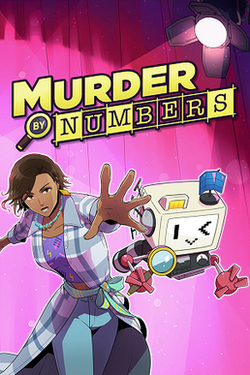

Murder by Numbers is a mash-up that reads like someone left Ace Attorney and Picross in a karaoke booth until they produced a baby who only speaks in punchlines and logic grids. Developed by Mediatonic and released for the Nintendo Switch on 5 March 2020 (with PC and later Stadia versions), the game pairs a campy 1990s LA-set visual novel with tightly focused nonogram puzzles. On paper this is a simple pairing: talk to suspects, examine locations, and solve picross-style logic grids to reveal clues. Under the hood, however, the mechanical choreography between narrative beats and puzzle resolution is where the design earns its stripes. This review approaches Murder by Numbers from a detail-oriented, technical perspective - how the puzzle rules are constructed, how the scoring and progression systems channel player behavior, how the audiovisual package supports decoding and engagement, and what the aggregate critical reaction says about the whole package.
Core loop and inputs The player inhabits Honor Mizrahi, an ex-TV detective, and her robot sidekick SCOUT. Investigation segments unfold in classic visual novel fashion: dialogue trees, interrogations and exploration nodes. What differentiates the loop is that investigation is literalized into nonogram puzzles - the kind of logic-gridded picture-reveal puzzles often called Picross. The switch between reading/decision-making and deterministic logic solving is instant and explicit: investigate, get a grid, solve the grid, extract a piece of evidence, present it to advance the scene. That tight coupling keeps the pacing centered on puzzle-solving as the primary interactive affordance rather than branching choice architecture. Nonogram design specifics Mechanically, the nonograms here follow the canonical digital nonogram rule set: rows and columns are annotated with clue sequences that sum to blocks separated by at least one empty cell. The implementation provides the usual marking tools: fill a square when you deduce it's part of the picture, mark a square as empty (X) to track deductions, and toggle notes to support mental bookkeeping. Where the game's design snakes into interesting territory is the graduated permissiveness and enforced constraints. Most puzzles are permissive: mistakes are allowed without immediate penalty, and the hint system can assist the player. In contrast, certain set-piece encounters introduce microgame constraints - you must complete a series of smaller nonograms within a time limit and you are prohibited from using the empty-space marker or hints. That toggling of constraints functions like difficulty gating internal to the narrative: it raises cognitive load, forces reliance on pure deduction speed, and highlights the game's capacity to vary player attention and working memory demands within the same formal system. Scoring, ranks and player incentives The game layers a Detective Rank for each case. Ranks start at F and increase as you accrue points - points are awarded based on puzzle performance and conserved when you avoid using hints. The consequence design is explicit: use fewer aids, get more points, unlock more bonus puzzles. Unlocking and clearing the bonus puzzles, together with S-ranking a case, reveals optional story content that explains SCOUT's backstory. This is a neat instance of mechanical gating serving narrative reward. From a systems perspective, the rank mechanics act as both an extrinsic motivator for replay (S-rank chase) and as a designer-controlled difficulty curve - players can choose to engage core content only, or invest time in the metagame to access the optional narrative threads. Error tolerance and user experience The decision to allow unlimited mistakes in most puzzles is consequential for accessibility and flow. Error tolerance reduces frustration for players new to nonograms while preserving challenge via incentives rather than hard failure states. The hint system acts as a soft difficulty knob; because using hints reduces point gains, designers avoid binary difficulty spikes and instead use economy to steer player behavior. Timed sections and markers-disabled puzzles serve as hard-coded difficulty peaks: they verify player mastery and reward speed and precision. This mixed model - permissive baseline, strict spikes - caters to both casual and completionist profiles. Technical underpinnings and cross-platform considerations Murder by Numbers is built in Unity, which plausibly facilitated its simultaneous release on Switch and PC and later porting to Stadia. Unity's runtime model is a good fit for a predominantly 2D, UI-driven title; the engine supplies cross-platform input handling, UI layout, and asset pipeline conveniences. The technical demands of Murder by Numbers are modest compared to real-time 3D titles, but the implementation challenge is quality in the polish: responsive grid input, low-latency feedback when toggling cells, clean state saves between puzzles and narrative beats, and deterministic behavior for the scoring math. Those are areas where the choice of engine pays off - the relatively straightforward feature set lets the team focus on UX friction rather than engine workarounds. Progression architecture The four-case structure divides the narrative into digestible acts. Each case's internal rank system plus a global bonus puzzle pool creates a dual progression path: narrative completion and metagame completion. This design encourages players to treat puzzles as both instruments for story progression and as discrete challenges to master. The reward of tying SCOUT's backstory to S-ranks and bonus clears is a smart use of optional content to reward mastery without gating key plot points behind completionist demands. Replayability & longevity Nonogram puzzles are inherently replayable if the content pool is large. The rank-and-bonus system incentivizes replay of puzzles, and because mistakes are non-punitive, the chase for S-ranks is primarily an efficiency/speed optimization problem rather than a rote retry loop. The timed marker-less puzzles function as a testbed for skill growth: a player who enjoys algorithmic elimination techniques, scanning strategies and heuristic shortcuts will find meaningful challenge even after the narrative concludes.
Art direction and visual clarity Character designs come from Hato Moa, which gives Murder by Numbers a distinctive, stylized aesthetic that riffs on 90s television kitsch. This matters for two technical reasons. First, character portraits and UI art need to occupy separate visual channels from the puzzle grid to avoid cognitive interference. The game generally succeeds here: portraits and background art operate as narrative context, while the nonogram grid is stripped of extraneous visual noise, keeping attention focused on numeric clues and tile states. Second, the art style supports the game's tone - campy and slightly melodramatic - which reduces cognitive dissonance when the difficulty ramps up. When the screen is asking you to solve a markerless time trial, the visuals are on a different emotional frequency that reduces pressure via humor. Animation, UI and feedback loops Polish in puzzle games is mostly invisible until it's missing. Murder by Numbers handles micro-interactions - cell fills, X-marks, cursor movement - with crispness. The grid reacts immediately to input, and the game provides immediate confirmation of correctness when rows/columns complete. That kind of deterministic visual feedback is crucial in logic puzzles where players form chains of inference; latency or ambiguous state can break logical chains and produce false negatives. Additionally, the UI clearly indicates when a puzzle forbids empty-space markers or hints, preventing accidental rule violations that would otherwise feel like software bugs rather than design choices. Audio and mood Masakazu Sugimori scored the game, and the main theme includes vocals by Bright Light Bright Light. The soundtrack doubles as a temporal filter: it evokes a glossy 90s detective show, which both supports ludonarrative cohesion and softens moments of cognitive strain. The audio engineering choice to keep tracks melodically simple is a technical win - it keeps music from competing with the player's concentration during puzzles while still delivering atmosphere during story beats. Performance considerations Because the game is primarily 2D UI and grid logic, heavy GPU demands are absent. The main technical priorities are stability across platform builds, consistent input mapping, and quick state serialization for saves and rank calculations. The Unity foundation likely made it straightforward to deliver similar behavior between Switch and PC builds, which is reflected in fairly consistent critical reception across platforms (Metacritic scores around the high 70s).
Murder by Numbers is an elegant exercise in hybrid design. The team at Mediatonic and writer Ed Fear built a system where narrative progression is concretely tied to puzzle mastery, and where optional content is gated by clearly signalled mechanical challenges. From a systems design standpoint, the use of flexible error tolerance paired with occasional strict-mode challenges is a smart way to extend the game's appeal: it lowers the entry barrier while offering high-skill goals for dedicated players. The nonogram engine - in the design, not the code - is deliberately modular: rules are stable, UI affordances are consistent, and the scoring ecology nudges behavior without heavy-handed punishment. When it comes to presentation, Hato Moa's character art and Masakazu Sugimori's soundtrack create an affective backdrop that supports concentration rather than competing with it, and the Unity-built tech foundation seems to have enabled clean cross-platform parity. Critical reception reflects that balance of smart mechanical design and polished presentation: aggregate scores sit in the high 70s on Metacritic, and outlets such as IGN and Nintendo World Report gave strong positive nods. If you enjoy methodical logic puzzles and a linear, well-acted mystery with optional completionist hooks, Murder by Numbers is an excellent value proposition on the Switch. It won't rewrite what a visual novel or a nonogram can be, but it combines both into something greater than the sum of its parts - precisely, efficiently, and with a wink. Recommended for players who like their deduction served with a side of 90s TV cheese and an optional speedrun of grid-based logic.
 Tangle Tower on Switch
 CSI: 3 Dimensions of Murder on PS2
 Puzzle by Nikoli 4: on PS4
 Slitherlink on PS4
 Professor Layton and the Last Specter on DS
 Fall Guys: Ultimate Knockout on Xbox Series X/S
 Fall Guys: Ultimate Knockout on PS4
 Fall Guys on PS5
 Foul Play on PS4
 Postman Pat on DS










 Another SquareThought Site