

 Aug 2024
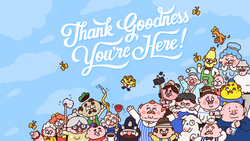

Thank Goodness You're Here! is the kind of tiny, stubbornly British comedy game that makes you smile and then feel mildly responsible for the local council. Developed by two Yorkshire chums under the name Coal Supper and published by Panic, it puts you in the shoes of an unnamed, very small yellow salesman who has the emotional range of a cracked teacup. You wander the fictional northern town of Barnsworth, slap things, talk to people, and see what happens. If you were expecting a sprawling open-world epic, you are in the wrong office. If you were expecting a gleefully bizarre hour-and-a-half of deadpan chaos, you are in the right town. The Switch version carries the game's hand-drawn 2D charm without trying to hide the fact that it's small and focused. That focus is intentional: the team pared gameplay back to a single 'interact' button - a slap - because puzzles had started to look like commitments. The result is less an interactive puzzle book and more a warmly weird sketch show you can walk through, slap occasionally, and giggle at in a way only mildly inappropriate for public transit.
Gameplay, in the sense of pressing buttons and expecting to be judged by an algorithm, is deliberately modest. Your avatar can move, jump, and slap. The slap is the Swiss Army knife of interaction - it moves things, breaks things, nudges things, and somehow counts as polite conversation in Barnsworth. Levels are not levels so much as neighbourhood vignettes: side-on streets, bird's-eye market squares, a few buildings that contain the sort of problems only small towns and surreal comedy can produce. A man has his arm stuck in a sewer grate. Another fellow's arm is so absurdly long it needs to go shopping. A lawn needs mowing. The kind of errands that suggest the universe is slightly bored and turned to improvisational theatre for entertainment. The game's structure loops through its handful of areas as you solve each resident's problem. It's not a branching epic; it's a loop of escalating gags where jokes compound into running bits. That economy is both the game's virtue and its limitation. When the comedy lands - and it lands often - it feels like being let into an inside joke written by two mates who understand how Yorkshire absurdism works. When it doesn't, you notice the thinness of the mechanical layer beneath the laughs. Several critics called it an 'interactive experience' more than a traditional game, and they were not wrong. If you prize ingenuity of input over clever writing, you might come away wanting. Timing matters more than dexterity. The repetitive nature of the slap-interact means the game rarely asks much of your skill; instead it asks for patience, attention, and a willingness to appreciate how many ways someone can be asked to fetch a loaf. The pace rarely drags - the whole thing wraps up in roughly three hours - but it does end suddenly, with the salesman, overwhelmed by pleas for assistance, returning to the mayor's office only to be handed one more errand. It's an ending consistent with the game's sense of humour (and with the feeling of being put back on hold for the fiftieth time), though some will feel it is abrupt. Development choices help explain why the gameplay feels the way it does. Coal Supper started with ambitions toward complex puzzles and branching vignettes, then decided the game would be better if it simply made them laugh. They kept the slap because it is concise and funny. Voices are mostly provided by the two creators, with a few guest turns - notable among them Matt Berry - that add authentic, richly deadpan accents to the proceedings. The humour skews British and Northern, which is precisely the point: the town of Barnsworth is a lovingly exaggerated Barnsley, and the jokes are happiest when you accept that local oddness is the engine here rather than traditional mechanics.
The Switch handles the game's hand-drawn 2D visuals with no fuss, and those visuals are the game's motor. Every frame is dense with visual gags and small details, a kind of visual cornucopia that rewards looking. Characters are bold and simple, animated in a style that recalls Cartoon Network oddities and comics like Viz, but with a Yorkshire accent and a fondness for grimy charm. Animations are punchy rather than flashy, and a contract animator's touches helped give NPCs the tiny, ridiculous gestures that make lines land. Sound design complements the visuals neatly. The soundtrack and sound effects are pitched to the game's atmosphere - jaunty when it needs to be, quietly absurd otherwise - while the voice acting gives the town its personality. Critics praised the presentation across the board, calling it a 'visual treat' and praising the density of its gags. On Switch, the presentation is the selling point: the aesthetics are the joke and the joke's delivery, and the console renders it cleanly and without performance theatrics. If you are playing on the bus, people will probably glance and think your game is a mobile cartoon about municipal bureaucracy. They will be right.
Thank Goodness You're Here! is less a traditional video game and more an impeccably timed sketch show you can guide. It is funny, frequently brilliant, and occasionally infuriating if you expected more mechanical depth. The Switch release captures the game's charm admirably: the art, the acting, and the scripts sparkle, and the limitations in gameplay feel like a design choice rather than an accident. Critics have rewarded it with high scores and nominations - including a BAFTA for British Game - and it's easy to see why: the humour is confident, properly local, and surprisingly universal in its surreal beats. If you want an experience that invents new ways to make municipal problems comedic, prepare to be delighted. If you want puzzles that will keep you occupied for dozens of hours, you will be disappointed in the nicest possible way. For roughly three hours, the Switch version will make you grin, occasionally guffaw, and think fondly of small towns and the strange people who live in them. It will not fix your lawn in real life, but it might teach you a new kind of slap etiquette. Score: 8.4/10 - for ambition of tone, excellence of presentation, and a measured willingness to be weird until the joke works.
 Professional Baseball Spirits 4 on PS3
 Monster Rancher on Switch
 Prototype 2 on PS4
 Tintin: Destination Adventure on PlayStation
 One Piece Grand Adventure on PS2
 Taiko no Tatsujin: Dokodon! Mystery Adventure on Switch
 Taiko no Tatsujin: Don to Katsu no Jikū Daibōken on Switch










 Another SquareThought Site