

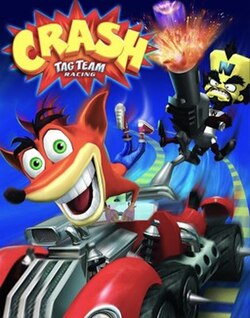

Crash Tag Team Racing arrived in 2005 with its snazzy idea: what if two karts could smoosh into one and then either drive or man a turret like a dysfunctional, cartoonish Transformer? It's a mash-up of karting, vehicular combat and hub-based platforming that winks at younger players while quietly trying to be clever enough for old Crash fans. If you're reading this because you love skillful racers, you'll find things to like and things that will make you sigh into a helmet. This review leans hard on the challenge side: what it asks of your thumbs, your timing, and your patience - and where it hands you a golden invitation to slack off and still win.
Crash Tag Team Racing trades pure driving purity for a clever gimmick called "clashing." Two racers can smash their cars together mid-race to form a tag-team vehicle with a turret and shared power-up pool. On paper this is a tactical delight: decide whether to drive or take the gun, steal an opponent's trajectory, or sacrificially slow yourself to hose someone with a piano dropped from the sky. In practice the mechanic rebalances the entire skill set the game demands. If you've spent your karting life perfecting power-slides and line optimization, beware: clashing can invalidate hours of hard work. The game rewards aggression and opportunistic clashes more than surgical driving. That means core skills shift from precision steering to timing and decision-making. The primary challenge becomes knowing when to engage in a clash and when to bail - because clashing gives stronger power-ups and builds boost but reduces speed. Smart players learn to treat clashes like poker: don't reveal the hand until the pot's worth it. Disengaging grants a brief speed burst, so the best moments come from a hit-and-run style: smash, spam the turret, jump out, use the pop boost to rocket past confused rivals. Boost management remains relevant, but it's earned in different ways. Traditional boost sources like power-sliding are still there, but boosts are also generated by destroying opponent cars, rack-ups of knockouts, and shooting trackside targets. Players who can multitask - drifting while lining up turret shots or punching targets between turns - will squeeze extra speed from the system. That's the kind of pressure that rewards dexterous thumbs and peripheral awareness. The turret introduces a two-player-in-one dynamic that demands different hand-eye coordination. Driving requires the usual arcade instincts: maintain momentum, cut corners without clipping, and use the occasional short boost. Turret control demands aim and target prioritization under motion. If you choose the gun, you're essentially playing a moving shooter with camera constraints; you need to lead your shots, time homing versus heavy weapons, and read track hazards that will ruin your day if you ignore lines. Character-specific weapons (Crash's Wumpa Gun, Von Clutch's radioactive bomblets, etc.) give each turret a unique playstyle. Learning those quirks is a small skill tree in itself. Single-player wraps races in hub-based platforming: you get out of the car, wander Von Clutch's MotorWorld, smash crates for coins, collect Power Crystals, and play driving minigames to unlock gems. Here the challenge swings back to platformer fundamentals. The environments are serviceable, and the platforming can be fun when it's used as a palate cleanser between races. The problem is inconsistency. Platforming sections are often criticized for clunky camera angles and awkward controls. That makes the platforming challenge less about polish and more about improvisation: you'll be rewarded for adaptability and patience. Expect some trial-and-error while navigating fetch quests and hover-platform hops. Minigames are where different skill sets get explicit. Fast Lap pushes pure racing lines and time-trial discipline. Crashinator flips the script and asks you to be a controlled wrecking ball - situational awareness and controlled chaos win here. Run and Gun and Rolling Thunder make you aim on the move: these reward tracking skill and lead-prediction. If you're chasing full completion, collecting coins, Die-O-Ramas and completing NPC side quests, the game nudges you into being a multitasker who can switch from traffic sniper to platforming scavenger without blinking. The coin economy - buy character clothing, unlock cars - gives modest meta-rewards, but the core challenges are still in the racetracks and minigames. Difficulty-wise, the game skews easy. Critics and players at the time noted that staying in clash mode could trivialize races, especially on lower difficulties. That means the highest-level skill in many matches is exploiting the clash system efficiently. For players seeking a steep learning curve, Crash Tag Team Racing may feel like training wheels with a rocket strapped on. However, there are higher-skill niches if you want them: mastering boost chains from power-sliding into targeted destruction, learning exact disengage timing to exploit the post-clash speed surge, and juggling driver/turret responsibilities in split-second decisions during multiplayer may still tax your reflexes. Multiplayer is locally focused with split-screen or LAN on consoles and wireless PSP up to eight players. The chaos of live players fixing each other with pianos or betraying alliance-clashes adds a layer of human strategy. Without online play, the best tactical testing ground is couch sessions, where the mental game of when to clash - and who to trust - becomes a hilarious form of sport. Some puzzling design choices limit depth: unlocks from single-player don't carry over to multiplayer, curbing the incentive to grind single-player strictly for competitive gains. If you want serious, long-term multiplayer progression, the systems are thin; if you want messy, couch-driven pandemonium where timing and opportunism rule, it's a blast. There are some rough edges: occasional frame-rate hiccups on non-PS2 ports and a PSP version that traded visuals for choppy performance. The single-player campaign is relatively short (around 5-6 hours for main objectives), and some platform segments feel tacked-on rather than integrated. Still, if you approach CTTR as a hybrid challenge - part timing/aim dexterity, part opportunistic decision-making, part platformer improvisation - it has a lot to teach and a lot of chaotic fun to provide. The real skills it cultivates are split-second tactical thinking, hybrid control dexterity, and an ability to switch contexts without rage-quitting.
The visuals stick to the Crash Bandicoot cartoon DNA: colorful tracks, expressive characters, and smooth animations during races. Tracks are detailed enough to be readable at speed, with themed hazards that feel playful rather than lethal. It's not trying to win awards for photorealism - it's an era-appropriate, stylized PS2 look that holds up when you remember it's supposed to be candy-colored mayhem. On PS2 the frame rate is generally stable and the environments feel lively; on PSP and GameCube some reviewers noted occasional drops and longer loading times. Lighting can be uneven - a few areas trend gloomier than the rest of the palette - but character design and the kinetic sense of motion during clashes and power-up theatrics relieve most aesthetic complaints. The full-motion videos are competent and the voice work mostly hits the comedy beats, even if the soundtrack itself isn't particularly memorable.
If you want a kart racer that forces you to refine your apex lines and drift perfectly, Crash Tag Team Racing will sometimes underdeliver. It's not that the driving is bad - the fundamentals are fine - but Radical Entertainment intentionally redirected the challenge toward conflict, timing and hybrid skills: mastering clashing tactics, turret aim, boost farming, and rapid context switching between driving and on-foot platforming. That rebalancing makes the game feel fresh and clever, especially in local multiplayer sessions where human unpredictability amplifies the stakes. For an 18-year-old who loves to crush opponents with a well-timed piano drop and then immediately bail into a boost, CTTR is a delightful playground. For purists chasing deep, competitive racing systems, it's a quirky detour that sometimes hands you the win on a silver platter. The single-player's short length, some clunky platform sections and the overall lack of depth stop it from being a top-tier racer, but the clashing mechanic alone is worth the price of admission for anyone who likes their racing with a side of tactical silliness. Score: a solid 7/10 - inventive, fun in bursts, and a worthy couch-multiplayer relic of the PS2 era.
 Crash Nitro Kart on PS2
 Crash 'N' Burn on PS2
 Project Awakening on PS4
 Combat Elite: WWII Paratroopers on PS2
 Monster Hunter Stories 2: Wings of Ruin on Switch
 Tomb Raider: Underworld on PS3
 NHL PowerPlay '96 on PlayStation
 Crash of the Titans on PS2
 Prototype 2 on PS4
 Grid Runner on PlayStation
 MTV Sports: Snowboarding on PlayStation












 Another SquareThought Site