

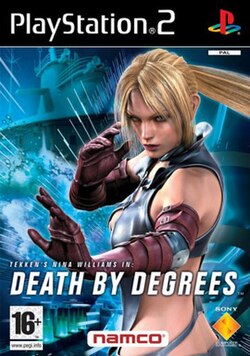

Death by Degrees is the odd little spin-off that Tekken fans didn't exactly ask for but secretly wanted to see: a single-player action-adventure built around Nina Williams, Tekken's clinically efficient assassin, finally getting her own spotlight to do what she does best-kick, slice, and deliver emotionally awkward family reunions. The game is more of a playable cinematic novella than a traditional fighting title; Namco leaned into cutscenes and a soap-opera spy plot that, for all its throwaway villain names and convenient betrayals, gives the Tekken Universe a five-act B-movie to nibble on. Critics tended to like the story bits more than the actual button work, and you'll feel that split the first time you're asked to break an enemy's bones in gruesome detail while watching a beautifully staged cutscene that asks you to care about the characters you just clumsily pummeled. If you're coming for Nina as pure, icy murder-lady charisma, the game's pitch is strong: an MI6/CIA-backed infiltration of Kometa via a tournament on a luxury cruise, a mysterious satellite-powered weapon project called Salacia, and a conveyor belt of executive bodyguards and family drama. The narrative gives Nina a concrete mission and a string of meaningful intersections with people who push her buttons-romantic rivals, scientist idealists, and, of course, her sister Anna, who provides the game's emotional fulcrum. The downside: for every smartly written scene that adds depth to Nina's stoic assassin persona, there are awkward transitions where the gameplay design and camera controls violently disagree with the script.
Death by Degrees is one of those experiments where the control scheme screams "legacy console oddity." Namco gave the game a two-stick reality show: the left analog stick controls movement with touch-sensitive nuance (tap to walk, hold to run, and dodgy degrees of evasion), and the right stick is reserved for all offensive actions. This design choice is brave in the way that wearing a tuxedo to a mud run is brave. It produces a combat feel that's deliberately different from the Tekken series: rather than combos named after obscure martial arts masters, you get deliberate targeting, limb-specific damage, and a bone-breaking mechanic that mechanically shows the skeleton damage you're causing. Mechanically this is the game's most interesting idea, and also its most tonally confused. Watching the game display shattered ulnae and exploded skulls is satisfyingly visceral on paper, but it stretches suspension of disbelief when enemies keep punching after visibly snapped femurs and shrug off head trauma like sore throats. The result is a design that rewards precision but fails to use the consequences of that precision to change encounters in meaningful ways. A brutal limb-targeting strike will do more damage and look impressively grisly, but it rarely forces the enemy to behave differently. It feels like a darkly comic stage prop: dramatic, loud, and not always functional. Outside of combat, the game flips between stealthy infiltration and straightforward beat-'em-up corridors. The narrative pushes you from the Amphitrite cruise ship to a Kometa island research facility, and each stage introduces new enemy types: bromantic bodyguards for Lana Lei, cyborg soldiers for the second ship run, and other executives who all get an action set piece and a fate. Replay value is addressed with unlockables-complete the game to access Anna Mode (playable sister vs. sister action), unlock costumes ranging from bikini to stealth suits, and even a 'Tekken 2 Nina' aesthetic after multiple clears-so completionists will enjoy squeezing out secrets even if the core loop grows repetitive. The cast is the real reason to keep playing. Nina's arc is small but tangible: she starts as the consummate professional, a CIA/MI6-signed sword with a cover as a tournament competitor, and ends the game with one pulled-back mask showing a memory and a moment of tenderness with Anna. The mission gives her agency-she becomes the "sweeper" who must finish what her team cannot-and the betrayals around her (Alan Smithee being Edgar Grant in a deliciously named fakeout) force Nina to operate without backup, reinforcing her isolation and competence. Anna is drafted as both antagonist and narrative mirror: their brawl scenes are less about who wins and more about the shared history that scars and binds them. Anna's final actions-sparing and then chillingly abandoning Nina in the water after saying they're "even"-reframe the sibling rivalry into a bitter, grown-up truce. It isn't Shakespeare, but within the game's pulpy genre it gives Nina emotional weight. Supporting players like Lukas Hayes and Lana Lei exist to tip the stakes: Hayes is the scientist with a good-intentioned project (Salacia) perverted into a weapon, and Lana is the corporate femme fatale who actually operates Salacia and kills for contracts. Edgar Grant's two-faced reveal (Alan Smithee by day, Kometa executive by plot twist) is the sort of melodrama the game wears proudly. The story's beats-capture, discovery, escape, base infiltration, and a final collapsing ship sequence-are the skeleton of a spy thriller dressed in Tekken sequins. The gameplay doesn't always keep pace with the cinematic ambition, but if you care about Nina and Anna and like your action spicy with family grudges, it mostly delivers.
The game's FMVs and cutscenes are where Namco clearly spent their romantic budget: well-directed, dramatically lit scenes carry emotional weight and often look better than the in-game action. These cinematic moments are why reviewers tended to praise the story-Nina's visual presence in cutscenes communicates personality without needing exposition. In contrast, in-engine models and textures can be uneven: character faces are serviceable, some environments feel detailed for a PS2 product in 2005, but resolution and animations often dip into low-polygons territory. The art direction tries to create a sleek spy atmosphere-expensive cruise lines, secret island labs, and neon-lit corporate boardrooms-and generally succeeds, though pop-in, long load times, and occasional camera fights with the player break immersion. Aesthetically, the shift from beautiful FMV to gritty gameplay looks is jarring enough to be a feature if you like contrast, but it undercuts the game's attempts at sustained cinematic flow. There are moments-Nina powering through a procession of enemies on the deck as the sea turns vicious-where the visuals and music combine into a memorably dramatic sequence. Unfortunately, technical faults such as protracted load screens and a sometimes-hostile camera keep the experience from being consistently polished.
Death by Degrees is a game of personality over polish: it gives Tekken's coolest assassin a coherent mission, a string of payoffs with her sister Anna, and a surprisingly earnest spy plot involving satellite-weaponized methane hydrate called Salacia. If you play it for the narrative, the cutscenes, and the taste of Tekken lore stripped of tournament brackets, it will reward you. If you play it expecting Tekken's tight fighting, you will be frustrated by the analog-stick-only offensive system, the strange bone-damage disconnects, and a camera that likes to argue with you. From an emotional perspective, Nina's arc-professional to slightly less ironclad, confronted with betrayal and family memory-is the game's heart. Anna operates as both foil and mirror, and the supporting cast gives Nina reasons to act beyond paycheck and pride. On the technical side, jagged combat ergonomics and long loading times keep this from being more than a cult curiosity. For fans of Tekken, or for those who like their action games to act like glossy spy novels with a lot of punching, Death by Degrees is worth a rent, a replay to unlock Anna, and a watch of its cutscenes. For everyone else, it's a fascinating misstep: interesting ideas, memorable characters, and execution that occasionally trips on its own ambition. Score: 5.1/10 - equal parts charm and clank.
 Death's Door on Switch
 Death's Gambit on Switch
 Death's Gambit on PS4
 Tintin: Destination Adventure on PlayStation
 One Piece Grand Adventure on PS2
 Taiko no Tatsujin: Dokodon! Mystery Adventure on Switch
 Onimusha: Dawn of Dreams on PS2
 Super Smash Bros. Ultimate on Switch
 Pac-Man Championship Edition DX+ on PS3
 R4: Ridge Racer Type 4 on PlayStation
 Tales of Arise on Xbox Series X/S
 Tekken on PlayStation












 Another SquareThought Site