

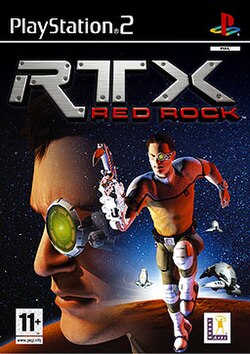

RTX Red Rock arrives with a premise that's punchy on paper: year 2113, Earth wins a war against mysterious LEDs (Light-Emitting Demons), then discovers the baddies have colonized Mars. Enter Major Wheeler, an RTX (Radical Tactics Expert) who is terrified of the very planet he must investigate, and his robotic sidekick IRIS. Developed and published by LucasArts for PlayStation 2, the game shipped in summer 2003 and was announced - then canned - for GameCube. Critics were underwhelmed: Metacritic aggregates it to a 49/100 and reviews repeatedly describe a product that tries to do a lot but lands unevenly. This review approaches RTX Red Rock like a tech inspector at a spaceship graveyard: I'm going to wedge my way into the engine bay, count the polygon bolts, and tell you whether the whole thing is actually ready for flight.
From a design perspective, RTX Red Rock is ambitious for a PS2-era action-adventure. It attempts to blend shooting, exploration, light puzzle work, and some genre-mixing variety that tries to keep the player moving across several gameplay modes. You play as Major Wheeler with IRIS (an on-screen companion that fits into both narrative and mechanical roles), perform reconnaissance, and engage the LED threat across Martian environments. Mechanically, the title suffers from an identity crisis more than a single fatal flaw. Multiple outlets noted "a lot of features and varied gameplay elements," and that's an accurate description: there are moments where the game feels like a competent third-person shooter, moments that lean toward adventure-puzzle, and moments that seem tacked-on for variety. The problem is cohesion. When the control scheme and mission design try to serve conflicting purposes - fast-paced combat versus careful puzzle resolution - neither midpoint is polished. Combat is serviceable but not tight; enemies present variety but lack sophisticated behaviors, which means firefights rely more on spongey health and raw lead than strategic AI exploitation. That makes encounters repetitive over long stretches. Controls are typical of mid-generation PS2 titles: basic movement, aim, and an assortment of weapons and gadgets. Reported impressions point to responsiveness that's acceptable in isolation but brittle when the game asks you to combine actions. Transitional states (e.g., moving to a climb or covering animation) show latency and sometimes awkward collision response, which breaks immersion and occasionally causes frustrating deaths in platform-heavy sections. The companion AI (IRIS) is charming from a narrative angle but technically conservative: IRIS contributes flavor and scripted assistance more often than smart tactical support. In multiplayer modes the game tries to extend longevity, but multiplayer was never the selling point and largely feels bolted on - a common symptom of single-player-first projects of this era. Level design swings between decent pacing and recycled corridors. The campaign has segments that are clearly well laid out, with decent flow and a clear objective structure, which supports Eurogamer's less harsh take that accepting limitations reveals "a rather solid enjoyable, well paced adventure game." However, many levels repeat assets and objectives, which amplifies the feeling of limited scope and polish. The game's difficulty curve is inconsistent: spikes can feel artificial since enemy placement and health pools sometimes compensate for thin combat systems. Net result: players who come for steady, skillful encounters will be disappointed; players who want a narrative-driven romp with some shooting and exploration will find redeeming moments but will also encounter tedium. Polish is the recurring issue. Critics like GameSpot summed it up as a promising concept that fails in execution. That failure is mostly procedural: rough transitions, unrefined enemy AI, and modular design decisions that don't harmonize into a satisfying whole. RTX Red Rock is neither broken enough to be a novelty nor refined enough to be a hidden classic - it sits in the uncomfortable middle where ambition outpaces finishing.
Graphically, RTX Red Rock is a textbook case of what happened when a mid-2000s console title didn't quite leverage a console's potential beyond baseline competency. The Martian setting gives the developers a clear aesthetic to work with: reds, ochres, dust-swept vistas. On a conceptual level the color palette and art direction help sell a barren Mars, and character/robot designs are serviceable with a touch of LucasArts flair for personality. Technically, however, the implementation reveals constraints. Textures are what you'd expect from many PS2 games: low-resolution in places, with obvious tiling on large surfaces and a reliance on smaller models for interactive elements. Polygon counts on characters and important set pieces are decent for the hardware, but many environmental props drop in detail at close range, and you can see the level-of-detail (LOD) transitions when panning the camera. Lighting is basic: flat base lighting with spot and particle effects thrown in for combat sequences, but there is a lack of advanced shading or global illumination - not a surprise for the platform, but it exacerbates the game's occasionally sterile look. Animation quality is inconsistent, another symptom of uneven polish. Key animations (intro beats and scripted moments) are readable and occasionally well-timed, but mid-combat movement and transitions can appear stiff or slightly off-sync with audio cues. This mismatch undermines immersion because motion should sell conviction; when it doesn't, players notice. Performance-wise, reviewers reported that the game doesn't choke your console but doesn't maintain rock-solid stability either: framerate dips and occasional pop-in are present in busy scenes, which again speaks to trade-offs between draw distance, particle effects, and the PS2's limited memory bandwidth. Cutscenes and voice work get a mixed grade. Voice acting is usable and helps the story move, but presentation values and animation fidelity aren't cinematic enough to elevate the basic script beyond competent radio-drama territory. Overall, RTX Red Rock looks and feels like a competent mid-generation PS2 title that was released before some final rounds of visual and mechanical polish could be applied.
RTX Red Rock is the kind of game that reads like a curriculum vitae of good ideas: varied gameplay modes, a quirky sidekick, Martian vistas, and an interesting premise. In practice those items are assembled into a package that feels only partially finished. The technical story is one of compromise: sufficient production values to be readable and occasionally engaging, but not enough iterative polish to make the disparate systems cohere. Critics mirrored this assessment: some found it tolerable and even enjoyable if you lower expectations, while others recommended avoiding it unless you desperately needed something new to play. If you're into historical PS2 archaeology or LucasArts curiosities, RTX Red Rock has value as a case study in mid-generation design trade-offs. If you expect tight combat, sophisticated AI, and a consistently polished presentation, this isn't the Martian colony to stake your claim on. For those who want a quirky, occasionally fun adventure and can forgive rough edges, there are moments worth seeing - but overall it's the kind of release that makes you wish the developers had a little more time in the hangar before takeoff.
 AC/DC Live: Rock Band Track Pack on PS2
 Rock Band 2 on PS3
 Tintin: Destination Adventure on PlayStation
 Disney's Chicken Little: Ace in Action on PS2
 One Piece Grand Adventure on PS2
 Taiko no Tatsujin: Dokodon! Mystery Adventure on Switch
 Ghoul Patrol on Switch
 Super Star Wars on PS4
 Herc's Adventures on PlayStation
 Star Wars Episode I: Racer on PS4
 Ghoul Patrol on PS4












 Another SquareThought Site