

 Nov 2017
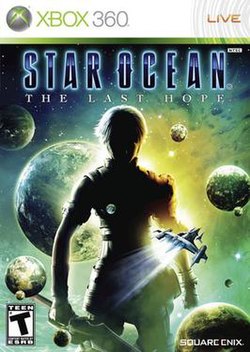

Star Ocean: The Last Hope arrived originally in the seventh generation as tri-Ace's big-scoped sci-fi RPG experiment: a four-character real‑time combat system grafted onto an interstellar exploration framework and wrapped in a prequel story. The 2017 PlayStation 4 remaster is essentially the grown-up, higher-resolution cousin of that 2009/2010 effort - a digital-only release with 4K support on PS4 Pro - but the bones of the design and the technical ambitions are where the game's personality lives. If you like measurable systems, frame-rate talk, and how game engines cope under the weight of cutscenes and sprawling battle choreography, you and this game will get along like a Rush gauge and a critical hit.
Under the hood The Last Hope is a thoroughly engineered action-RPG. tri-Ace re-used and improved an engine lineage (descended from their Infinite Undiscovery work) and targeted a constant 60 frames per second on-capable hardware - not an aesthetic choice so much as a functional one. At 60fps the feeling of input-to-action in the combat loop is sharp and measurable: movement, interrupts, and timed counters like Blindsides all land with the sort of tactile accuracy that falls apart at lower frame-rates. The PS4 remaster's headliner is higher resolution and PS4 Pro 4K support, but that core design - combat paced for 60 fps - still defines how the game is played. Combat systems, quantified The game's combat is less a menu-driven math puzzle and more a layered real-time toolkit. tri-Ace rebuilt party engagement around four controllable slots (a return to the series' roots after the previous title's three) and added mechanical depth without bloating button lists. The Rush gauge is an individual resource per character, enabling preemptive strikes or burst abilities; it functions as both an offensive timing mechanic and a way to resource-manage your action economy. Blindsides reward spatial positioning: slip behind an aggressive enemy to trigger a back-attack, which is an elegant design that nudges players to think in 3D instead of 'mash until stun.' BEAT and AI tuning The Battle Enhancement Attribute Type (BEAT) gives you macro-level control over AI behavior and combat roles: offense, defense, and stealthy approaches are tuneable, and as battle ranks increase action-upgrades unlock more advanced behaviors. From a technical perspective BEAT is tri-Ace's attempt to provide deterministic but flexible AI: teammates perform reliably according to the parameters you set, but the system still allows player skill to outpace automation. The battle simulator (accessible from the Calnus' battle arena) is cleverly implemented for a single-player RPG: it provides a closed environment to test AI pairings and BEAT strategies, which matters because the interplay between your AI teammates and the player's inputs is where the game either sings or stumbles. Systems that matter beyond combat Private Actions (PA) are tri-Ace's social-systems layer and they're surprisingly consequential. Roughly a hundred PA events are gated by room assignments and interpersonal choices; they affect affinity and can alter post-game cutscenes and endings. From a systems viewpoint PAs are deterministic event triggers tied to state machines (who's roomed with whom, affection thresholds, and narrative flags). The implementation feels like a compact save-state logic tree - straightforward, transparent, gratifying for completionists who like predictable unlock paths. Ship, world traversal, and practical UX notes The Calnus is more than a narrative hub: its deck, recreation room, conference room and crew quarters are UI nodes for planet selection, item creation, practice and PA management. Planetary travel is presented as a 'star ocean' hop sequence, but in the Xbox 360 era this came with a practical annoyance - disc swapping when jumping between certain planets. The PS4 remaster being digital removes that particular IO friction, which is an underrated QoL improvement: seamlessly streaming content is one of those backend changes that has immediate gameplay impact. On the older hardware tri-Ace called out storage capacity and data complexity as development constraints; you can see that in how content is packaged across hubs and encounter instances. The remaster mostly alleviates those pain points through modern IO and resolution scaling. Criticisms from a systems nerd perspective The game's pacing can be uneven: long scripted sequences interleave with crunchy, repeatable combat loops. The English voice acting and lip-sync showed strain in earlier releases, and while the International PS3 build added dual voice tracks and illustrated portraits, not every version shipped identically. From a technical narrative perspective, the engine handles massive setpiece fights and particle effects well, but camera and objective clarity occasionally lag behind the combat complexity - the game expects the player to read the battlefield as much as the HUD, and that isn't always communicated cleanly.
Rendering and presentation The Last Hope was ambitious for its generation. tri-Ace outsourced pre-rendered movies to Visual Works and balanced in-engine real-time scenes with those cinematic assets. The original Xbox 360 build was tuned to maintain 60fps during active gameplay, which required careful LOD and animation batching to avoid CPU/GPU stalls. On PS4 hardware the remaster benefits from higher base resolution and improved texture fidelity; the PS4 Pro build adds 4K support which primarily ups texture clarity and reduces aliasing, making particle effects and environmental details like ship interiors and planetary surfaces noticeably crisper. Animation and art pipeline Character art leans heavily on Katsumi Enami's illustrative work (especially notable in the Japanese release portraits) and Motoi Sakuraba's layered soundtrack does a lot of heavy lifting tonally. The animation system mixes pre-baked cutscene motion with real-time combat blends; successful transitions are usually seamless, but the game's heavy reliance on lip-synced cutscenes (especially with the English tracks) exposes a mismatch between facial animation granularity and dialogue timing. Where the frame-rate headroom helps the most is during dense combat encounters: smoothing input latency and allowing more aggressive animation blending without frame drops. Tech trade-offs The engine design represents familiar trade-offs: to hit target frame-rates tri-Ace limits some draw complexity at a distance and caches many environmental effects. That's why the Calnus interiors, while detailed up close, can look simplified from afar - an obvious but justifiable optimization on the target hardware of the era. The remaster's improved fidelity doesn't rewrite those trade-offs, but it does make them less visually jarring. Pre-rendered cinematics still outperform in-engine scenes for expressive detail, which is why Visual Works' sequences remain a highlight even in 4K.
Star Ocean: The Last Hope on PS4 is a technical document in game form: an ambitious action-RPG that leans on a 60fps combat philosophy, per-character Rush gauges, BEAT AI tuning, and a ship-as-hub architecture that ties systems together. The remaster fixes a few practical issues from the original hardware cycle (notably disc-swap friction and visual polish), and PS4 Pro support brings a deserved clarity to environments and effects. It isn't flawless - narrative pacing, some voice/lip-sync mismatches and occasional camera-obfuscation keep it from being a technical masterpiece - but tri-Ace built a system-first RPG that values measurable responsiveness and predictable systemic outcomes. If you care about how a game's engine enables player agency, and you enjoy dissecting combat rulesets and AI behavior, The Last Hope remains a rewarding play: smart, occasionally rough around the edges, and fundamentally engineered to feel good when the systems click. Score: 7.5/10 - a technical win with a few ergonomics left to patch.
 Last Window: The Secret of Cape West on DS
 Root Letter: Last Answer on PS4
 Combat Elite: WWII Paratroopers on PS2
 Onimusha: Dawn of Dreams on PS2
 Disney's Chicken Little: Ace in Action on PS2
 Action Man: Operation Extreme on PlayStation
 Star Ocean: Second Evolution on PS4
 Resonance of Fate on PS3
 Resonance of Fate on PS4
 Star Ocean: The Divine Force on Xbox Series X/S
 Star Ocean: First Departure R on PS4










 Another SquareThought Site