

 Oct 2014
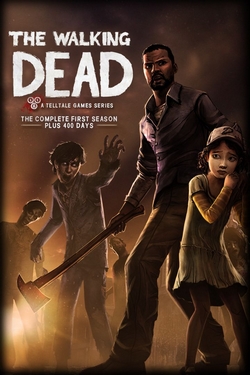

Telltale's The Walking Dead: Season One is the game that did for narrative-driven episodic adventures what sunscreen does for sunburn: it didn't invent the problem, but it made everything a lot more survivable. Ported to PS4 in 2014 as part of the post-launch retail/'Game of the Year' wave, the season-first instalment is a five-episode experiment in emotion, timing and cross-platform engineering. Under the hood it's less about running and shooting and more about input latency, state persistence and the invisible plumbing of choice tracking. If you care about how games are made as much as what they make you feel, Season One is a case study dressed in gore and parental instinct.
Mechanically the game is a relatively restrained point-and-click third-person adventure built on the in-house Telltale Tool. The interaction model relies on an on-screen reticle and contextual prompts: move the cursor to highlight objects or people, press the interaction button, and the game will either examine, pick up or initiate a dialog. This simplicity is deceptive. Designers layered several timing systems on top of it - timers in dialog trees, quick-time events (QTEs) during frantic moments, and a global decision tracker that records dozens of flags per playthrough. Those timers are the mechanical backbone of the tension; they force players into split-second morality plays where hesitating is mechanically different from making a choice. The effect is less "right or wrong" and more "how you react under stress," which fits the setting like a bandage on an arm. The QTE implementation is straightforward but consequential. Success or failure typically results in a checkpoint reload from moments prior, which kept the pacing brisk without punishing the player with long reloads. Restart-on-fail is a pragmatic design choice: it maintains cinematic momentum and avoids bouncing the player into a different gameplay loop. The game also provides a rewind/save system that encourages experimentation. Multiple save slots and a rewind feature let you explore branches without replaying entire episodes - a practical decision given the game's episodic release cadence and the desire for players to compare outcomes across choices. What's fascinating from a systems perspective is Telltale's approach to decision persistence. Choices are tracked globally and can propagate consequences across episodes. The team exposed a methodology where many decisions alter character attitudes rather than branch the main plot radically; the designers accepted a single terminal scene as the narrative anchor (Lee's fate and Clementine's final choice), and then engineered dozens of permutations - for example, Episode 5's first act reportedly had 32 variations depending on prior flags. That's an elegant compromise between authored narrative control and player agency: large-scale structure is preserved while micro-variations make playthroughs feel personal. There are also difficulty and accessibility toggles that affect UI hints and the choice-notification system. Minimal mode turns off hints and the choice notification, which impacts how much metagame feedback players receive about the consequences of their actions. On consoles, the controller mapping is tight and responsive; on touch devices, Telltale invested time refining touch controls (less relevant to the PS4 player, but important to understanding how the game was engineered to be portable).
Visually, Season One uses a deliberately comic-inspired aesthetic that echoes Robert Kirkman's source material. The art direction by Derek Sakai leans on stylized character models, strong edge lighting and a texture palette that favors muted colors - all of which serve two functions: set tone and reduce the need for hyper-realistic assets. From a performance standpoint this is smart: lower photoreal fidelity reduces GPU stress and simplifies cross-platform scaling. The Telltale Tool was optimized for a wide range of targets (PC, consoles, mobiles), and that shows in the PS4 port which trades ultra-high-resolution textures for consistent frame pacing and stable lighting across scenes. Animation is where the engine both shines and shows its age. Cinematic blocking and character face poses deliver emotional weight - Dave Fennoy's Lee and Melissa Hutchison's Clementine owe half their impact to well-directed performance capture and voice acting - but smaller animations and lip-sync can feel jerky compared to modern motion-capture pipelines. The camera system borrows cues from cinematic action games, using framed third-person shots and dynamic cuts for tension. These choices reduce the need for fully interactive camera control, simplifying collision and occlusion work while giving artists control over composition. On the technical downside, reviewers and players noted occasional graphical hitches and glitches at launch (a legacy of juggling multi-platform releases), and the game's save format required several post-release updates that sometimes invalidated saved games. The PS4 release consolidated many of the fixes and packaged the episodes together, which improved stability, but the history is a reminder: episodic delivery demands robust save and versioning strategies. The devs learned this the hard way - the save-system fragility was repeatedly patched across platforms, and Telltale explicitly refactored their tools for future seasons to avoid similar pitfalls.
If you measure The Walking Dead: Season One strictly by cutting-edge graphics or open-world gadgetry, it will lose to newer, flashier titles. If you judge it by systems design - how decisions are recorded, how timing creates emotional stakes, how a cross-platform engine balances fidelity and performance - it's a textbook success. Telltale built a narrative engine where the mechanics (timed dialogs, QTEs, global decision flags, rewind/save tools) are integral to the storytelling. The PS4 port benefits from consolidated patches and the upgraded hardware, offering smoother framerates and more reliable saves than the early episodic releases. The occasional animation awkwardness and the legacy of save-game headaches are small stains on a broadly impressive technical and design accomplishment. Season One is a compelling demonstration that technical decisions - engine choice, input timing, save architecture and cross-platform design - can elevate a narrative beyond its script. For players who care about how games are constructed, the season is both a gripping story and a lesson in pragmatic engineering under deadlines. For everyone else, it remains an emotionally powerful experience that feels meticulously crafted. Either way, bring tissues and pay attention: the game punishes hesitation, and sometimes for good reason.
 One Piece Grand Battle! on PS2
 Microsoft Xbox One
 One Piece: Pirates' Carnival on PS2
 Tintin: Destination Adventure on PlayStation
 One Piece Grand Adventure on PS2
 Taiko no Tatsujin: Dokodon! Mystery Adventure on Switch
 Taiko no Tatsujin: Don to Katsu no Jikū Daibōken on Switch
 The Wolf Among Us 2 on PS5
 The Wolf Among Us 2 on Xbox Series X/S
 Sam & Max Save the World Remastered on PS4
 Sam & Max: The Devil's Playhouse Remastered on PS4
 The Walking Dead: Season Two on PS3










 Another SquareThought Site