

 Dec 2015
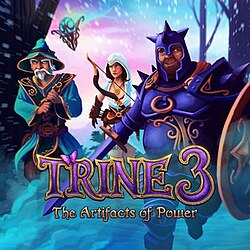

Trine 3: The Artifacts of Power arrives on PS4 like a sequel that grew a 3D mustache overnight and tried very hard to look mature. It's the 2015 entry in Frozenbyte's cuddly-but-deadly fantasy trilogy: Pontius the knight, Amadeus the wizard and Zoya the thief are back, still bound together by the Trine artifact, still living in a medieval world that thinks 'physics puzzle' is an acceptable hobby. This is the first Trine to hand the series a three-dimensional playground, but it keeps most of its soul tied to 2D puzzle-platforming roots. If you're here for an in-depth character analysis, good - because the game's chief crime isn't that it forgets how to be fun (it mostly remembers that). It's that it gives its characters proper narrative teeth and then cuts the steak before anyone finishes chewing. That tension - between solid character work and an unfinished story - is the beating heart of Trine 3's experience on PS4. The characters evolve, tug at your sympathy, and then the game ends like someone paused a movie and walked off with the remote.
Trine 3 doesn't reinvent the three-hero wheel; it lovingly rebalances it. Gameplay still revolves around swapping between Pontius, Amadeus and Zoya to solve environmental puzzles, fight enemies, and rescue the plot. Pontius is all heavy-metal chivalry: sword swings, shield blocks and 'I am the beefy problem solver' energy. Zoya is nimble sarcasm in leather: bow and grappling hook let her traverse vertical spaces and be the team's long-range brain. Amadeus is the brains-and-beanstalk act - levitating, conjuring and reshaping objects with magic. These archetypes are comfortable now, the kind of friendships you treat like an old hoodie; predictable, warm, and surprisingly surprisingly useful. Where the gameplay analysis deserves real attention is in how those roles are married to character arcs. The Trine artifact granted immortality, which is presented not as a cool power-up but as a curse that quietly gnaws at the trio. They want freedom. They try to return the Trine's power, and the artifact shatters. Dramatic consequence: their attempt to free themselves literally sets a monster loose. That narrative pivot transforms routine puzzles into consequences - you aren't just building a bridge for the sake of geometry, you're trying to repair a magical artifact and save your conscience. It makes the act of swapping a character feel narratively meaningful rather than mechanically convenient. Mechanically, the PS4 version keeps the series' signature swapping fluid and cooperative-friendly - the game supports three-player multiplayer if you want your friends to experience together how many ways a wizard can accidentally trap a knight in a floating crate. The game also includes challenge levels and a level editor, which lets creative players stretch the toybox well beyond the campaign. The transition to 3D was a major design headache for Frozenbyte; they had to overhaul abilities so they still felt like Pontius, Amadeus and Zoya even when depth was added to the puzzles. Sometimes that reinvention hits the sweet spot - Amadeus manipulating objects in three dimensions gives puzzles a lovely tactile complexity - but other times it feels like the team is apologizing to old fans, trying not to break what worked in the earlier 2D titles. Narratively, the heroes' arcs are concise and pointed. Pontius is the honor-bound one who resents immortality's hollow victories. Zoya, who once benefited from shadows and secrecy, finds those comfortable traits flipped into a longing for release. Amadeus, the dreamer, is cursed with the knowledge that immortality dulls urgency; he actually wants stakes again. They traverse the Astral Academy, learn about Sarek - a wizard who sealed his heart away and went insane - and discover the fractured history of the artifacts: soul, mind and body. The trio's quest to collect shards and repair the Trine is emotionally coherent, and the game sets up stakes with tidy logic: free us, or we keep being prisoners of a thing that defines us. If Trine 3 had run another hour or two, the character beats feel like they would have landed as a satisfying trilogy chapter. Instead, the game stops mid-arc. It sets up Sarek's corruption and the corrupted artifact, then just... cuts the strings. That abrupt ending turned many players into very irritated narrative completionists. So the gameplay shines when it aligns with character intent - solving puzzles to earn back agency is a clever marriage of mechanics and motive. But the game's short runtime and unresolved plot arc undercut the payoffs the design is trying to earn. Frozenbyte admitted the project was too ambitious for its budget, and that ambition-versus-resources squeeze is visible in the campaign's brevity.
Visually, Trine 3 is where the trilogy flexes. Moving to 3D was billed as a challenge and it shows: the environments aspire to lush medieval fantasy, with the Astral Academy providing gothic lecture-hall vibes and physics-driven puzzle spaces that feel hand-painted but live in three dimensions. The game's art direction sticks to the series' aesthetic - warm, storybook textures, dramatic lighting that makes even a collapsing platform look contemplative - while trying to temper the complexity that 3D brings. On PS4, the visuals are generally sweet: character models retain their cartoonish charm, and spells look like tasteful fireworks. But the technical leap is a double-edged sword. Frozenbyte had to redesign abilities to preserve character identity after adding depth, and while that worked most of the time, occasionally the camera and 3D navigation introduce friction where 2D clarity once ruled. The decision to keep the 2D gameplay focus while adopting 3D elements is sensible - it lets the game feel like Trine rather than 'Trine: Now With Depth' - but it also creates moments where puzzles feel like they're straddling two design languages. Still, the PS4 handles the visuals capably: frame rates are mostly stable, animations are expressive, and the palette keeps the fantasy vibe cozy rather than ostentatious. Musically, Ari Pulkkinen, who scored the previous Trine games, returns, and the compositions complement the character-driven story beats. The soundtrack rarely screams for attention but consistently props scenes up like a polite wingman, so when a narrative moment lands it has music that nods approvingly behind it.
If you want tidy closure and a full arc that takes the trio from cursed immortals to free-ish people with a satisfying final boss handshake, Trine 3 on PS4 will both soothe and annoy you. The game does a great job developing Pontius, Amadeus and Zoya into protagonists whose motivations tie directly into the puzzles you solve. The narrative premise is clever - immortality as a plot device that fuels both character growth and level design - and the leap into 3D adds fresh angles to classic Trine mechanics. Where it falls down is not in concept but in execution scale: the campaign is short, the story cuts off mid-conflict, and players were right to grumble. Frozenbyte later noted the financial limits that kept the game from being longer; it reads like ambition outpaced reality. Still, the PS4 build is a pleasant platformer with a charismatic cast, gorgeous moments, and puzzle design that rewards thinking in character rather than in isolation. Play Trine 3 if you care about well-realized character beats, enjoy cooperative puzzle-platforming, and don't mind an unfinished sandwich - there's meat and sauce, but no top slice of bread. If the unresolved ending gnaws at you, at least there's an easter egg in Trine 4 that whispers what could have been, offering a tiny postscript to a game that dared to change its shape and then ran out of runway.
 Power Gig: Rise of the SixString on PS3
 Power Pro Kun Pocket 14 on DS
 Power Pro Kun Pocket 10 on DS
 Tintin: Destination Adventure on PlayStation
 Disney's Chicken Little: Ace in Action on PS2
 Puzzle by Nikoli 4: on PS4
 One Piece Grand Adventure on PS2
 Trine 4: The Nightmare Prince on PS4
 Trine: Enchanted Edition on Switch
 Trine 2: Complete Story on Switch
 Trine 2: Complete Story on PS4
 Trine: Enchanted Edition on PS4










 Another SquareThought Site