

 Jan 1979
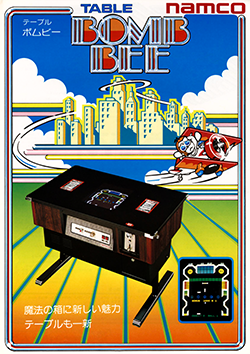

Bomb Bee arrives on PS4 as part of the Arcade Archives series, which is a fancy way of telling modern consoles to play museum curator and dust off ancient arcade ROMs. This particular exhibit dates back to 1979, a time when hair was large, patience was eternal, and Toru Iwatani was not yet famous for guiding a round, yellow man into snack-based immortality. Bomb Bee is the follow-up to Gee Bee and tries to be both breakout knockabout and pinball party, which is charming in the same way a potato wearing sunglasses is charming. The game did not exactly storm arcades in 1979; sales were underwhelming, and for a while the industry treated it like a politely ignored relative at a wedding. Retrospective interest comes from the fact that it used a full-color display at an early date, marks one of Iwatani's first steps toward game design fame, and is historically interesting as an early Namco-Nintendo collaboration. On PS4 you get a faithful emulation of all that charm, awkwardness, and 1970s design philosophy, wrapped in a menu that understands modern concepts like save states and screenshots. That does not make Bomb Bee into a blockbuster, but it does make it easy to admire without having to physically stand in front of a cabinet while someone else smokes and eats something unfortunate.
Bomb Bee plays like someone took Breakout, shook it until the blocks realigned into strangely shaped letters, and then put a pinball machine on top. Play alternates between up to two players, which is to say you and a friend can take turns failing at the same task and blaming each other. The control originally relied on a rotary analog stick to move two paddles; translated to PS4, that sincerity becomes either d-pad or analog-stick motion. It is simple, direct, and occasionally infuriating in the way only older arcade controls can be: precise outcomes, minimal forgiveness. The objective is familiar to anyone who has spent time deleting bricks from the top of the screen. You ricochet a ball with those paddles and attempt to clear colored bricks. The design includes side sections with pop-bumpers that are pinball staples, and when you clear those side bricks the bumpers increase from 10 to 100 points. There is also a bonus objective where lighting the letters N A M C O with the ball yields a multiplier-style reward. It is mercifully uncomplicated and aggressively retro: no inventory, no skill trees, no microtransactions. Just a ball, two paddles, and a steady decline of dignity. The hybrid nature of the game gives it a quirky rhythm. At times you feel like you are playing a methodical breakout clone, setting up the ball, nudging it into favorable orbits. At others the pop-bumpers turn the arena into a chaotic roulette of ricochets. That duality is the game�s personality: composed when it wants to be, desperately chaotic when the ball decides otherwise. Strategy exists but it is modest. Clearing side bricks early to upgrade bumpers is sensible, but so is the occasional fluke that rewards reflexes and luck in equal measure. Difficulty is lean and persistent. Bomb Bee was not designed to be a psychological study in long-term skill acquisition; it was designed to eat quarters and make people queue for the machine. On PS4 the coin consumption is purely historical, which is a relief. The multiplayer alternating mode is more about communal scoreboard grief than cooperative mastery. If you enjoy short bursts of old-school arcade logic, there is a straightforward pleasure here. If you crave modern pacing, narrative, or elaborate reward systems, Bomb Bee is going to feel like a polite lecture on how games used to be.
Graphically, Bomb Bee is a relic you can respect. For 1979 it made a fuss by using a full-color display, which back then was the equivalent of a dramatic costume change. Today, on a PS4 screen, it looks minimalist and charmingly flat, like an animation in a textbook that forgot to evolve. The brick colors and simple sprites have a straightforward clarity that helps you focus on the ball physics rather than fancy particle effects. Arcade Archives keeps the visuals faithful. You get the original color palette, the screen layout, and the occasional jitter that announces the hardware of the time. There is historical value in seeing how designers used limited pixels to communicate important gameplay elements. There is not much in the way of animation or spectacle, but it never pretends to be modern art. If pixel-perfect emulation and an authentic cabinet feel matter to you, the PS4 version does its job. If you came hoping for high-definition remasters, cinematic camera angles, or post-processing filters that make everything look like a tropical vacation, you will be disappointed in a serene, 1970s way.
Bomb Bee on PS4 is best understood as a museum piece with some playable teeth. It will not change anyone�s life, but it will teach a useful historical fact: early arcade designers tried combining genres and sometimes produced pleasant oddities. The game�s mixture of breakout-style brick clearing and pinball bumpers is a quirky experiment rather than a polished genre-definer. Its commercial failure at the time and lukewarm retrospective scores are part of its charm; it feels like a work in progress from a studio that would later deliver genre-defining hits. If you are buying Arcade Archives: Bomb Bee for nostalgia, preservation, or a short, dry arcade session where you can quietly admire design constraints, you will find it worth the time. If you are buying it hoping for a packed campaign, online leaderboards full of sweaty competitors, or the emotional depth of a modern indie, the experience will be underwhelming and intentionally minimal. On the plus side, no quarters are required, you can quit whenever the ball treats you unfairly, and you can always tell your friends that you are studying gaming history. That is a polite lie that sounds impressive at parties.
 Oretachi Game Center Zoku: Rabio Lepus on PS2
 Arcade Archives 2: Ridge Racer on PS5
 Street Fighter V: Arcade Edition on PS4
 Dancing Stage Fever on PS2
 Oretachi Game Center Zoku: Quarth on PS2
 Telling Lies on PS4
 Tokimeki Memorial 2 Taisen Puzzle Dama on PlayStation
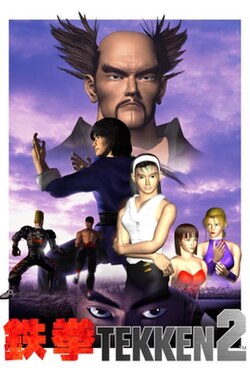
 Tekken 2 on PlayStation
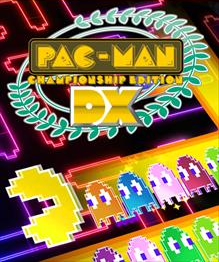
 Pac-Man Championship Edition DX+ on PS3
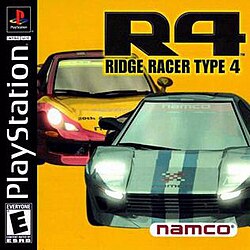
 R4: Ridge Racer Type 4 on PlayStation
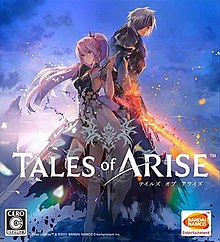
 Tales of Arise on Xbox Series X/S
 Tekken on PlayStation










 Another SquareThought Site