

 Jan 1979
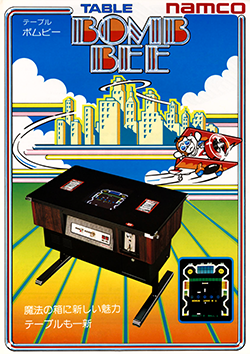

When you boot up Arcade Archives 2: Bomb Bee on the Nintendo Switch 2, you are not being handed a lost masterpiece from the golden age of arcades so much as a curio: an honest-to-goodness late seventies arcade experiment that wears its lineage on its sleeve. Designed by Toru Iwatani in 1979 as the sequel to Gee Bee, Bomb Bee is a hybrid of block-breaker and video pinball - a machine-era game translated into pixels and points. This reissue is less a modernization than a museum placard; it invites you to peer closely, to wonder how rudimentary mechanics once looked revolutionary, and to appreciate the historical scaffolding that would eventually support icons like Pac-Man and Galaxian.
Bomb Bee's rules are simple the way a shuttered coin-op cabinet is simple: you move paddles, ricochet a ball, clear bricks, and chase the high score. The physical arcade used a rotary analog stick as its control, and that idiosyncratic input shapes how the original plays. In practice the game reduces to managing two small paddles at the screen's bottom, timing ricochets and nudges so the ball arcs into colored brick clusters overhead. When you clear side bricks you alter the value of the adjacent pop-bumper - a tiny but meaningful twist that flips that bumper from 10 points to 100, a multiplier that rewards selective aggression. Multiplayer is present but strictly alternating: two players share the machine, trading turns like taking breaths between quarters. There's a modest suite of objectives beyond simple brick-clearing: light the letters that spell "NAMCO" for a bonus, exploit pop-bumpers when they yield bigger points, and coax the ball into high-value oscillations. The game leans on emergent challenge rather than complexity. There are no power-ups, no multi-ball wizardry and no elaborate enemy patterns; instead Bomb Bee bets on precise timing and the tiny satisfactions of a well-placed ricochet. That sparseness is both Bomb Bee's virtue and its vice. On the one hand the mechanics are pure: little to learn, long to master. On the other hand modern players will notice how quickly the novelty fades. After the initial thrill of the full-color display - impressive in 1979 - the gameplay loop can feel repetitive. Critics of the era (and some modern retrospectors) argued that Bomb Bee added too little to Gee Bee's formula. The historical footnote is interesting: Bomb Bee didn't sell well, and when Namco's next title, Galaxian, took off, unsold Bomb Bee machines were bundled with it to clear stock. That tells you everything about how the market judged this design at the time. Playing Bomb Bee on a Switch 2 has its own quirks. The tactile disconnect is inevitable: a modern thumbstick cannot fully replicate the subtle feel of an arcade rotary control. What the reissue gets right is fidelity to the original scoring and physics, so veterans of arcade rooms will recognize the rhythm. For newcomers, Bomb Bee is best approached as a study in restraint - a look at how early designers squeezed interesting decisions out of scant inputs and limited circuitry.
Bomb Bee's visuals are honest to a machine whose hardware budget would make contemporary indie developers weep with nostalgia. The original arcade boasted a full-color display that, in 1979, was noteworthy; in 2020s terms it is charmingly primitive. Bricks are simple colored blocks, the paddles are functional slivers, and the pop-bumpers are little beacons of score opportunity. The presentation is not trying to be artful so much as communicative: everything is designed to be read at a glance in a noisy arcade. Translated onto the Switch 2, these graphics benefit from clean emulation. Pixels are crisp, colors pop against the black background, and the small animations - the ball's bounce, the flashing "NAMCO" letters - retain their period charm. There are no modern visual embellishments here: no high-res filters, no rewritten sprite art. That restraint is a double-edged sword. If you come in expecting neon spectacle you'll be disappointed. If you come prepared to admire mechanical clarity - the way a single pixel of movement conveys momentum, the precise timing of collisions - then the display is wonderfully faithful. Sound is likewise utilitarian: simple beeps and clangs that do the job. They won't compete with your poster of the mid-90s fighting-game boom, but as historical artifacts they put you in the right room: a smoky arcade alcove where the soundtrack is a chorus of quarter-fed machines and shouted scores.
As a modern package on the Nintendo Switch 2, Arcade Archives 2: Bomb Bee is an act of conservation rather than reinvention. It preserves a small, stubbornly specific piece of video game history: an early Namco experiment by Toru Iwatani that sat on the cusp of bigger things. The game itself is concise and mechanically pure, but it never quite evolves beyond its simple loop. That economy is interesting, educational even, but it is not always entertaining for long stretches. If you are a collector, a student of game design, or someone who enjoys tracing the ancestry of arcade staples, Bomb Bee is worth an hour or a dozen. Its role as an early Namco-Nintendo collaboration and a stepping stone to later successes makes it historically significant. If you want a lasting, addictive play experience on your Switch 2, you will likely spend more time with Galaxian, Pac-Man, or any of the more fully realized titles that followed in Bomb Bee's wake. For what it is - a tidy, well-emulated relic - I award it a 6 out of 10. Respect where it's due; nostalgia where it's earned; and if you find yourself smiling at the sight of that tiny ball ricocheting between paddles, you are exactly the sort of person Namco had in mind back in 1979.
 Arcade Archives 2: Air Combat 22 on Xbox Series X/S
 Arcade Archives 2: Ridge Racer on PS5
 Street Fighter V: Arcade Edition on PS4
 Oretachi Game Center Zoku: Quarth on PS2
 Oretachi Game Center Zoku: Trio the Punch on PS2
 Oretachi Game Center Zoku: Nekketsu Koukou Dodge Ball Bu on PS2
 Tekken 2 on PlayStation
 Pac-Man Championship Edition DX+ on PS3
 R4: Ridge Racer Type 4 on PlayStation
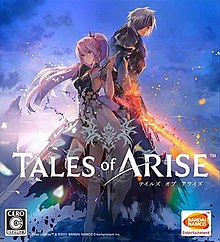
 Tales of Arise on Xbox Series X/S
 Tekken on PlayStation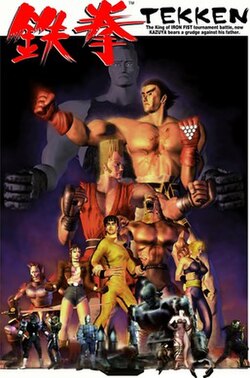










 Another SquareThought Site